
Helical secures $10 million in seed funding to develop bio foundation models into functional systems.
The startup founded in Luxembourg is already producing solutions for several top-20 global pharmaceutical companies, including a partnership with Pfizer that is publicly acknowledged. Its $10M seed funding round is spearheaded by redalpine, with angel investors that include the CEOs of Cohere and HuggingFace.
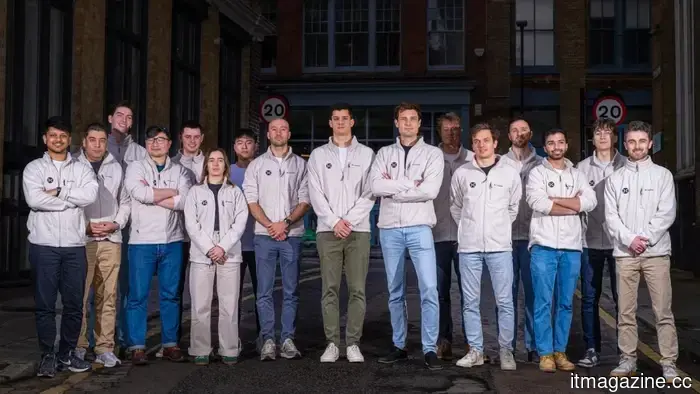
Helical, a pharmaceutical AI startup based in London and established by three childhood friends from Luxembourg, has secured $10 million in a seed round led by redalpine, with contributions from Gradient, BoxGroup, and Frst.
Prominent angel investors feature Aidan Gomez, the CEO of Cohere; Clément Delangue, the CEO of HuggingFace; and professional footballer Mario Goetze. The funding will facilitate the company’s expansion into additional top-20 pharmaceutical programs and the growth of Helical’s science and engineering workforce.
The founders of the company—Rick Schneider, Maxime Allard, and Mathieu Klop—are three friends from school who have taken different career paths to address the same challenge. Schneider developed technology at Amazon before assisting the German enterprise software company Celonis in scaling its operations in France and Japan.
Allard led data science teams at IBM prior to pursuing a PhD centered on reinforcement learning and robotics. Klop became a cardiologist and genomics researcher. When biological foundation models started to emerge, the trio recognized a common gap: the rapid arrival of models capable of revolutionizing drug discovery was outpacing the infrastructure needed to apply them at scale.
Helical's premise is that bio foundation models, AI systems trained on extensive genomic, transcriptomic, and proteomic data, have already reached a quality level that allows for meaningful computational hypothesis-testing in pharmaceutical research.
However, the intermediary layer between a model's output and a scientific decision has not evolved at the same pace. This results in bench scientists and machine learning engineers operating in isolated environments, teams duplicating one-off notebooks for each program, and analyses that are difficult to replicate or adapt across different disease areas.
Helical addresses this gap by developing the necessary infrastructure. Its platform features two main components: a Virtual Lab for biologists and translational scientists, and a Model Factory for machine learning engineers and data scientists, both utilizing shared data and models to deliver consistent, verifiable results.
The company is already in production with several leading global pharmaceutical firms. Its publicly announced collaborations involve projects with Pfizer focused on predictive blood-based safety biomarkers and with Tanabe Pharma America on AI-driven target discovery for neurodegenerative disorders, including ALS.
In these implementations, Helical claims to have shortened discovery timelines from years to weeks. The larger industry context lends credibility to its ambitions: global pharmaceutical R&D expenditures surpass $300 billion each year, with the average cost of bringing a drug to market exceeding $2 billion, development timelines extending over a decade, and over 90% of candidates entering clinical trials failing to gain approval.
Daniel Graf, General Partner at redalpine, characterized the investment as a commitment to transitioning “from siloed AI models to integrated virtual AI labs” as biological foundation models merge with general language reasoning. This funding round builds on an earlier €2.2 million raise in 2024 from Frst, BoxGroup, and returning angel investors such as Gomez and Delangue.
Other articles
 Stanford's yearly AI report reveals a divide between those immersed in AI and the general public.
The 2026 AI Index from Stanford reveals a significant disagreement between AI specialists and the general public regarding almost all aspects of AI's future. Just 10% of Americans feel more enthusiasm than apprehension about it.
Stanford's yearly AI report reveals a divide between those immersed in AI and the general public.
The 2026 AI Index from Stanford reveals a significant disagreement between AI specialists and the general public regarding almost all aspects of AI's future. Just 10% of Americans feel more enthusiasm than apprehension about it.
 The $852 billion valuation of OpenAI is being questioned by its own investors.
Certain investors in OpenAI are raising doubts about its $852 billion valuation as the company updates its roadmap. A leaked memo alleges that Anthropic has exaggerated its $30 billion run rate by $8 billion.
The $852 billion valuation of OpenAI is being questioned by its own investors.
Certain investors in OpenAI are raising doubts about its $852 billion valuation as the company updates its roadmap. A leaked memo alleges that Anthropic has exaggerated its $30 billion run rate by $8 billion.
 Why contemporary workplaces are reconsidering hydration and its impact on employee performance
Explore the reasons behind the increasing emphasis on hydration in contemporary work environments and how enhanced access to water can boost employee productivity, concentration, and overall performance.
Why contemporary workplaces are reconsidering hydration and its impact on employee performance
Explore the reasons behind the increasing emphasis on hydration in contemporary work environments and how enhanced access to water can boost employee productivity, concentration, and overall performance.
 Google Home is receiving numerous enhancements to improve your interactions with Gemini.
Google is tackling the annoyance of being interrupted mid-sentence with the newest set of Gemini for Home updates, along with several useful enhancements.
Google Home is receiving numerous enhancements to improve your interactions with Gemini.
Google is tackling the annoyance of being interrupted mid-sentence with the newest set of Gemini for Home updates, along with several useful enhancements.
 Google Home is receiving numerous enhancements to refine your interactions with Gemini.
Google is tackling the annoyance of being interrupted mid-sentence with the new updates for Gemini for Home, alongside a few useful enhancements.
Google Home is receiving numerous enhancements to refine your interactions with Gemini.
Google is tackling the annoyance of being interrupted mid-sentence with the new updates for Gemini for Home, alongside a few useful enhancements.
 OpenAI's valuation of $852 billion is facing criticism from its investors.
Several investors in OpenAI are raising doubts about its $852 billion valuation as the company updates its plans. A confidential memo suggests that Anthropic has exaggerated its $30 billion run rate by $8 billion.
OpenAI's valuation of $852 billion is facing criticism from its investors.
Several investors in OpenAI are raising doubts about its $852 billion valuation as the company updates its plans. A confidential memo suggests that Anthropic has exaggerated its $30 billion run rate by $8 billion.
Helical secures $10 million in seed funding to develop bio foundation models into functional systems.
Helical has secured $10 million to develop the application layer that ensures the reproducibility of bio foundation models in pharmaceutical research and development. The application is already in use with Pfizer.