
Why probability, rather than averages, is transforming AI decision-making.
What is the value of enhancing your chances of success? Or minimizing the risk of an expensive failure? Throughout much of modern history, we have struggled to provide clear answers to these questions, often relying on averages that are straightforward yet frequently misleading.
However, this is starting to change. A new set of tools, referred to as ChanceOmeters, is now capable of directly measuring uncertainty. Similar to how a speedometer indicates speed, these tools quantify the likelihood of various outcomes. Backed by AI and a novel type of data that retains uncertainty, they can perform thousands of calculations at once, offering something far more beneficial than a single figure: the odds.
This transformation alters how decisions are experienced. When you can observe the probabilities fluctuate in real time, it engages both intuition and analysis. We have long described this as linking the intellect with instinct, a concept we refer to as Limbic Analytics.
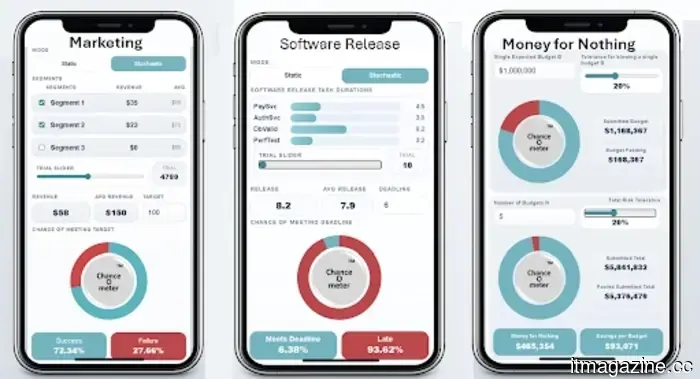
Take a straightforward marketing decision, for instance. You need to select two out of three customer segments to target. If you depend on averages, the choice is clear: select the two segments with the highest anticipated revenue. However, if your objective is to surpass $100,000 in sales, incorporating uncertainty changes the scenario. Two of the segments might rise and fall in tandem, while the third behaves separately. By diversifying to mitigate uncertainty rather than solely focusing on maximizing averages, you can boost your chances of achieving your goal. The optimal choice is determined by probabilities, not merely expectations.
The same concept is relevant in software development. Picture launching a product requiring four approval processes that can take place simultaneously, each estimated to last six weeks. The average indicates a six-week timeline, but in reality, delays tend to accumulate. Factoring in uncertainty, the likelihood of completing everything in six weeks drops to around 6%. A ChanceOmeter allows you to test various deadlines and assess the probability of success, shifting the discussion from optimism versus pessimism to selecting a risk level you are willing to accept.
Uncertainty is often viewed as something to avoid. Nonetheless, it can be leveraged to generate value from nothing. For example, consider the budgeting process undertaken by every company and government body. To prevent running short, each department includes a buffer, which is a reasonable strategy in isolation. However, across an entire organization, this leads to a significant buildup of unused contingency funds. Techniques that exploit uncertainty, such as pooling contingencies, can help reclaim this excess, essentially generating "money for nothing."
The persistent challenge has been practical. You cannot simply aggregate uncertainties like you would with dollars; a coherent way to represent and combine them is essential. This capability developed on Wall Street in the 1980s, when financial engineers created methods to simultaneously model thousands of potential futures.
In 2013, we co-founded a nonprofit organization with the late Nobel laureate Harry Markowitz to extend these capabilities beyond financial engineering. Our aim was to establish open data standards that would allow uncertainty to be stored, shared, and calculated as easily as numerical data in a spreadsheet. This initiative has enabled non-experts to engage with uncertainty directly using familiar tools.
The outcome is what we are currently witnessing with these interactive applications. These data systems carry uncertainty with them, permitting calculations to reflect how various risks interact. When combined with AI, which inherently understands probabilities, they create a robust new approach to reasoning about the future.
We are just beginning to uncover the implications of this advancement. From marketing strategies to software launches and budgets, the same trend emerges: averages obscure risk and opportunity, while probabilities bring them to light. Once you can measure your chances, you can also manage and enhance them.
Other articles
 Meta and YouTube held responsible in significant social media addiction lawsuit.
A jury in Los Angeles determined that Meta and YouTube were responsible for creating addictive platforms that caused harm to a young user, resulting in a $6 million award and establishing a precedent for over 10,000 ongoing cases.
Meta and YouTube held responsible in significant social media addiction lawsuit.
A jury in Los Angeles determined that Meta and YouTube were responsible for creating addictive platforms that caused harm to a young user, resulting in a $6 million award and establishing a precedent for over 10,000 ongoing cases.
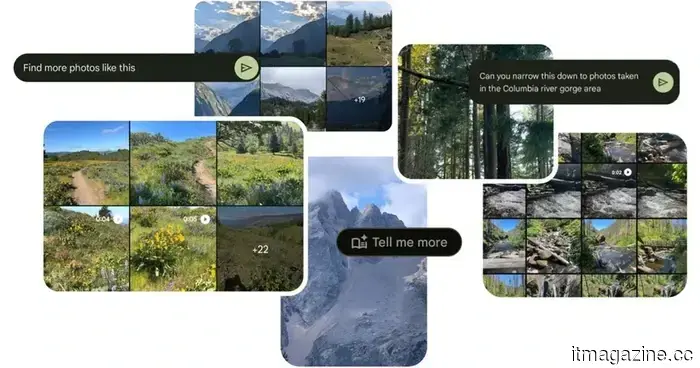 Google Photos aims to prevent you from unintentionally damaging your photos.
Google Photos is overhauling its editor to minimize unintentional alterations, substituting gesture shortcuts with a more intentional workflow that emphasizes accuracy, consistency, and a reduction in accidental edits on Android devices.
Google Photos aims to prevent you from unintentionally damaging your photos.
Google Photos is overhauling its editor to minimize unintentional alterations, substituting gesture shortcuts with a more intentional workflow that emphasizes accuracy, consistency, and a reduction in accidental edits on Android devices.
 Researchers developed a chip capable of functioning at temperatures exceeding those of lava.
Researchers have developed a chip that operates at 700°C. This advancement has the potential to transform AI, space exploration, and virtually every gadget you possess.
Researchers developed a chip capable of functioning at temperatures exceeding those of lava.
Researchers have developed a chip that operates at 700°C. This advancement has the potential to transform AI, space exploration, and virtually every gadget you possess.
 Why probability, rather than averages, is transforming decision-making in AI.
AI-driven tools such as ChanceOmeters assist organizations in assessing uncertainty, modeling results, and enhancing decision-making beyond simple averages.
Why probability, rather than averages, is transforming decision-making in AI.
AI-driven tools such as ChanceOmeters assist organizations in assessing uncertainty, modeling results, and enhancing decision-making beyond simple averages.
 Meta and YouTube were found responsible in a groundbreaking trial related to social media addiction.
A jury in Los Angeles determined that Meta and YouTube were responsible for creating addictive platforms that caused harm to a young user, resulting in a $6 million award and establishing a precedent for over 10,000 ongoing cases.
Meta and YouTube were found responsible in a groundbreaking trial related to social media addiction.
A jury in Los Angeles determined that Meta and YouTube were responsible for creating addictive platforms that caused harm to a young user, resulting in a $6 million award and establishing a precedent for over 10,000 ongoing cases.
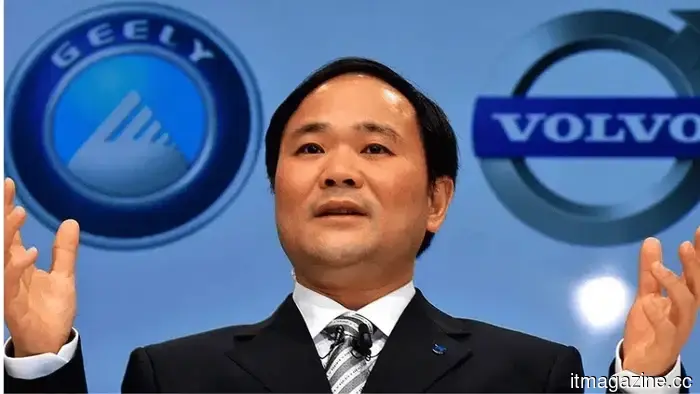 Geely will cease the construction of new factories and will utilize Volvo's manufacturing facilities instead.
Geely's chairman, Li Shufu, has announced that the company will cease the construction of new factories, opting instead to utilize Volvo's existing facilities and collaborate with Ford and Renault for overseas production.
Geely will cease the construction of new factories and will utilize Volvo's manufacturing facilities instead.
Geely's chairman, Li Shufu, has announced that the company will cease the construction of new factories, opting instead to utilize Volvo's existing facilities and collaborate with Ford and Renault for overseas production.
Why probability, rather than averages, is transforming AI decision-making.
AI-driven tools such as ChanceOmeters assist organizations in assessing uncertainty, simulating outcomes, and enhancing decision-making beyond mere averages.