
Why probability, rather than averages, is transforming decision-making in AI.
What is the value of enhancing your success rate or mitigating the risk of a significant failure? Historically, we have struggled to provide clear answers to these questions. We have often depended on averages, which are straightforward but can also be misleading.
However, this is changing. A new set of tools, referred to as ChanceOmeters, can now directly measure uncertainty. Just as a speedometer gauges speed, these tools assess the probability of various outcomes. Fueled by AI and a novel form of data that maintains uncertainty, they perform thousands of calculations in an instant and offer something far more valuable than a single figure: the odds.
This transformation alters the way decisions are perceived. When probabilities can be observed in real time, both intuition and analysis become engaged. We have long described this as linking rational thought with gut feelings, a concept we term Limbic Analytics.
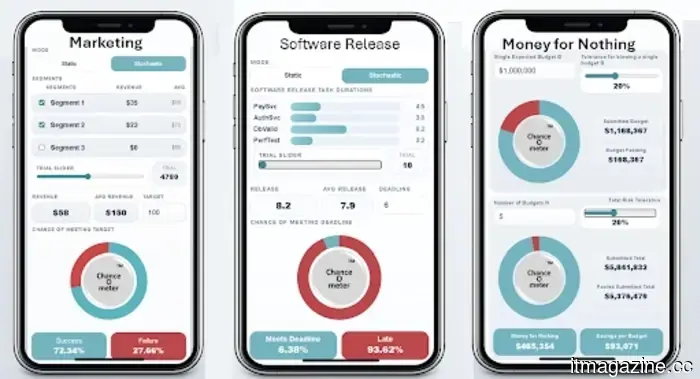
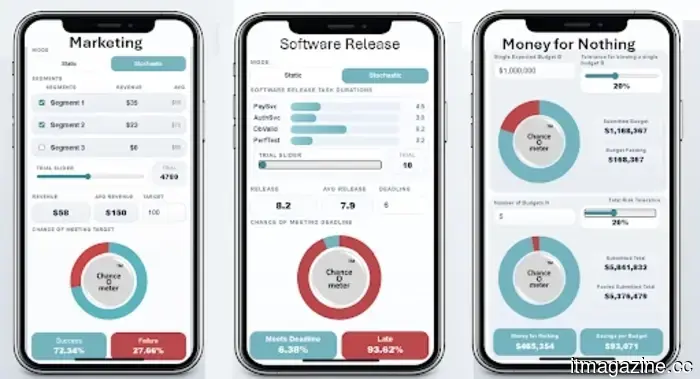
Take a straightforward marketing decision as an example. You need to select two of three customer segments to focus on. If you rely on averages, the choice is clear: select the two segments with the highest expected revenue. However, if your objective is to surpass $100,000 in sales, considering uncertainty changes everything. Two segments might rise and fall in tandem, while a third operates independently. By diversifying across different uncertainties rather than merely maximizing averages, you can enhance your chances of reaching your target. The "optimal" choice is influenced by probabilities, not solely by expectations.
In software development, a similar principle applies. Imagine launching a product that depends on four parallel approval processes, each expected to take six weeks. The average suggests a timeline of six weeks. In reality, delays accumulate. When uncertainty is taken into account, the odds of completing everything in six weeks drop to about 6%. A ChanceOmeter allows you to experiment with various deadlines and view the success probabilities. Suddenly, the decision shifts away from optimism or pessimism to selecting a level of risk you are willing to embrace.
Uncertainty is often regarded as something to be avoided. Nonetheless, it can be harnessed to generate value. Consider the budgeting process that every organization and governmental body undertakes. To prevent budget shortfalls, each department includes a buffer. While this is reasonable behavior in isolation, across an entire organization, it leads to a substantial excess of unused contingency funds. Techniques that leverage uncertainty, like pooling contingencies, enable us to reclaim this surplus, effectively creating “money for nothing.”
The challenge has always been practical. Uncertainties cannot simply be combined like monetary amounts. A coherent method for representing and integrating them is essential. This capability emerged on Wall Street in the 1980s, where financial engineers devised ways to model thousands of potential futures simultaneously.
In 2013, we established a nonprofit alongside the late Nobel laureate Harry Markowitz to extend these capabilities beyond financial engineering. The aim was to develop open data standards so that uncertainty could be stored, shared, and calculated with the same ease as numbers in spreadsheets. This effort has enabled non-experts to directly engage with uncertainty using familiar tools.
The outcome is evident in the interactive applications we now see. These are data systems that incorporate uncertainty, allowing calculations to reflect how risks interact. When paired with AI, which adeptly navigates probabilities, they offer a robust new approach to contemplating the future.
We are just starting to understand the implications. From marketing efforts to software releases to budgeting, the same pattern emerges. Averages obscure risk and opportunity, while probabilities illuminate them. Once you can assess your chances, you can not only manage but also enhance them.
Other articles
 Geely will cease the construction of new factories and will utilize Volvo's manufacturing facilities instead.
Geely's chairman, Li Shufu, has announced that the company will cease the construction of new factories, opting instead to utilize Volvo's existing facilities and collaborate with Ford and Renault for overseas production.
Geely will cease the construction of new factories and will utilize Volvo's manufacturing facilities instead.
Geely's chairman, Li Shufu, has announced that the company will cease the construction of new factories, opting instead to utilize Volvo's existing facilities and collaborate with Ford and Renault for overseas production.
 Stay informed quicker with Google Home's latest feature, Gemini Live.
The Gemini Live upgrade for Google Home introduces interactive news that can be explored through voice commands, transforming brief updates into more extensive discussions that adjust to your inquiries in real-time.
Stay informed quicker with Google Home's latest feature, Gemini Live.
The Gemini Live upgrade for Google Home introduces interactive news that can be explored through voice commands, transforming brief updates into more extensive discussions that adjust to your inquiries in real-time.
 Apple made an unexpected move by reducing the price of the Studio Display XDR.
A sense of pricing rationality has joined the conversation.
Apple made an unexpected move by reducing the price of the Studio Display XDR.
A sense of pricing rationality has joined the conversation.
 OpenAI collaborates with Smartly to introduce conversational advertisements within ChatGPT.
OpenAI is collaborating with Smartly to develop interactive advertisement formats within ChatGPT, just six weeks after its advertising pilot surpassed $100 million in annualized revenue with under 600 advertisers.
OpenAI collaborates with Smartly to introduce conversational advertisements within ChatGPT.
OpenAI is collaborating with Smartly to develop interactive advertisement formats within ChatGPT, just six weeks after its advertising pilot surpassed $100 million in annualized revenue with under 600 advertisers.
 Meta and YouTube were found responsible in a groundbreaking trial related to social media addiction.
A jury in Los Angeles determined that Meta and YouTube were responsible for creating addictive platforms that caused harm to a young user, resulting in a $6 million award and establishing a precedent for over 10,000 ongoing cases.
Meta and YouTube were found responsible in a groundbreaking trial related to social media addiction.
A jury in Los Angeles determined that Meta and YouTube were responsible for creating addictive platforms that caused harm to a young user, resulting in a $6 million award and establishing a precedent for over 10,000 ongoing cases.
 Gmail has finally enabled the option to change your outdated usernames.
Google is finally implementing a feature that Gmail users have requested for years: the ability to change the actual username in their Gmail address. This is no longer just a preliminary rollout, as Google has announced that the feature is now accessible to all Google Account users in the US. However, it remains a limited release, […]
Gmail has finally enabled the option to change your outdated usernames.
Google is finally implementing a feature that Gmail users have requested for years: the ability to change the actual username in their Gmail address. This is no longer just a preliminary rollout, as Google has announced that the feature is now accessible to all Google Account users in the US. However, it remains a limited release, […]
Why probability, rather than averages, is transforming decision-making in AI.
AI-driven tools such as ChanceOmeters assist organizations in assessing uncertainty, modeling results, and enhancing decision-making beyond simple averages.