
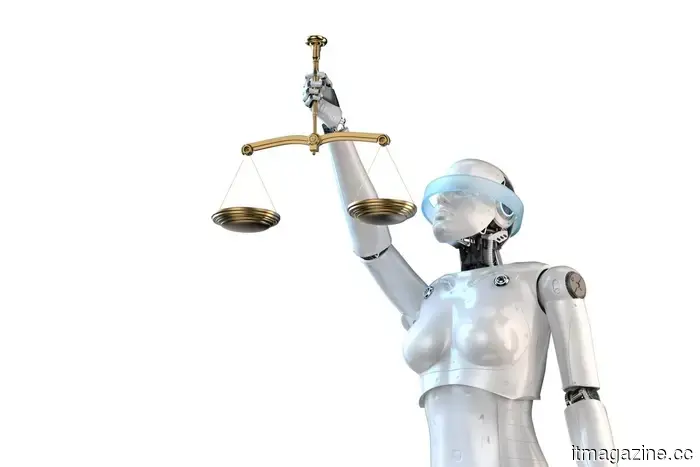
AI has mastered procedural law.
For a long time, it was believed that legal disputes were the domain of people with stone faces and piles of papers. But technology does not stand still. Our old acquaintance, the Neuro-Lawyer, has undergone another upgrade and has finally reached the understanding that it is not enough to simply know who is right; one must also know how to properly torment the opponent in court.
If previously the neural network could only philosophize on the topic of "Who should, and who should not" (this is called substantive law), now it has uncovered the great secret of the bureaucratic dance. Artificial intelligence has mastered civil and arbitration processes. In simple terms, it now understands the difference between "filing a lawsuit" and "filing a lawsuit on time and paying the fee promptly."
Now AI will suggest what to write in the lawsuit so that the judge does not throw it out the window on the 15th page, and will ponder whether it is worth initiating a review of the case at all. In general, now any practicing lawyer, tormented by doubts about pre-trial procedures or the amount of state duty, can skip flipping through thick codes and simply ask the soulless machine.
Let us remind those who are not legal specialists: there is law that says "do not kill" and "pay taxes," and there is law that explains how exactly you will be judged if you did kill or did not pay. The latter is precisely the process. And it is vitally necessary to understand, for example, until what point you have a chance to introduce important evidence into the case or how to properly state that "everything is annoying, let's take a break."
But the most interesting thing is that procedural innovations have overlapped with seven areas of law that AI already knows by heart. Labor, corporate, advertising law, and consumer protection have now been enriched with procedural nuances. If a lawyer asks about how to take a brand from a competitor, the neural network will not only provide a link to the law but will also slyly inquire: "And how do you plan to prove the degree of confusion in court? Did you bring the methodology?"
Yegor Staroverov, the head of Neuro-Lawyer, expressed the general thought this way: procedural legislation is simply an instruction for applying the law. By teaching the machine to read instructions, we not only free lawyers from boredom but also make the answers more complete and, to be frank, usable in real battles.
Let us remind you that this miracle assistant operates on the basis of the "Garant" system, meaning it advises strictly with references to authoritative sources. It can also read files, create knowledge bases, and solve routine tasks with one click.
Forecast of consequences for the Russian justice system
First, a sharp increase in the quality of claims can be expected. If previously texts like "give it back because I want it" were submitted to the courts, now AI will suggest that the claim procedure must first be followed before one can "want." Some judges, accustomed to dismissing half of the cases due to formal errors, will suddenly have to genuinely delve into the essence of disputes rather than just write off a decision. On one hand, this is stressful for judges; on the other hand, it is a benefit for society.
Second, an "arms race" will inevitably arise. The plaintiff's side will come with a perfectly crafted claim, while the defendant's side will come with a rebuttal that the same AI, but with a different account, has composed even better. The court will only have to observe this duel of artificial intelligences and issue a verdict signed by a living person. This will elevate the role of the judge to that of an arbiter in a cyber-sport discipline.
Third, template legal consultations will become obsolete. Those lawyers whose job was to tell clients "this is under the jurisdiction of such-and-such court" and charge for it will have to either upgrade their qualifications or go sell hot pies. Artificial intelligence will do this faster, cheaper, and without tea breaks.
And finally, the most unexpected consequence. When every practicing lawyer gets their hands on such a procedural assistant, courts will not drown in the number of errors but rather in perfect correctness.
Imagine that all parties in the process stop making mistakes. All motions are filed on time, all deadlines are met, all documents are attached. This is an ideal world! But it will immediately become clear that the laws themselves are imperfect. If previously the imperfection of the law was overlooked due to errors in its application, now, when the application becomes perfect, the absurdity of some norms will surface. And then it will be necessary to fix not AI, but legislation. However, we are still far from that, but it is quite pleasant to dream of a bright future where courts do not drown in paperwork but seek justice.
Other articles
-and-headphones-Headphone-(a)-from-Nothing.jpg) Smartphone Phone (4a) and headphones Headphone (a) from Nothing
The brand Nothing, which loves to create transparent devices, has brought two new products to Russia. The smartphone Phone (4a) and the large headphones Headphone (a) are now on sale. As usual, the main features here are the design that allows you to observe the rich inner world of the devices, and the attempt to harmonize hardware with artificial intelligence.
Smartphone Phone (4a) and headphones Headphone (a) from Nothing
The brand Nothing, which loves to create transparent devices, has brought two new products to Russia. The smartphone Phone (4a) and the large headphones Headphone (a) are now on sale. As usual, the main features here are the design that allows you to observe the rich inner world of the devices, and the attempt to harmonize hardware with artificial intelligence.
 T-Mobile 5G Home Internet's newest offer provides up to $300 in cashback.
If you have been thinking about transitioning from traditional cable, T-Mobile 5G Home Internet’s latest promotion could be the most persuasive reason to do so. The provider is giving new customers up to $300 back, depending on the selected plan. Along with an easy setup, unlimited data, and no-contract policy, this time-limited offer shines as one of the most straightforward and […]
iPhone Fold. What is known about the specifications, release dates, and price
Apple still does not publicly confirm work on a foldable iPhone. However, discussions about the device have noticeably intensified in specialized media.
T-Mobile 5G Home Internet's newest offer provides up to $300 in cashback.
If you have been thinking about transitioning from traditional cable, T-Mobile 5G Home Internet’s latest promotion could be the most persuasive reason to do so. The provider is giving new customers up to $300 back, depending on the selected plan. Along with an easy setup, unlimited data, and no-contract policy, this time-limited offer shines as one of the most straightforward and […]
iPhone Fold. What is known about the specifications, release dates, and price
Apple still does not publicly confirm work on a foldable iPhone. However, discussions about the device have noticeably intensified in specialized media.
 MAIBENBEN has gathered a "cube" for non-trivial tasks.
The company decided that creative people and those who work with big data need a special gift and introduced the MAIBENBEN PC95A workstation. Inside this monolithic cube resides a powerful AMD Ryzen AI MAX+ 395 processor with AMD Radeon 8060S graphics. Judging by the specifications, the device is designed for those who locally "communicate" with large language models, process terabytes of data, or engage in complex 3D rendering. The new product comes with a two-year warranty - apparently, there is confidence in the product.
MAIBENBEN has gathered a "cube" for non-trivial tasks.
The company decided that creative people and those who work with big data need a special gift and introduced the MAIBENBEN PC95A workstation. Inside this monolithic cube resides a powerful AMD Ryzen AI MAX+ 395 processor with AMD Radeon 8060S graphics. Judging by the specifications, the device is designed for those who locally "communicate" with large language models, process terabytes of data, or engage in complex 3D rendering. The new product comes with a two-year warranty - apparently, there is confidence in the product.
 "Rikor" has started producing smartphones.
Not long ago, the Nizhny Novgorod company "Rikor," known for its servers and computer equipment for corporate giants, was producing "hardware" for government institutions. And suddenly, quite unexpectedly, it announced its entry into the consumer smartphone market, presenting two models - RIKOR NEURO S3 and RIKOR NEURO S5.
"Rikor" has started producing smartphones.
Not long ago, the Nizhny Novgorod company "Rikor," known for its servers and computer equipment for corporate giants, was producing "hardware" for government institutions. And suddenly, quite unexpectedly, it announced its entry into the consumer smartphone market, presenting two models - RIKOR NEURO S3 and RIKOR NEURO S5.
 If you develop Android applications using AI, Google's new standard simplifies the process of selecting the appropriate model.
For Android app developers depending on AI for coding, selecting the appropriate model can be challenging. Not all models are created equal, and many are not explicitly designed for Android development processes. To tackle this issue, Google has launched a new benchmark aimed at assisting developers in evaluating the performance of various AI models in real-world Android scenarios.
If you develop Android applications using AI, Google's new standard simplifies the process of selecting the appropriate model.
For Android app developers depending on AI for coding, selecting the appropriate model can be challenging. Not all models are created equal, and many are not explicitly designed for Android development processes. To tackle this issue, Google has launched a new benchmark aimed at assisting developers in evaluating the performance of various AI models in real-world Android scenarios.
AI has mastered procedural law.
For a long time, it was believed that legal battles were the domain of stone-faced people and piles of paperwork. But technology does not stand still. Our old acquaintance, the Neuro-Lawyer, has undergone another upgrade and has finally reached the understanding that it is not enough to simply know who is right; one must also know how to properly torment the opponent in court.