

If you develop Android applications using AI, Google's new standard simplifies the process of selecting the appropriate model.
Android Bench assesses how effectively various AI models perform real-world Android coding tasks.
For developers creating Android applications and utilizing AI for coding, selecting the right model can be challenging. Not all models are the same, and many do not cater specifically to Android development workflows. To tackle this issue, Google has launched a new benchmark designed to help developers gauge the performance of different AI models on practical Android coding tasks.
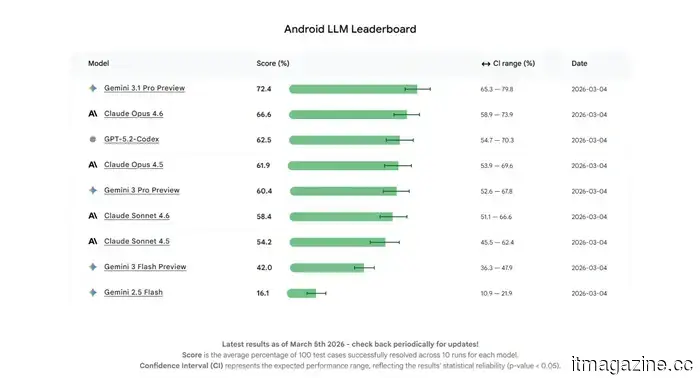
Named Android Bench, this benchmark aims to evaluate how effectively large language models (LLMs) manage common Android development activities. Google states that it assesses models based on actual tasks from public GitHub projects, where models are required to replicate genuine pull requests and address issues akin to what developers face when developing Android applications. The outcomes are then verified to determine if they genuinely solve the stated problems.
Choosing the optimal ✨ AI model for a specific task can be daunting due to the numerous available choices, which is why the industry turns to LLM benchmarks for direction. However, the challenge for Android developers lies in these benchmarks not being calibrated to accurately assess the types of tasks they encounter.
In essence, the benchmark evaluates whether the code produced by AI models effectively resolves the issue rather than merely appearing correct at first glance. This allows Google to determine the actual usefulness of various models in tackling real Android development challenges.
With the inaugural version of Android Bench, Google aimed “to focus solely on measuring model performance and not on agentic or tool usage.” The findings reveal a significant disparity, with models managing to complete between 16% and 72% of the benchmark tasks. The company intends for the release of these results to facilitate easier model comparisons for developers, enabling them to select those truly capable of addressing authentic Android coding issues.
Beyond guiding developers, the benchmark may incentivize AI companies to enhance their models' comprehension of Android development. To further this endeavor, Google has made Android Bench’s methodology, dataset, and testing framework available on GitHub. Over time, this could result in AI tools that are more adept at navigating intricate Android codebases, assisting developers in building and repairing applications more efficiently.
Pranob is an experienced technology journalist with over eight years of expertise in covering consumer technology. His work has been...
Samsung's Galaxy S26 Ultra introduces 25W wireless charging but may not perform as promised.
In the Galaxy S26 Ultra, Samsung has rolled out several updates related to battery and charging, including a minor increase in battery capacity as well as enhancements in wired and wireless charging speeds. After receiving numerous complaints from fans, Samsung has finally raised wireless charging to a rate of 25W, a significant upgrade from the previous 15W standard seen across its premium models. However, achieving those speeds could prove to be more challenging than anticipated.
A new bug in Android 16 reportedly undermines VPN functionality.
A recently identified issue in Android 16 has raised alarms among security specialists and VPN providers, as evidence suggests a system-level bug could quietly impair VPN connections on affected devices. This problem, which has been reported for several months, may leave users unknowingly vulnerable while they assume their internet traffic remains protected.
Samsung offers a Galaxy S26 Ultra rental at half the retail price for a year.
Samsung has devised a novel approach to attract more customers to the Galaxy S26 series in one of its major markets, announcing a new “Galaxy Forever” program in India via a press release. Although the name might sound somewhat unclear, it operates as an ownership or upgrade program where customers can acquire the Galaxy S26 Ultra (starting at $1502) or Galaxy S26 Plus (starting at $1,288) by paying half of the device’s price upfront, divided into 12 interest-free monthly payments. The standard Galaxy S26 is not included in this offer.





Other articles
 Tests indicate that the Apple M5 Max is outpacing AMD and establishing a new performance benchmark.
Apple's M5 Max has established a new benchmark for performance, surpassing AMD's top offerings in single-core assessments and even exceeding the multi-core performance of Apple's M3 Ultra chip.
Tests indicate that the Apple M5 Max is outpacing AMD and establishing a new performance benchmark.
Apple's M5 Max has established a new benchmark for performance, surpassing AMD's top offerings in single-core assessments and even exceeding the multi-core performance of Apple's M3 Ultra chip.
 Samsung, it seems you have problems!
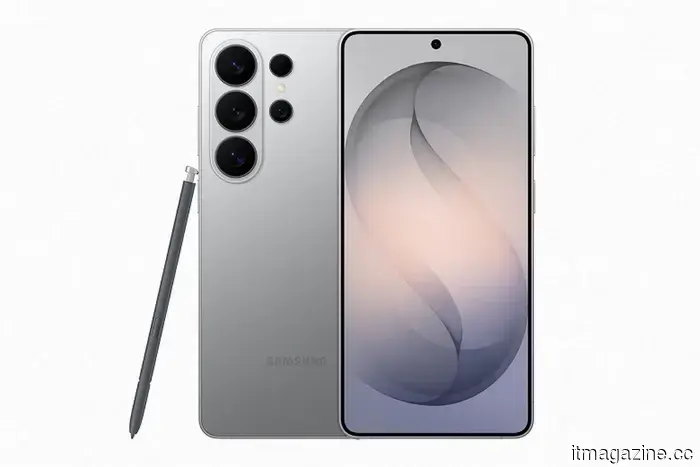
The official presentation of the Galaxy S26 took place on February 25. Beautiful, "polished," showcasing smart features and promises of a bright future. However, the future for Samsung arrived a bit earlier, and it turned out to be far from bright and rosy.
Samsung, it seems you have problems!
The official presentation of the Galaxy S26 took place on February 25. Beautiful, "polished," showcasing smart features and promises of a bright future. However, the future for Samsung arrived a bit earlier, and it turned out to be far from bright and rosy.
 iRU hides Tactio 515 behind the screen
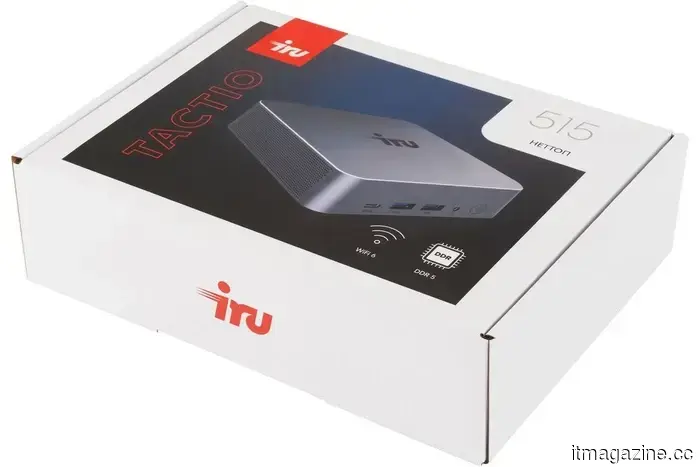
The Russian company iRU has solved the problem of a constantly cluttered desk by releasing a device that is practically invisible on the office table. More precisely, it attaches to the back of the monitor. The Tactio 515 is a nettop for those who value every centimeter of their workspace.
iRU hides Tactio 515 behind the screen
The Russian company iRU has solved the problem of a constantly cluttered desk by releasing a device that is practically invisible on the office table. More precisely, it attaches to the back of the monitor. The Tactio 515 is a nettop for those who value every centimeter of their workspace.
 T-Mobile's latest promotion for 5G Home Internet offers up to $300 in rebates.
If you've been thinking about changing from conventional cable, T-Mobile 5G Home Internet's latest promotion could be the strongest incentive to do so. The provider is giving new customers up to $300 back, based on the plan selected. With an easy setup, unlimited data, and no contracts, this limited-time deal is among the most straightforward and [...]
T-Mobile's latest promotion for 5G Home Internet offers up to $300 in rebates.
If you've been thinking about changing from conventional cable, T-Mobile 5G Home Internet's latest promotion could be the strongest incentive to do so. The provider is giving new customers up to $300 back, based on the plan selected. With an easy setup, unlimited data, and no contracts, this limited-time deal is among the most straightforward and [...]
 If you develop Android apps using AI, Google's new benchmark simplifies the process of selecting the appropriate model.
For Android app developers who depend on AI for coding, selecting the appropriate model can be challenging. Not every model is created equal, and many lack specific training for Android development processes. To help with this issue, Google has launched a new benchmark aimed at assisting developers in assessing the performance of various AI models in real-world Android scenarios.
If you develop Android apps using AI, Google's new benchmark simplifies the process of selecting the appropriate model.
For Android app developers who depend on AI for coding, selecting the appropriate model can be challenging. Not every model is created equal, and many lack specific training for Android development processes. To help with this issue, Google has launched a new benchmark aimed at assisting developers in assessing the performance of various AI models in real-world Android scenarios.
 AI has mastered procedural law.
For a long time, it was believed that legal battles were the domain of stone-faced people and piles of paperwork. But technology does not stand still. Our old acquaintance, the Neuro-Lawyer, has undergone another upgrade and has finally reached the understanding that it is not enough to simply know who is right; one must also know how to properly torment the opponent in court.
AI has mastered procedural law.
For a long time, it was believed that legal battles were the domain of stone-faced people and piles of paperwork. But technology does not stand still. Our old acquaintance, the Neuro-Lawyer, has undergone another upgrade and has finally reached the understanding that it is not enough to simply know who is right; one must also know how to properly torment the opponent in court.
If you develop Android applications using AI, Google's new standard simplifies the process of selecting the appropriate model.
For Android app developers depending on AI for coding, selecting the appropriate model can be challenging. Not all models are created equal, and many are not explicitly designed for Android development processes. To tackle this issue, Google has launched a new benchmark aimed at assisting developers in evaluating the performance of various AI models in real-world Android scenarios.