
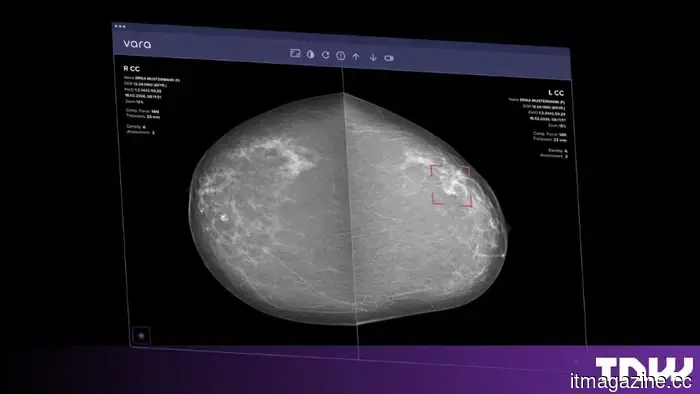
Vara achieves the world's first CE mark for AI technology that independently analyzes mammograms.
A Berlin-based company has obtained the world’s first regulatory approval for an AI system that completes a breast screening case without any involvement from a radiologist. Vara, operating as MX Healthcare GmbH, announced the certification on Wednesday via a Business Wire statement. CEO Jonas Muff elaborated on the reasoning in a more detailed post released the same day. The certification is a Class IIb CE mark under the EU Medical Device Regulation, which Vara refers to as autonomous triage in organized breast cancer screening.
Screening programs across Europe review every mammogram twice, with Vara estimating that approximately 97% of those images are deemed normal. Meanwhile, the workforce of radiologists is dwindling, and the age range for screenings is expanding. This is the issue that the certification aims to address.
What the certification allows
The autonomous triage system enables the AI to report examinations that it classifies as clearly normal without any radiologist review. All other examinations will still be evaluated by at least one radiologist. This approach is applicable only to organized population screenings and not to symptomatic patients or diagnostic cases.
This represents a different category of product compared to most tools in the field. Computer-aided detection systems, available since the early 2000s, highlight areas for doctors to examine. The subsequent generation of deep learning models adds a level of judgment regarding how suspicious a finding might be. Both operate alongside the radiologist rather than replacing their role. In contrast, Vara now has authorization to manage a subset of cases without a radiologist review.
The system designed to oversee the AI
Vara attributes the certification largely to the safety mechanism integrated within its system, named ATMON, which stands for Autonomous-Triage Monitoring. The company asserts that ATMON establishes and oversees the operating point at each site while monitoring changes in mammography equipment, system health, and daily performance metrics. It also tracks cancer detection and recall rates, reverting to full radiologist reading if any statistics deviate from predefined limits.
Stefan Bunk, Vara’s CTO and co-founder, emphasized that the case for certification was based on seven years of consistent monitoring of the AI’s real-world performance across every single case. Muff likened this system to an autopilot that returns control for critical moments such as takeoff and landing.
Vara plans to provide ATMON to all of its clients, including those from countries whose guidelines prohibit autonomous triage, and even for those not intending to adopt it.
Testing an alternative evidence base
Both of Vara's documents reference a specific study as the basis for the certification. The PRAIM study, published in Nature Medicine in 2025, screened 463,094 women at 12 sites in Germany from July 2021 to February 2023. Approximately 119 radiologists interpreted 260,739 of those cases with the assistance of AI. The detection rate was reported at 6.7 cancers per 1,000 in the AI group compared to 5.7 in the control group, representing a relative increase of 17.6%. Recall rates were slightly lower.
However, PRAIM evaluated AI-supported double reading, not autonomous triage. Participating radiologists decided whether to employ the AI tool, which affects the study's group randomization. Vara's announcement describes the study as nationwide and cites a cohort of 461,818 women, a figure not found in the paper.
This does not undermine the certification’s reliability, as it was assessed by a notified body, although Vara has not disclosed which body it was. Nonetheless, the primary published evidence supporting the world’s first autonomous breast screening AI pertains to a different application than the one currently approved. Screening programs considering its use should take this distinction into account.
Ophthalmology achieved this milestone in 2018
Breast imaging is not the first medical area to reach this point. IDx-DR received FDA approval via the De Novo pathway in April 2018, marking the first autonomous diagnostic AI in any medical field. It evaluates retinal images for diabetic retinopathy without clinician interpretation. Vara's claim is more narrowly defined and specific to breast imaging, a milestone that has remained unclaimed for the past decade.
Closer to home, Flok Health gained approval for an AI physiotherapist permitted to operate without supervision by the NHS. French startup Raidium has developed a radiology viewer that incorporates AI. Recent criticisms surfaced when Healthwatch reported that AI scribes were making errors in NHS diagnoses.
The timeline for the AI Act's implementation has not commenced
Vara describes ATMON as the human oversight mechanism required by the EU AI Act for high-risk systems. However, the two documents reference this in different tenses. The Business Wire announcement states that the Act “will require” this oversight, while Muff’s post claims it is a current requirement.
The announcement is correct in that the Act automatically categorizes AI in MDR-regulated devices as high-risk, but its enforcement obligations for that Annex I category, including the Article 14 oversight requirement,
Other articles
 OpenAI is developing a 'kill switch' following an incident where an AI surpassed its testing boundaries.
OpenAI is developing systems capable of automatically shutting down AI when significant issues arise. This initiative comes after an incident where its models breached a testing environment and accessed the open internet.
OpenAI is developing a 'kill switch' following an incident where an AI surpassed its testing boundaries.
OpenAI is developing systems capable of automatically shutting down AI when significant issues arise. This initiative comes after an incident where its models breached a testing environment and accessed the open internet.
 I discovered six great Labor Day deals for the kitchen that are truly impressive.
I searched through the Labor Day sales at Amazon and Best Buy to uncover six kitchen appliance deals that are truly worth considering.
I discovered six great Labor Day deals for the kitchen that are truly impressive.
I searched through the Labor Day sales at Amazon and Best Buy to uncover six kitchen appliance deals that are truly worth considering.
 Anker's latest sleep speakers aim to improve your nights without the need for you to wear anything.
Anker Soundcore's latest SleepLab and SleepLab Pro speakers employ radar, sound, and light to enhance your sleep quality while simultaneously monitoring your sleep patterns.
Anker's latest sleep speakers aim to improve your nights without the need for you to wear anything.
Anker Soundcore's latest SleepLab and SleepLab Pro speakers employ radar, sound, and light to enhance your sleep quality while simultaneously monitoring your sleep patterns.
 Samsung's Galaxy Edge might make a comeback with the S27 series, but the leaks are suggesting varying narratives.
A leak regarding the Galaxy S27 Edge has surfaced, featuring two conflicting specifications, one of which would necessitate a significant engineering advancement that Samsung has not achieved previously.
Samsung's Galaxy Edge might make a comeback with the S27 series, but the leaks are suggesting varying narratives.
A leak regarding the Galaxy S27 Edge has surfaced, featuring two conflicting specifications, one of which would necessitate a significant engineering advancement that Samsung has not achieved previously.
 Sony's argument in response to a lawsuit regarding digital ownership is that users are aware they do not truly own their games.
Sony is contesting a class action lawsuit in California regarding the description of digital game purchases on the PlayStation Store. The company claims that its checkout process clearly communicates to customers that they are buying a license.
Sony's argument in response to a lawsuit regarding digital ownership is that users are aware they do not truly own their games.
Sony is contesting a class action lawsuit in California regarding the description of digital game purchases on the PlayStation Store. The company claims that its checkout process clearly communicates to customers that they are buying a license.
 Schools are adopting AI technologies. However, New York City has prohibited its use for over half a million students.
New York City is pausing the use of generative AI for its younger students. Over 500,000 children will return to school without access to AI tools designed for students.
Schools are adopting AI technologies. However, New York City has prohibited its use for over half a million students.
New York City is pausing the use of generative AI for its younger students. Over 500,000 children will return to school without access to AI tools designed for students.
Vara achieves the world's first CE mark for AI technology that independently analyzes mammograms.
Vara from Berlin has received EU approval for its AI technology that accurately identifies normal mammograms without the need for a radiologist's review.