
Sony's argument in response to a lawsuit regarding digital ownership is that users are aware they do not truly own their games.
Sony contends that its disclosures on the PlayStation Store make it clear that digital games are licensed rather than owned.
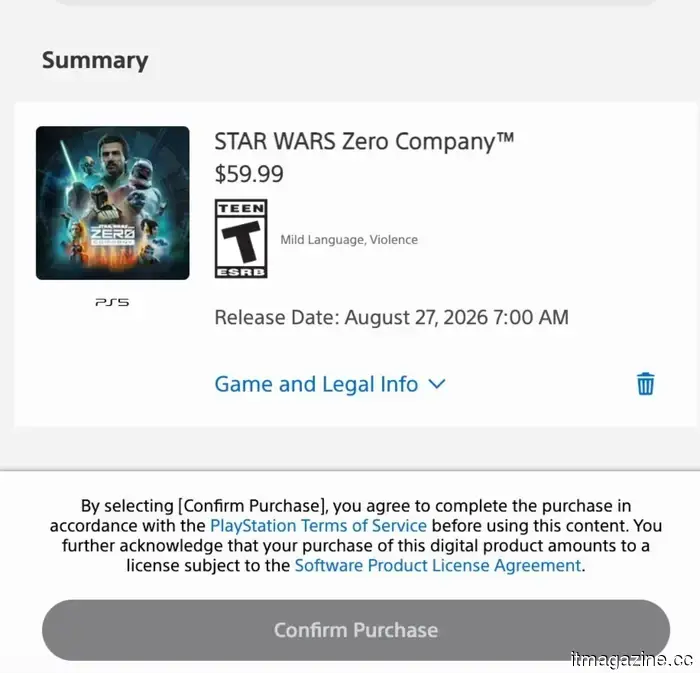
Sony has submitted a response to a class action lawsuit in California concerning how it labels digital game purchases on the PlayStation Store. As reported by GameFile, the company claims that its checkout process complies with state disclosure regulations and that a reasonable consumer does not expect to attain true ownership when buying digital games.
What the lawsuit alleges
The lawsuit charges Sony with breaching a California statute concerning the description of digital products. The plaintiffs assert that using terms like buy and purchase on the PlayStation Store misleads customers into thinking they possess the software indefinitely. The law prohibits vendors from using such terms unless they clearly inform buyers during the checkout process that they are securing a license that can be revoked.
GameFile/PlayStation Store
In its filing, Sony countered this assertion. The company stated that its checkout procedure already fulfills the state's requirements. Sony asserts that the PlayStation Store explicitly indicates to buyers that a purchase constitutes a software license and provides links to the complete terms of service before any transaction is completed.
How Sony interprets ownership
Along with its procedural defense, Sony presented a broader argument regarding consumer expectations. The company claimed that no reasonable buyer believes they are obtaining full ownership of a game when acquiring it digitally. To support this claim, Sony referenced the practical operations of digital inventories, noting that multiple customers can purchase the same digital game one after another. Sony argued that if the first buyer had genuinely attained ownership of that copy, subsequent buyers would not be able to purchase it.
This argument comes as Sony advances its focus on a digital-first strategy for PlayStation. The company has announced its intention to cease the production of physical discs for new PlayStation titles starting in January 2028 and has remained committed to this plan despite criticism from fans and collectors. Detractors contend that this shift leaves players with fewer assurances regarding long-term access to the games they purchase, whether digital or otherwise.
Sony has requested the court to dismiss the case entirely, asserting that its disclosures already meet the legal requirements. The lawsuit remains ongoing, and its resolution could influence how digital storefronts communicate ownership in the future.





Other articles
 Meta claims that its latest AI model is now capable of competing with those from OpenAI and Anthropic.
Meta has just launched Muse Spark 1.3, its strongest AI model to date, and as reported by Bloomberg, the company claims it is now capable of competing with OpenAI and Anthropic.
Meta claims that its latest AI model is now capable of competing with those from OpenAI and Anthropic.
Meta has just launched Muse Spark 1.3, its strongest AI model to date, and as reported by Bloomberg, the company claims it is now capable of competing with OpenAI and Anthropic.
 Snowflake exceeded expectations in nearly all areas, except for one figure that went in the opposite direction.
Snowflake surpassed expectations for revenue, profit, and guidance, leading to a more than 20% increase in its stock price. However, its remaining performance obligations were $370 million lower than anticipated.
Snowflake exceeded expectations in nearly all areas, except for one figure that went in the opposite direction.
Snowflake surpassed expectations for revenue, profit, and guidance, leading to a more than 20% increase in its stock price. However, its remaining performance obligations were $370 million lower than anticipated.
 Uber and Wayve introduce London’s inaugural robotaxi service, featuring a safety driver in each vehicle.
Uber and Wayve started transporting passengers in London on Thursday using fewer than 20 Ford Mustang Mach-Es. TfL has approved the vehicles as private hire cars, which means a licensed driver must be present and accountable for every journey.
Uber and Wayve introduce London’s inaugural robotaxi service, featuring a safety driver in each vehicle.
Uber and Wayve started transporting passengers in London on Thursday using fewer than 20 Ford Mustang Mach-Es. TfL has approved the vehicles as private hire cars, which means a licensed driver must be present and accountable for every journey.
 Apple is facing a £2 billion lawsuit in the UK regarding App Tracking Transparency, initiated by a former official from the Competition and Markets Authority (CMA).
App developers in the UK have submitted a £2 billion claim to the Competition Appeal Tribunal, claiming that Apple imposes tougher tracking-consent regulations on third parties compared to its own advertising operations.
Apple is facing a £2 billion lawsuit in the UK regarding App Tracking Transparency, initiated by a former official from the Competition and Markets Authority (CMA).
App developers in the UK have submitted a £2 billion claim to the Competition Appeal Tribunal, claiming that Apple imposes tougher tracking-consent regulations on third parties compared to its own advertising operations.
 I discovered 6 Labor Day audio deals that are just perfect.
I went through the Labor Day audio sales on Amazon and Best Buy and discovered six soundbar and speaker deals that are truly worth looking into.
I discovered 6 Labor Day audio deals that are just perfect.
I went through the Labor Day audio sales on Amazon and Best Buy and discovered six soundbar and speaker deals that are truly worth looking into.
 Schools are adopting AI technologies. However, New York City has prohibited its use for over half a million students.
New York City is pausing the use of generative AI for its younger students. Over 500,000 children will return to school without access to AI tools designed for students.
Schools are adopting AI technologies. However, New York City has prohibited its use for over half a million students.
New York City is pausing the use of generative AI for its younger students. Over 500,000 children will return to school without access to AI tools designed for students.
Sony's argument in response to a lawsuit regarding digital ownership is that users are aware they do not truly own their games.
Sony is contesting a class action lawsuit in California regarding the description of digital game purchases on the PlayStation Store. The company claims that its checkout process clearly communicates to customers that they are buying a license.