
Uber and Wayve introduce London’s inaugural robotaxi service, featuring a safety driver in each vehicle.
London has launched its first robotaxi service, although each vehicle still has a driver in the driver's seat. On Thursday, Uber and Wayve began transporting passengers using a fleet of Ford Mustang Mach-Es, each supervised by a licensed driver who is able to take control if necessary. Uber owns and manages the vehicles, while Wayve, a British company based in Cambridge, provides the driving software.
The service has been anticipated for some time. In June, Uber started a waitlist in London, and the developments since then have primarily involved regulatory matters rather than technological advancements.
The fleet is intentionally kept small. Uber is starting with fewer than 20 cars, and Transport for London (TfL) approved a trial that allows up to 15 vehicles for one year when it granted permissions in August. What TfL specifically licensed is crucial, as the modified Wayve vehicles were authorized as private hire vehicles (PHVs) rather than automated vehicles, necessitating a licensed PHV driver to be present and legally accountable for the car during every journey.
To remove the driver entirely necessitates a different type of permission. An Automated Passenger Services permit, issued through the Driver and Vehicle Standards Agency under the Automated Vehicles Act, involves a separate process that neither company has finalized. Uber is not committing to a timeline. “That process is still playing out,” noted Sarfraz Maredia, Uber’s head of autonomous mobility, while also confirming that the fleet would expand in the future.
Passengers cannot specifically request a robotaxi. Fares remain the same as with any ordinary Uber ride; riders are paired with a robotaxi without the option to request one directly and can decline the ride if desired, while the app bypasses the tipping prompt.
The regulator has carefully outlined its role. “Safety is our top priority. Any new vehicle licensed to transport passengers on London’s roads must align with our Vision Zero goal,” stated a TfL spokesperson, adding that the authority retains monitoring and enforcement authority over the trial.
The presence of a supervisor also limits what the trial can demonstrate. A car with a paid driver has similar operating costs to that of a regular minicab, so the financial benefits of autonomy are not something this deployment can showcase.
Being the first in this market offers some advantages, as the competition in London is intense. Waymo is preparing to launch its own service in London, and Baidu is making similar efforts, which means that a supervised launch serves as a way to establish a milestone before either company arrives.
However, the capability comparison is not favorable. Waymo is already operating fully driverless services in 14 cities across the United States, making Uber's London launch appear to be a generation behind its primary competitor's current offerings.
This trend is consistent in Uber’s expansion across Europe. Its first robotaxi service on the continent commenced in Zagreb last month, also with safety drivers, and the Tokyo pilot it is conducting with Wayve and Nissan follows the same supervised approach.
For Wayve, the London launch serves as a testing ground for its strategy. The company is developing an end-to-end driving model instead of relying on pre-mapped city layouts and has spent the last year building the computational infrastructure needed, securing investments from firms like AMD, Arm, and Qualcomm, in addition to a Series D funding round aimed at scaling the system.
London poses a challenging environment for testing. With narrow streets, cyclists, bus lanes, roadworks, and a layout that predates cars, it presents a tougher challenge than the broad grids where American robotaxis have honed their driving abilities.
Moreover, it is a city with an established competitor. Black-cab drivers have openly criticized how algorithmic competition affects taxi economics, and a supervised fleet of 15 offers them a manageable target while licensing discussions remain unresolved.
Currently, the presence of the safety driver is central to the operation. Until the DVSA permit is obtained, this remains a driver-assistance service featuring a highly sophisticated assistance system, and overall, robotaxis have been advancing more quickly than the challenges associated with their expansion can be resolved.
Other articles
 A breach at Thomson Reuters has reached appellate courts in twelve different jurisdictions across the United States.
Thomson Reuters reports that an unauthorized individual gained access to files from C-Track, its court case management system, revealing appellate court records in 12 US jurisdictions and Ontario.
A breach at Thomson Reuters has reached appellate courts in twelve different jurisdictions across the United States.
Thomson Reuters reports that an unauthorized individual gained access to files from C-Track, its court case management system, revealing appellate court records in 12 US jurisdictions and Ontario.
 An inexpensive software tool deleted Booz Allen's internal AI threat ranking.
Booz Allen evaluated 18 AI models for infiltrating a live network. Only Claude Mythos succeeded in this task. Subsequently, an inexpensive harness bridged the gap.
An inexpensive software tool deleted Booz Allen's internal AI threat ranking.
Booz Allen evaluated 18 AI models for infiltrating a live network. Only Claude Mythos succeeded in this task. Subsequently, an inexpensive harness bridged the gap.
 From uncontrolled expansion to technology-driven development in China's AI short drama sector.
In September, China introduced its initial specific regulatory framework for micro-dramas, known as the Administrative Measures for the Development of Micro-Dramas.
From uncontrolled expansion to technology-driven development in China's AI short drama sector.
In September, China introduced its initial specific regulatory framework for micro-dramas, known as the Administrative Measures for the Development of Micro-Dramas.
 The initial action taken by Apple’s new CEO was to rename a lake in Canada.
Apple Maps has recently added Lake America for users in the US. This update occurred on John Ternus's first day, while MapQuest currently holds the top spot for not making the same update.
The initial action taken by Apple’s new CEO was to rename a lake in Canada.
Apple Maps has recently added Lake America for users in the US. This update occurred on John Ternus's first day, while MapQuest currently holds the top spot for not making the same update.
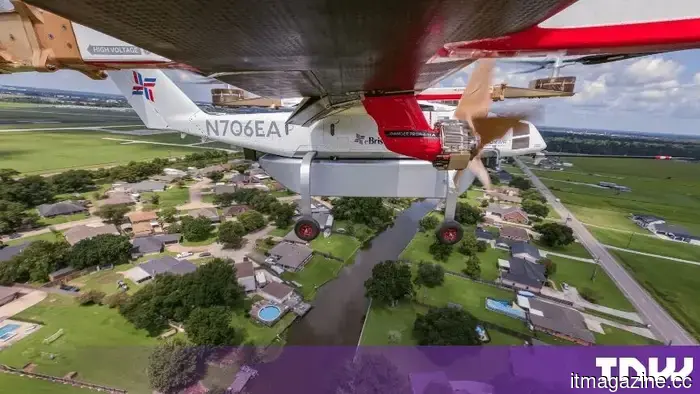 The FAA has just allowed an unmanned cargo plane to depart from an operational airport.
Elroy Air operated an uncrewed cargo aircraft weighing 500 pounds from a regulated airport in Louisiana, marking the initial flights under an FAA pilot program.
The FAA has just allowed an unmanned cargo plane to depart from an operational airport.
Elroy Air operated an uncrewed cargo aircraft weighing 500 pounds from a regulated airport in Louisiana, marking the initial flights under an FAA pilot program.
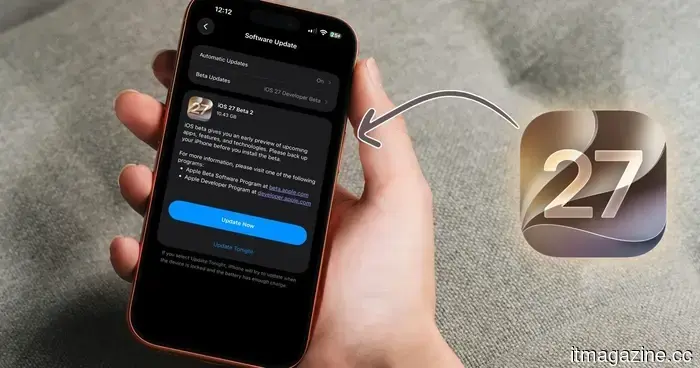 Apple has simplified the process of using two iPhones with a single number.
iOS 27 may simplify the process of managing two iPhones. With iPhone Handoff, you can alternate between devices while maintaining the same phone number.
Apple has simplified the process of using two iPhones with a single number.
iOS 27 may simplify the process of managing two iPhones. With iPhone Handoff, you can alternate between devices while maintaining the same phone number.
Uber and Wayve introduce London’s inaugural robotaxi service, featuring a safety driver in each vehicle.
Uber and Wayve started transporting passengers in London on Thursday using fewer than 20 Ford Mustang Mach-Es. TfL has approved the vehicles as private hire cars, which means a licensed driver must be present and accountable for every journey.