
The upcoming front in cybersecurity will be within the processor.
**Summary:** Processors execute instructions without discerning their legitimacy. Dover Microsystems’ CoreGuard, developed from DARPA's $100M CRASH program, introduces a silicon-level enforcement layer that monitors instructions against programmable micropolicies. NXP partnered with Dover in 2018 for embedded platforms. IBM's research reveals that 25% of malicious breaches are now AI-driven, costing an average of $6M. Dover holds 17 patents and has been validated through red-team exercises by the government.
Cybersecurity faces a location challenge. Attackers exploit vulnerabilities in systems that businesses have safeguarded for years with software, yet the central processor often remains unaware of any issues. Verizon's 2026 Data Breach Investigations Report highlights that vulnerability exploitation has emerged as the primary access vector, responsible for 31% of breaches, while only 26% of critical vulnerabilities were entirely addressed by 2025.
As computing infiltrates physical systems, the stakes rise. AI workloads, connected infrastructure, industrial machinery, and autonomous devices rely on processors to convert software instructions into tangible actions. A compromised application may transcend data security issues and challenge control. IBM's 2026 breach research indicates that AI-enabled malicious breaches cost an average of $6 million.
Though software is essential for modern computing, its complexity presents ongoing security challenges. Introducing another software defense layer could result in organizations relying on vulnerable software to protect other vulnerable software. The emerging question is whether the processor itself can help determine the legitimacy of instruction execution.
Jothy Rosenberg, a seasoned technology startup founder and the Executive Chairman of Dover Microsystems, has dedicated years to exploring this concept. His past ventures included two exits over $100 million, and his work with Dover focuses on a proposition that contests the software-first cybersecurity model: processors should be equipped to recognize banned behavior instead of blindly executing all instructions.
"Processors remain based on the same simple design created in 1945, which means they cannot identify if they are under attack," Rosenberg states. He emphasizes the issue because vulnerabilities persist even after implementing security solutions. "Introducing a large system meant to protect you that contains bugs is just another way for attackers to gain access." It has been found that software typically harbors 15 bugs for every thousand lines of source code.
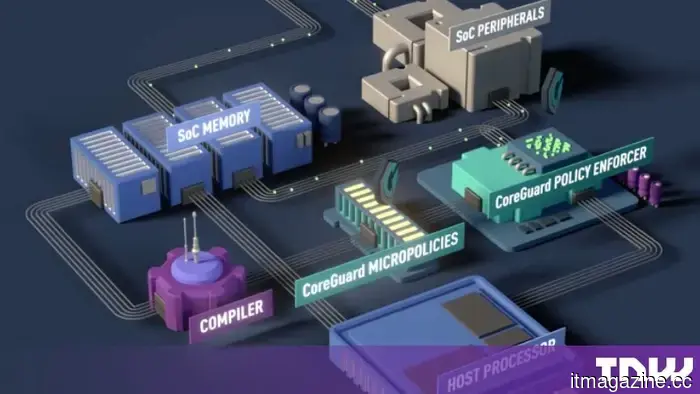
Dover’s CoreGuard tackles this issue at the silicon level. The technology serves as an extra layer of processor security, monitoring executed instructions. Programmable rules, or micropolicies, dictate what actions the processor is allowed to take. If an instruction breaches these rules, CoreGuard is designed to block its execution and notify the surrounding system.
Rosenberg explains that a processor inherently lacks the ability to judge the legitimacy of executing instructions. He simplifies this notion: "Our mission is to monitor every instruction the processor executes and determine at the same processing speed whether it is correct."
This concept stems from a pivotal moment in cybersecurity history. The 2010 Stuxnet attack illustrated how malicious code could transition from the digital realm into the physical world, driving DARPA's CRASH program—a $100 million research initiative aimed at crafting fundamentally different cyber defense strategies. Dover's technology was born from that research, further developed at a research firm, and evolved into an independent entity in 2017.
The company has collaborated with semiconductor firms. NXP reported in 2018 that it had engaged Dover to integrate CoreGuard into upcoming embedded platforms, describing the technology as hardware-based security IP that protects processors from software vulnerabilities and network attacks.
Rosenberg asserts that the relevance of this technology will increase as processors start making more significant decisions. He underscores AI as a critical pressure point, noting that AI systems, being software themselves, can wield significant operational authority. "AI systems are very vulnerable to attack," he emphasizes. "They are highly leveraged, tasked with solving crucial problems."
Dover's technology is designed to work as silicon IP in conjunction with a host processor. The firm holds 17 patents, positioning it uniquely around processor-level enforcement. The architecture has also been crafted to tackle specific software exploitation categories, including buffer-overflow attacks, using hardware-enforced micropolicies.
Thus, the strategic question extends beyond a single cybersecurity company. Semiconductor manufacturers, defense contractors, and infrastructure technology firms increasingly confront the challenge of securing computing at the juncture where software translates into action. Rosenberg contends that merely introducing another generation of software-based security products will not remedy the underlying issue.
"Software has bugs. Hardware is immune to manipulation in the same manner. Hardware's functions are fixed," he notes. This perspective places Dover within a broader technological transition: cybersecurity may gradually shift from protecting the software surrounding processors to empowering processors with an active role in regulating software behavior. As computing becomes further integrated into the physical realm, Rosenberg argues that the silicon underlying the code may emerge as one of the most crucial areas for establishing security boundaries.

Other articles
 Brazil is establishing its definition of a deepfake just five weeks prior to the election.
The electoral court took steps to widen AI regulations in anticipation of the election on October 4, following an incident where an AI avatar of Jair Bolsonaro campaigned in violation of a communication ban.
Brazil is establishing its definition of a deepfake just five weeks prior to the election.
The electoral court took steps to widen AI regulations in anticipation of the election on October 4, following an incident where an AI avatar of Jair Bolsonaro campaigned in violation of a communication ban.
 UBS states that China is improbable to catch up with ASML’s leading technology within this decade.
UBS states that China will not be able to replicate ASML's EUV technology in this decade, but they anticipate high-volume immersion DUV production within the next two to five years, which is what The Hague licenses.
Meta eliminates fraudulent app advertisements in India following two requests.
Applications masquerading as pornography have the potential to intercept one-time passwords and banking PINs. Meta has taken down the ads that Reuters identified but did not respond to their inquiries.
UBS states that China is improbable to catch up with ASML’s leading technology within this decade.
UBS states that China will not be able to replicate ASML's EUV technology in this decade, but they anticipate high-volume immersion DUV production within the next two to five years, which is what The Hague licenses.
Meta eliminates fraudulent app advertisements in India following two requests.
Applications masquerading as pornography have the potential to intercept one-time passwords and banking PINs. Meta has taken down the ads that Reuters identified but did not respond to their inquiries.
 A Chinese court has put a freeze on Nexperia’s shares in four of its subsidiaries.
The Dongguan court has frozen approximately 2.14 billion yuan in shareholdings until 2029 in relation to Wingtech's lawsuit against the Dutch chip manufacturer and three of its executives.
A Chinese court has put a freeze on Nexperia’s shares in four of its subsidiaries.
The Dongguan court has frozen approximately 2.14 billion yuan in shareholdings until 2029 in relation to Wingtech's lawsuit against the Dutch chip manufacturer and three of its executives.
 Unions at Micron in Taiwan are preparing to hold a vote on whether to strike regarding bonuses.
Two unions, representing approximately 10,000 employees, are advocating for profit sharing, referencing Samsung and SK Hynix. A strike could impact an already constrained memory market.
Unions at Micron in Taiwan are preparing to hold a vote on whether to strike regarding bonuses.
Two unions, representing approximately 10,000 employees, are advocating for profit sharing, referencing Samsung and SK Hynix. A strike could impact an already constrained memory market.
 Texas has 474GW in data center requests but lacks clarity on how many of these are legitimate.
Interconnection queues throughout the US contain over 700GW of data center applications, which is ten times the current usage. States are beginning to impose fees for these requests.
Texas has 474GW in data center requests but lacks clarity on how many of these are legitimate.
Interconnection queues throughout the US contain over 700GW of data center applications, which is ten times the current usage. States are beginning to impose fees for these requests.
The upcoming front in cybersecurity will be within the processor.
Jothy Rosenberg, the founder of Dover Microsystems, contends that processors still lack the ability to detect attacks. CoreGuard, developed from DARPA's $100M CRASH initiative, monitors every instruction at the silicon level and applies security measures before any harm can happen.