
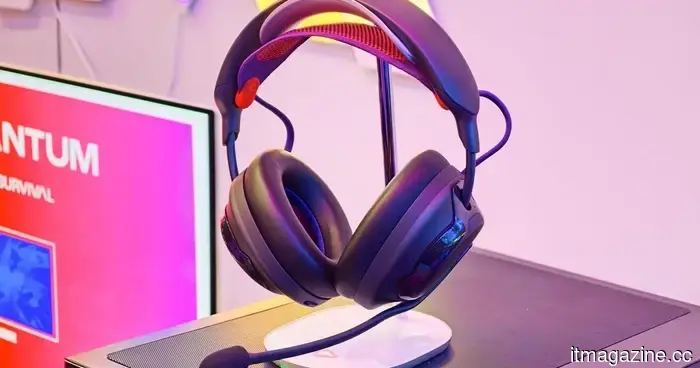
JBL believes that the future of gaming audio lies in being more intelligent, not merely wireless.
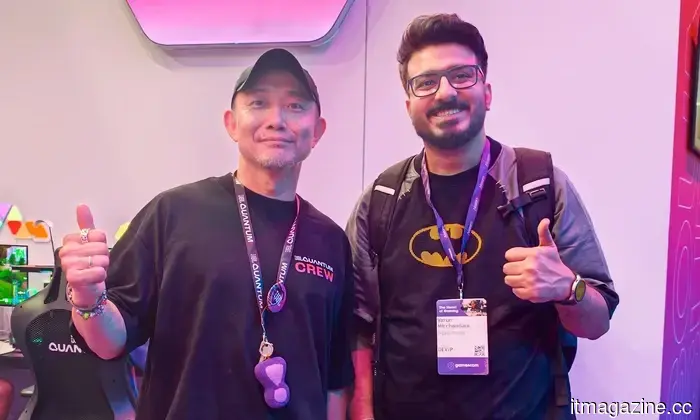
At Gamescom 2026, I had a conversation with Gordon Tong, Senior Director of Product Strategy and Planning, Gaming at JBL, regarding a crucial element of gaming sessions: audio.
Varun Mirchandani / Digital Trends
Our discussion, initially focused on wireless gaming, expanded to include JBL’s Quantum strategy, AI-enhanced audio, and the company’s belief that its greatest strength is not merely being the loudest brand in gaming. To spoil the surprise: it sees its advantage as being JBL.
The Era of Wireless is Established
Gordon noted that wireless gaming audio has significantly progressed beyond its initial testing stages. Gamers who once insisted on wired connections and “zero latency” are now increasingly at ease with low-latency wireless options. The market is clearly moving in that direction.
“Gamers have mentally shifted from demanding wired, zero-latency connections to accepting low-latency wireless solutions. It's been a notable psychological change in the industry.”
Wireless gaming audio, once viewed as a compromise for those unwilling to forgo wired connections, has now become a standard component of modern gaming setups. The technology has evolved, latency has drastically decreased, and gamers are increasingly prioritizing the convenience of wireless over the minutiae of milliseconds.
Varun Mirchandani / Digital Trends
As a gamer myself, I share Gordon’s sentiment. If I can’t perceive a difference while playing Valorant, I’m not particularly concerned about whether my audio is transmitted via a cable or wirelessly.
JBL's Unique Advantage Isn’t RGB
How does JBL stack up against Logitech, Razer, and SteelSeries? Gordon views it less as a conventional rivalry. Instead, JBL is leveraging its decades of audio expertise, which competitors can’t replicate overnight.
“Think of it this way: it’s not merely about competition. Each brand offers different solutions for gamer needs. When consumers choose our brand, they recognize JBL as a sound icon, so we inherently commit to that acoustic standard across all price ranges.”
JBL
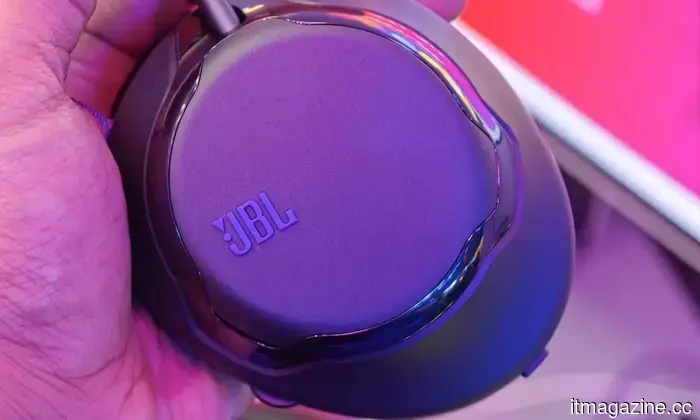
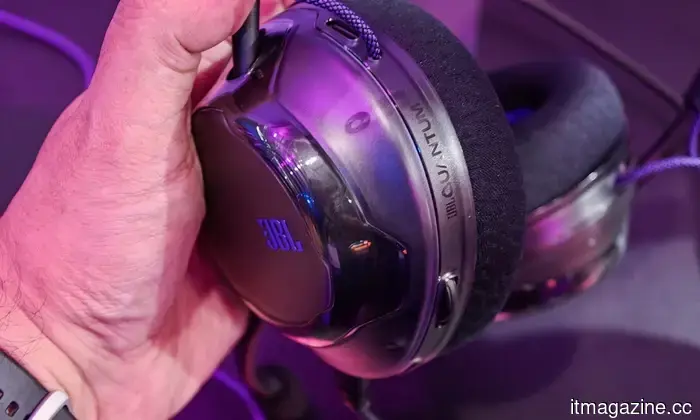
This approach is especially notable when examining JBL’s revamped Quantum lineup. The newly introduced $49.95 Quantum 120 and $129.95 Quantum 520X both feature 50mm carbon dynamic drivers, as do the higher-end Quantum models.
“Whether we’re producing a $400 headset or a $45 headset, we utilize the same driver — a 50mm carbon dynamic driver.”
JBL clearly wants to highlight this driver. Carbon diaphragms are prized in dynamic-driver design for their stiffness and low mass, aiding in the control of unwanted diaphragm flex and resonance. JBL claims its specific carbon damping material is designed to minimize distortion and deliver detailed sound, while the latest Quantum 850 enhances high-frequency extension to improve sound localization.
Varun Mirchandani / Digital Trends
In simpler terms: the driver is essentially the component producing sound in your headset. A well-controlled driver can clarify subtle details, which is crucial when distinguishing between “I heard something” and “there’s a Jett behind me.”
AI Aims to Detect Your Enemy Before You Do
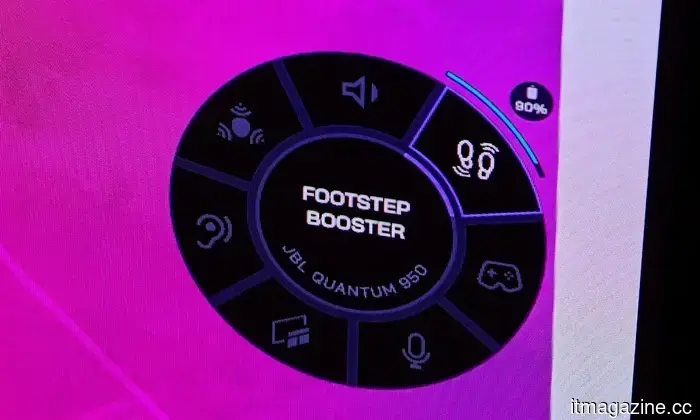
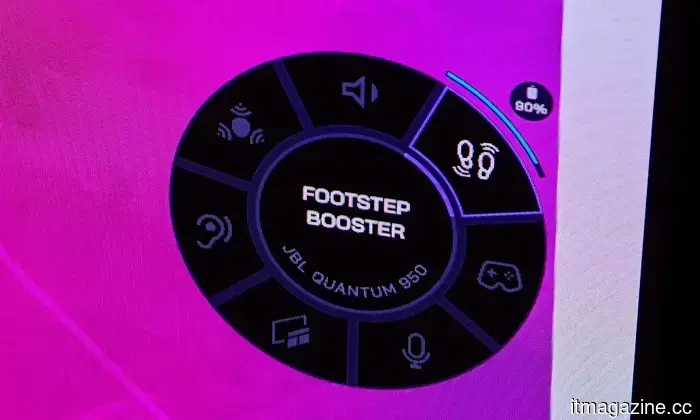
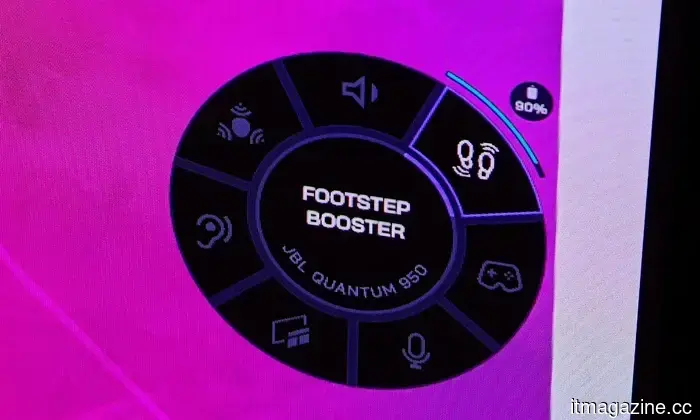
The standout element of our discussion was JBL’s AI Footstep Booster. Unlike a standard EQ that indiscriminately amplifies high frequencies and turns every nearby flashbang into a piercing sound, JBL’s system continuously analyzes game audio, dynamically pinpointing significant sounds like footsteps, voices, gunshots, and explosions.
“Our algorithm actually analyzes and interprets game sounds to isolate and dynamically boost footstep frequencies.”
Having spent considerable time adjusting EQ settings to hear footsteps in Valorant, I find this intriguing. The issue with traditional methods is that raising the frequencies of footsteps can also amplify all other sounds, leading to a harsher overall audio experience.
Varun Mirchandani / Digital Trends
If JBL can effectively isolate the important sounds without drowning the rest of the game in noise, that’s certainly more compelling than another EQ adjustment. This feature is currently anticipated for release in Q4 2026, primarily focused on top FPS games.
TWS is Amazing… Until the Battery Runs Out
We also discussed True Wireless earbuds, an area where JBL already has a foothold with its Quantum TWS range.
Varun Mirchandani / Digital Trends
This topic felt especially personal since I currently use the JBL Quantum TWS. I appreciate the comfort, sound quality, and immediacy of the in-ear design. My main complaint, however? Battery life. In Valorant, two matches can be sufficient for me to start reaching for the charging case.
JBL
Fortunately, Gordon was refreshingly honest about the trade-off. TWS makes sense for mobile gaming, while PC and console gamers often treat it as a versatile device. Ultimately, physics is still at play: small earbuds lack the battery capacity of larger headsets.
JBL Isn’t Aiming to Imitate Razer
One of the key insights from Gordon was that JBL is not attempting to outpace its gaming rivals by mimicking


Other articles
 A solar-powered mobile clinic has successfully traveled 800 km throughout Kenya.
Dutch students traveled 800km across Kenya in a solar-powered ambulance, which generated more energy than it consumed. Europe has allocated 2.6 billion euros for health initiatives in Africa, but none of that funding is directed towards this project.
A solar-powered mobile clinic has successfully traveled 800 km throughout Kenya.
Dutch students traveled 800km across Kenya in a solar-powered ambulance, which generated more energy than it consumed. Europe has allocated 2.6 billion euros for health initiatives in Africa, but none of that funding is directed towards this project.
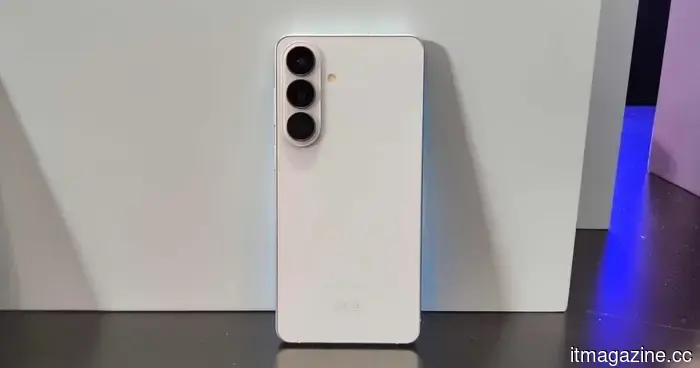 Samsung might provide the Galaxy S27 and S27+ with a much-needed zoom enhancement.
A recent leak suggests that the Galaxy S27 and S27+ may utilize the same 3x telephoto system as the S27 Pro, possibly replacing the outdated 10MP zoom camera present in the current models.
Samsung might provide the Galaxy S27 and S27+ with a much-needed zoom enhancement.
A recent leak suggests that the Galaxy S27 and S27+ may utilize the same 3x telephoto system as the S27 Pro, possibly replacing the outdated 10MP zoom camera present in the current models.
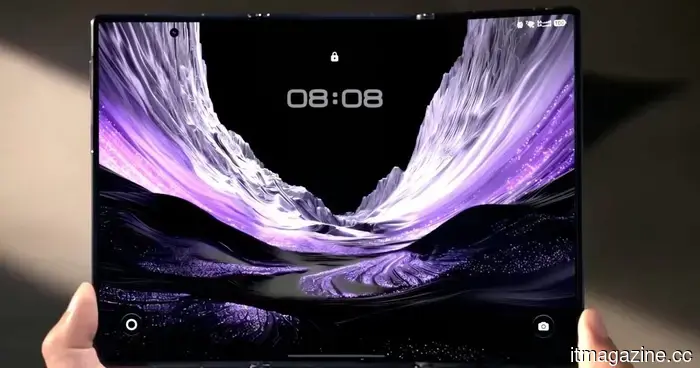 Huawei’s latest competitor to the Galaxy Z TriFold features a double-fold design, has a capacity of 2TB, and is strikingly designed in purple.
Huawei's upcoming tri-fold features a new inward-folding design that safeguards its large flexible display, while also incorporating 2TB of storage, stylus compatibility, privacy screen options, and three elegant finishes.
Huawei’s latest competitor to the Galaxy Z TriFold features a double-fold design, has a capacity of 2TB, and is strikingly designed in purple.
Huawei's upcoming tri-fold features a new inward-folding design that safeguards its large flexible display, while also incorporating 2TB of storage, stylus compatibility, privacy screen options, and three elegant finishes.
 Windows 11 introduces switches to eliminate Bing results and Store recommendations from Search.
Windows 11 is introducing a feature that allows users to disable Bing results in Search. Microsoft has also provided this option to users in the EEA to comply with a DMA deadline set for 2024.
Windows 11 introduces switches to eliminate Bing results and Store recommendations from Search.
Windows 11 is introducing a feature that allows users to disable Bing results in Search. Microsoft has also provided this option to users in the EEA to comply with a DMA deadline set for 2024.
 ChatGPT Ads reaches an annualized figure of $1 billion as the EU regulates it under the Digital Services Act.
OpenAI reports that ChatGPT Ads has achieved an annualized revenue of $1 billion and has launched self-service purchasing in Europe, coinciding with the Commission's designation under the DSA.
ChatGPT Ads reaches an annualized figure of $1 billion as the EU regulates it under the Digital Services Act.
OpenAI reports that ChatGPT Ads has achieved an annualized revenue of $1 billion and has launched self-service purchasing in Europe, coinciding with the Commission's designation under the DSA.
 LG Energy Solution enters into a 10-year lithium agreement in Arkansas beginning in 2029.
LG Energy reached a 10-year lithium offtake agreement with an Arkansas project in which Equinor holds a 45% stake. The contract established in 2022 for German lithium is set to fulfill deliveries by 2025.
LG Energy Solution enters into a 10-year lithium agreement in Arkansas beginning in 2029.
LG Energy reached a 10-year lithium offtake agreement with an Arkansas project in which Equinor holds a 45% stake. The contract established in 2022 for German lithium is set to fulfill deliveries by 2025.
JBL believes that the future of gaming audio lies in being more intelligent, not merely wireless.
I had a conversation with Gordon Tong from JBL at Gamescom 2026 regarding wireless gaming, 50mm carbon drivers, AI-driven footsteps, and the company’s approach to Quantum.