
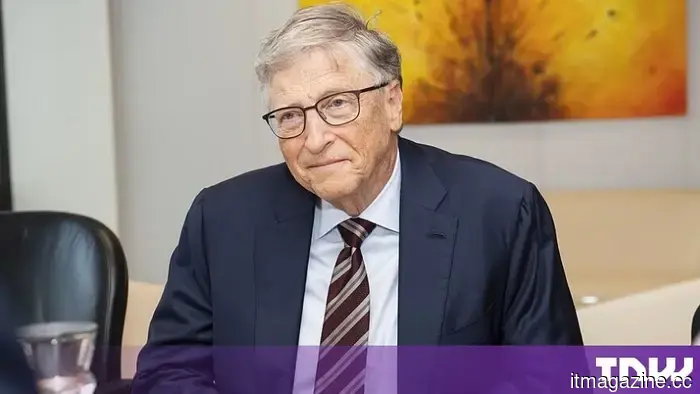
How Bill Gates utilizes AI and why he believes nobody is getting ready for it.
Bill Gates has released a memo suggesting the implementation of a tax on AI, the establishment of job categories reserved for humans, and the creation of new institutions to facilitate the transition. He mentioned to GeekWire that industry leaders have private concerns but remain silent in public. Gates initially proposed a robot tax in February 2017, coinciding with the European Parliament's introduction of robotics regulations that did not include the tax.
He noted that those developing AI share concerns privately, although they do not express them publicly. “I know they’re all worried. Or at least everyone I know, which is basically everybody except Elon,” he told GeekWire.
This discussion stems from a memo he published recently, which contends that the industry is surpassing the safety boundaries it set for itself, and that preparations for what lies ahead are lacking.
TNW reported on his proposals, which include a tax on AI, the designation of certain jobs for humans, and the formation of new institutions to oversee the transition.
In the interview, Gates added a detail that he did not include in his memo. He remarked, “Even the lack of control I assumed would take many more years to manifest, we're now witnessing a lack of control.”
On the tax issue, Gates is reiterating a previous stance. His initial suggestion to tax robots emerged in February 2017, focusing on factory automation rather than models, with similar reasoning.
Europe addressed this topic in the same month. The European Parliament voted 396 to 123, with 85 abstentions, on rules regarding robotics, and the proposed tax was not included in the legislation.
What was approved is noteworthy. The resolution urged the Commission to assess the sustainability of member states’ social security systems amidst the rise of robots, which reflected the underlying issue behind the remedy that MEPs chose not to advance.
Additionally, the adopted text proposed the concept of electronic personhood for advanced autonomous robots, an idea that has seen little development since.
The rapporteur expressed dissatisfaction, with Mady Delvaux stating that certain coalitions in Parliament had disregarded a forward-looking discussion about workers, a sentiment welcomed by the robotics sector.
Nearly a decade later, there has been no shift in position. The AI Act governs risk and mandates human oversight, and TNW has questioned whether it can safeguard jobs without hindering innovation.
It achieves neither of the objectives Gates advocates for. It does not impose a tax on a model, it does not allocate a specific category of work to people, and no member state has suggested such measures.
The evidence supporting either side is less robust than either acknowledges. TNW has contended that the impact of AI on jobs in Europe appears different from the overall statistics.
Thus, the memo returns to its original premise. A man who first proposed this in 2017 is making the same suggestion again, while Europe has already made its decision.
Other articles
 Sony Music and Warner Chappell have filed a lawsuit against Anthropic regarding the inclusion of song lyrics in the training data for Claude.
Sony Music Publishing and Warner Chappell have taken legal action against Anthropic concerning song lyrics. In 2025, a court in Munich determined that memorizing lyrics constitutes reproduction.
Sony Music and Warner Chappell have filed a lawsuit against Anthropic regarding the inclusion of song lyrics in the training data for Claude.
Sony Music Publishing and Warner Chappell have taken legal action against Anthropic concerning song lyrics. In 2025, a court in Munich determined that memorizing lyrics constitutes reproduction.
 Mobile operators claim that UK networks are unprepared for AI traffic.
VodafoneThree claims that UK networks are unprepared for AI traffic and is advocating for changes in planning regulations. Meanwhile, the EU's Gigabit Infrastructure Act has already established that permits are automatically granted.
Mobile operators claim that UK networks are unprepared for AI traffic.
VodafoneThree claims that UK networks are unprepared for AI traffic and is advocating for changes in planning regulations. Meanwhile, the EU's Gigabit Infrastructure Act has already established that permits are automatically granted.
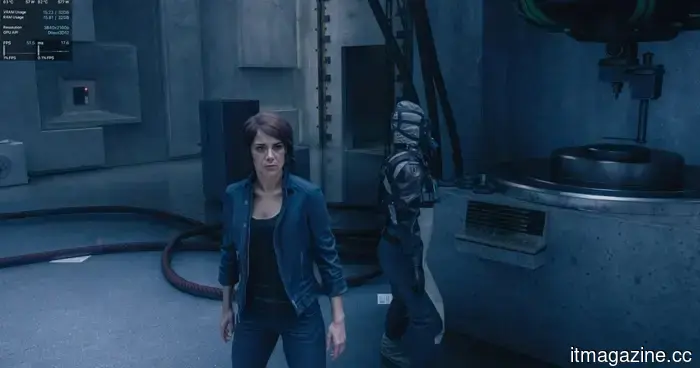 The leak of Nvidia's DLSS 5 is enhancing the visual appeal of games while also making people behave more oddly.
We are all aware that Nvidia revealed its newest DLSS 5 in March 2026, which claimed to deliver photorealistic lighting in gaming. However, Nvidia's significant advancement in AI-driven gaming graphics has come unexpectedly: via a leaked, incomplete version of DLSS 5 that modders have already been able to implement in multiple games. The preliminary outcomes are impressive and unusual. [...]
The leak of Nvidia's DLSS 5 is enhancing the visual appeal of games while also making people behave more oddly.
We are all aware that Nvidia revealed its newest DLSS 5 in March 2026, which claimed to deliver photorealistic lighting in gaming. However, Nvidia's significant advancement in AI-driven gaming graphics has come unexpectedly: via a leaked, incomplete version of DLSS 5 that modders have already been able to implement in multiple games. The preliminary outcomes are impressive and unusual. [...]
How Bill Gates utilizes AI and why he believes nobody is getting ready for it.
Bill Gates is suggesting a tax on artificial intelligence and robots, similar to his proposal from February 2017. During that same month, the European Parliament chose to exclude the tax from its regulations on robotics.