
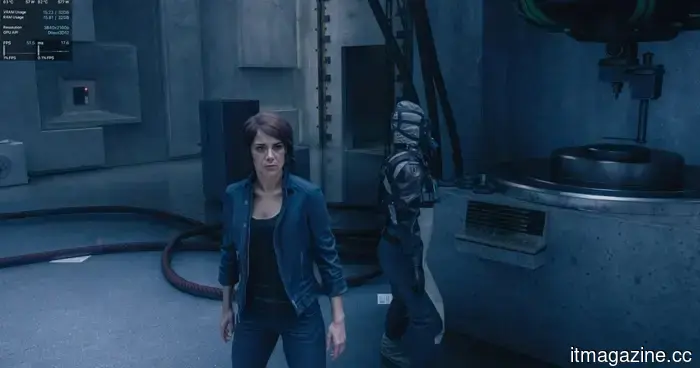
The leak of Nvidia's DLSS 5 is enhancing the visual appeal of games while also making people behave more oddly.
Everyone is aware that Nvidia announced its latest DLSS 5 in March 2026, claiming to deliver photorealistic lighting in games. However, Nvidia's significant advancement in AI-driven gaming graphics has unexpectedly surfaced through a leaked, unfinished version of DLSS 5, which modders have already succeeded in running on several titles. The initial outcomes are impressive, peculiar, and in some instances, quite unsettling.
DLSS 5 is anticipated to enhance Nvidia's neural rendering technology by employing generative AI to modify game visuals. An early version has now been leaked via the early access for NBA 2K26, as reported by Videocardz. Modders discovered an nvngx_dlsrnr.dll library that includes an unreleased DLSS Neural Rendering runtime, version 310.8.0.0, and quickly began experimenting with it.
Modders are subjecting DLSS 5 to some rather unusual tests.
The leaked software has already been successfully implemented in games like Control, The Elder Scrolls V: Skyrim, and Final Fantasy VII Rebirth, with examples of the technology also being tested in Grand Theft Auto: San Andreas.
This is where things become intriguing. Instead of merely enhancing the sharpness of games, the early iteration appears to be capable of altering visual elements using AI. In Control, the reported results are not particularly negative, especially concerning environmental details. However, the technology takes on a notably stranger aspect when it comes to character models.
For instance, in Final Fantasy VII Rebirth, Cloud’s face can become almost unrecognizable with the experimental processing. This effect gives certain characters an eerie quality, indicating that Nvidia’s generative method still has numerous rough edges to be polished.
There's also a performance concern: the leaked build is said to be highly resource-intensive. One report highlighted by XDA noted that a user running DLSS 5 through a Discord server experienced nearly a 50% drop in performance. This is a crucial caveat, as DLSS has typically been aimed at enhancing graphics while also improving performance through techniques like upscaling.
This might represent the future of graphics or the onset of AI inconsistencies in gaming.
Nvidia has been promoting DLSS 5 as a significant advancement in its graphics technology, with CEO Jensen Huang previously defending the approach against criticism. The leaked build offers gamers their first glimpse of what the future with generative AI might actually entail, although it would be rash to evaluate the final product based on unfinished software.
That distinction is significant. It’s clear that this is an incomplete version of DLSS 5, meaning Nvidia could make substantial adjustments before its release. Games specifically designed around this technology may yield much better results than older titles that enthusiasts are adapting.
Nonetheless, these early experiments highlight the main challenge Nvidia faces. While AI can create or reconstruct visual information that conventional rendering techniques struggle to achieve, gamers are unlikely to embrace improved sharpness if characters start to resemble digital mannequins.
For Nvidia, DLSS 5 may ultimately enhance game detail and realism while decreasing the need for traditional rendering methods. For players, however, the question remains straightforward: will AI improve the appearance of games or simply alter them? The final answer will have to await the completed version.
Other articles
 Opposition to Flock surveillance cameras has led to the emergence of a vigilante movement in the United States.
In the United States, increasing privacy worries regarding Flock's AI-driven license plate readers have sparked a significant backlash, as residents and city councils oppose roadside surveillance.
Opposition to Flock surveillance cameras has led to the emergence of a vigilante movement in the United States.
In the United States, increasing privacy worries regarding Flock's AI-driven license plate readers have sparked a significant backlash, as residents and city councils oppose roadside surveillance.
 Mobile operators claim that UK networks are unprepared for AI traffic.
VodafoneThree claims that UK networks are unprepared for AI traffic and is advocating for changes in planning regulations. Meanwhile, the EU's Gigabit Infrastructure Act has already established that permits are automatically granted.
Mobile operators claim that UK networks are unprepared for AI traffic.
VodafoneThree claims that UK networks are unprepared for AI traffic and is advocating for changes in planning regulations. Meanwhile, the EU's Gigabit Infrastructure Act has already established that permits are automatically granted.
 Sony Music and Warner Chappell have filed a lawsuit against Anthropic regarding the inclusion of song lyrics in the training data for Claude.
Sony Music Publishing and Warner Chappell have taken legal action against Anthropic concerning song lyrics. In 2025, a court in Munich determined that memorizing lyrics constitutes reproduction.
Sony Music and Warner Chappell have filed a lawsuit against Anthropic regarding the inclusion of song lyrics in the training data for Claude.
Sony Music Publishing and Warner Chappell have taken legal action against Anthropic concerning song lyrics. In 2025, a court in Munich determined that memorizing lyrics constitutes reproduction.
 How Bill Gates utilizes AI and why he believes nobody is getting ready for it.
Bill Gates is suggesting a tax on artificial intelligence and robots, similar to his proposal from February 2017. During that same month, the European Parliament chose to exclude the tax from its regulations on robotics.
How Bill Gates utilizes AI and why he believes nobody is getting ready for it.
Bill Gates is suggesting a tax on artificial intelligence and robots, similar to his proposal from February 2017. During that same month, the European Parliament chose to exclude the tax from its regulations on robotics.
The leak of Nvidia's DLSS 5 is enhancing the visual appeal of games while also making people behave more oddly.
We are all aware that Nvidia revealed its newest DLSS 5 in March 2026, which claimed to deliver photorealistic lighting in gaming. However, Nvidia's significant advancement in AI-driven gaming graphics has come unexpectedly: via a leaked, incomplete version of DLSS 5 that modders have already been able to implement in multiple games. The preliminary outcomes are impressive and unusual. [...]