

Claude now recalls what you shared, regardless of the context in which it is used.
Claude can now retain information during your conversation and transfer it to Cowork, allowing users to view, modify, or delete specific memories.
One of the most frustrating aspects of using an AI assistant is the need to repeat yourself. Claude aims to address this issue. Starting today, the memory Claude utilizes in chat is also accessible in Claude Cowork, meaning the context you've developed over months of discussions will accompany you when you delegate tasks to Claude.
This means Claude can be aware of your projects, priorities, and preferences without needing another lengthy introduction. For instance, if you explain in chat how your team defines its metrics, Cowork can utilize that information while preparing your next quarterly business review. Discussing a conference in chat allows Cowork to retain details such as the city, speakers, and participant count when handling the logistics.
Claude now has the ability to remember as you converse.
Another significant change is that Claude's memory updates in real-time during conversations, rather than waiting until the end to summarize. If you mention that a project deadline has shifted to September, Claude will retain that information for your next discussion without requiring you to explicitly instruct it to remember.
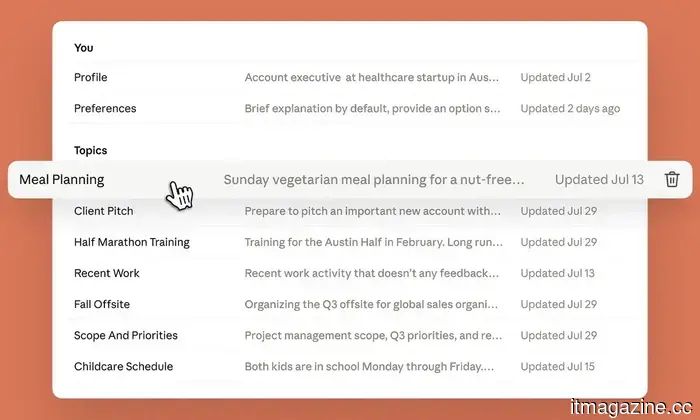
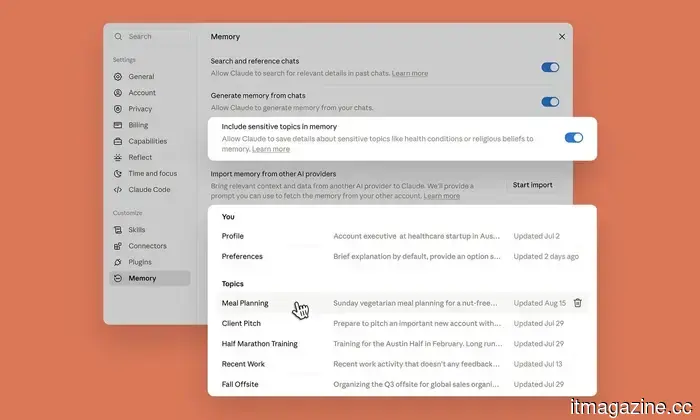
Moreover, users have visibility into what Claude remembers. Saved memories are displayed as individual files categorized by topic, which users can access, modify, or delete. Any corrections made will reflect in future discussions and Cowork tasks.
You also have control over what Claude remembers.
By default, Claude will not save sensitive information, including topics related to health, race, ethnicity, religion, politics, or gender identity. However, users can opt to allow Claude to retain such details by activating the "include sensitive topics in memory" option. When Claude saves information on sensitive topics, users will receive a notification, and the setting can be disabled at any time.
Furthermore, there are still certain categories that Claude will not retain even with sensitive memory enabled, such as identifying numbers, criminal history, and immigration status. Users can also pause or reset memory at any time.
The overarching idea is straightforward: Claude aims to make memory feel less like a concealed AI gimmick and more like a personal workspace you can truly control. By allowing that memory to transfer seamlessly between chat and Cowork, Anthropic is alleviating one of the most annoying aspects of working with AI—having to repeat the same information repeatedly.
Varun is a seasoned technology journalist and editor with over eight years in consumer tech media. His work encompasses...
Harvard developers have created an AI app to assist visually impaired individuals with navigation.
Mobilio uses a smartphone’s camera, GPS, and motion sensors to help users avoid obstacles. AI accessibility tools have quietly emerged as some of the most practical applications of the technology. We have witnessed smartphones helping visually impaired users locate nearby objects and smart glasses connecting them with people who can describe their surroundings. Harvard researchers are now advancing this concept with an app designed specifically for navigation.
Named Mobilio, the app leverages a smartphone’s camera, GPS, motion sensors, and LiDAR (when available) to assist blind and low-vision users in following routes, staying on walkable paths, and avoiding obstacles. Researchers at Harvard’s John A. Paulson School of Engineering and Applied Sciences developed the system after consulting over 100 blind and low-vision individuals regarding their navigation technology needs.
A New York Times investigation has reported on a July 6 drone attack in Zaporizhzhia, Ukraine, that resulted in the deaths of three civilians, including a 19-year-old university student. Human operators programmed the drone to approach a gas station, but an autonomous AI system chose the specific target to attack, likely propane tanks. The drone did not reach its intended target and instead exploded nearby.
For decades, technology has prioritized accelerating communication. However, it seems we have reached our limit. According to The New York Times, the newest trend is slow tech, with apps like Carrier Pidge and Roost intentionally delaying message delivery for minutes, hours, or even longer. Yes, digital carrier pigeons are in vogue. Launched in April, Carrier Pidge saw its user base grow from a few hundred to over 75,000, while Roost reportedly reached 650,000 downloads this month. Apparently, waiting is back in style.






Other articles
 Android 17 has finally introduced the Pixel feature that my motion-sensitive self has been anticipating.
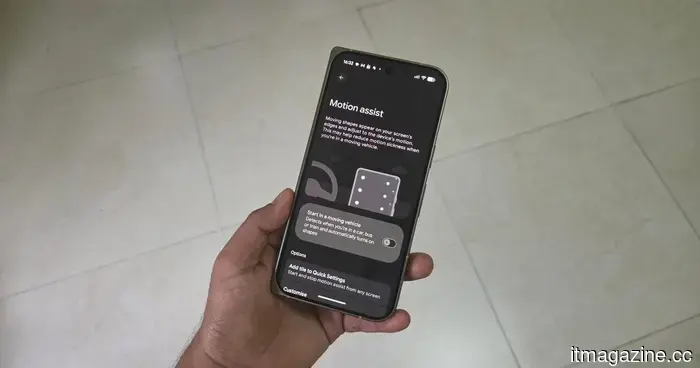
The new Motion Assist feature from Android 17 is being rolled out to Pixel 11 phones, incorporating animated screen cues aimed at alleviating the sensory mismatch that leads to motion sickness.
Android 17 has finally introduced the Pixel feature that my motion-sensitive self has been anticipating.
The new Motion Assist feature from Android 17 is being rolled out to Pixel 11 phones, incorporating animated screen cues aimed at alleviating the sensory mismatch that leads to motion sickness.
 The Galaxy S27 Ultra from Samsung might be undergoing a redesign, beginning with its large camera protrusion.
Leaked renders of the Galaxy S27 Ultra indicate that Samsung may be working on a revamped camera module, a bigger battery, and possibly substantial alterations within the recognizable Ultra design.
The Galaxy S27 Ultra from Samsung might be undergoing a redesign, beginning with its large camera protrusion.
Leaked renders of the Galaxy S27 Ultra indicate that Samsung may be working on a revamped camera module, a bigger battery, and possibly substantial alterations within the recognizable Ultra design.
 WhatsApp is substituting its six-digit security PIN with a genuine password.
WhatsApp is substituting its six-digit verification PIN with a complete password, and claims that over a billion users have already set up a passkey.
WhatsApp is substituting its six-digit security PIN with a genuine password.
WhatsApp is substituting its six-digit verification PIN with a complete password, and claims that over a billion users have already set up a passkey.
 Emerald AI has secured $150 million at a valuation of $1.05 billion to enhance its data center capabilities.
Emerald AI secured $150 million, achieving a valuation of $1.05 billion for its software that reduces data center power usage during times of grid stress, as stated by the company.
Emerald AI has secured $150 million at a valuation of $1.05 billion to enhance its data center capabilities.
Emerald AI secured $150 million, achieving a valuation of $1.05 billion for its software that reduces data center power usage during times of grid stress, as stated by the company.
 ROG’s latest gaming mice are designed for esports, yet they will also be a great asset for your spreadsheets.
At Gamescom 2026, ASUS ROG unveiled the Gladius IV Ace and Spatha X 65K gaming mice, in addition to announcing new esports collaborations and a new Instagram channel for its fans.
ROG’s latest gaming mice are designed for esports, yet they will also be a great asset for your spreadsheets.
At Gamescom 2026, ASUS ROG unveiled the Gladius IV Ace and Spatha X 65K gaming mice, in addition to announcing new esports collaborations and a new Instagram channel for its fans.
 Intuit is spinning off Mailchimp and steering it towards zero growth.
Intuit announced a revenue of $21.4 billion for fiscal 2026, based on its results, and projected Mailchimp's growth to be between a decline of 1% and no growth as a new segment.
Intuit is spinning off Mailchimp and steering it towards zero growth.
Intuit announced a revenue of $21.4 billion for fiscal 2026, based on its results, and projected Mailchimp's growth to be between a decline of 1% and no growth as a new segment.
Claude now recalls what you shared, regardless of the context in which it is used.
Claude is offering its memory feature for use in both chat and Cowork, enabling users to maintain context across different conversations and tasks while having control over what the AI retains.