

Emerald AI has secured $150 million at a valuation of $1.05 billion to enhance its data center capabilities.
A company that is just two years old has achieved a valuation of $1.05 billion. It develops software designed to reduce electricity consumption in data centers on demand. Emerald AI announced on Tuesday that it has raised $150 million in an oversubscribed Series A funding round, co-led by Energize Capital and DCVC, bringing its total funding to over $220 million.
The list of investors reveals much, with participation from Nvidia, Siemens, RWE, and GE Vernova, as well as financing from Aramco Ventures, Samsung Ventures, Salesforce Ventures, JERA Ventures, and CIA-backed In-Q-Tel, along with prominent investors John Doerr and Tom Steyer. Now, twelve companies from the Fortune Global 500 have stakes and are part of the company’s strategic advisory board.
### The Function of the Software
Emerald Conductor categorizes computing tasks based on each customer’s tolerance for delay. When the utility indicates that the grid is under stress, the platform can slow down, pause, limit, or relocate tasks that can afford to wait. This differs from the majority of efficiency software, which typically adjusts cooling systems while leaving computing processes unchanged; Emerald targets the workload itself.
Founder and CEO Varun Sivaram, who previously held climate policy positions in the Biden administration, established the company in 2024. Ayse Coskun, the chief scientist, is a professor in computer science at Boston University and has contributed significantly to research in the field.
### The Claim
The company asserts that if this approach is implemented widely, it could release more than 100 gigawatts of unused capacity within the current U.S. grid. This energy would be available years ahead of any new generation and transmission development. Constructing grid infrastructure can take decades, and the report cites the International Energy Agency regarding the fact that data centers will account for almost half of the growth in U.S. electricity demand by 2030.
Sivaram mentioned that the intelligence fueling the AI revolution might also address its own greatest limitation, which is power.
### Utility Incentives
Silicon Valley Power services about 55 data centers over a 20-square-mile area in Santa Clara, including major players like Nvidia and Intel, making it one of California's most energy-intensive service regions. According to director Nicolas Procos, all the surplus capacity once available is now allocated, leaving two paths: expand the system or find innovative solutions. Silicon Valley Power opted for the latter, launching a Flexible Load Interconnection Program with Emerald that offers data centers enhanced grid access in exchange for verified, controllable flexibility.
### Proven Results
The most notable published result stems from a field test conducted in Phoenix in May 2025, where Emerald and its partners successfully reduced the power consumption of a 256-GPU Nvidia cluster by 25% from its average base load for three hours. In 33 trials, the system managed 212 tasks without exceeding its established service tier, with power predictions deviating by just 4.52% from the average during the tests.
Marcus Schuler established the parameters for Implicator. The research, conducted by Emerald staff and partners, focused on one pre-profiled cluster, managing batch training and fine-tuning while leaving real-time inference, streaming, and model serving unaffected. The authors noted that measuring anything beyond a single cluster would require larger deployments with comprehensive site telemetry.
### European Trials
Emerald has conducted five commercial demonstrations in various locations, including Arizona, Illinois, Virginia, Oregon, and London, with partners like Nvidia, Oracle, Nebius, EPRI, and National Grid. The London setting highlights the approach's relevance in a market facing significant constraints. The Essex data center in Britain had to wait for grid connections, and currently, 63% of new European capacity is located outside the largest five markets due to queues and land availability issues. Both RWE and Siemens have invested, with RWE also being part of the advisory board. European utility companies are adopting an American firm’s solution to address a European challenge.
### Authority over the Load
Successful testing does not grant commercial rights to interrupt operations at data centers. This remains an unresolved issue and a significant hurdle. Full utility control over the load-side breaker is “non-negotiable” for quicker interconnections, stated Silicon Valley Power’s COO Chris Karwick. Operators are reluctant to relinquish this control since abrupt shutdowns could jeopardize costly hardware.
As of late June, there was no standardized binding agreement between utilities and data centers, as reported by Schuler. Often, bill credits are insufficient to justify deferring profitable work, while faster grid access serves as a stronger incentive. Steven Carlini, Schneider Electric’s chief advocate for AI and data centers, noted that while data centers have the capability to slow down, cap, or shift workloads, their willingness to do so is uncertain.
### Emission Outcomes
Shifting computing tasks to off-peak periods can potentially lead to increased emissions, primarily if fossil fuels supply
Other articles
 ERP, MES, SCADA: a unified low-code platform for industry instead of a "zoo"
The Russian MES systems market will exceed 15 billion rubles in 2026, maintaining a growth rate of no less than 8%. However, behind these figures lies a deeper transformation: customers are increasingly rejecting the "zoo" of disparate solutions in favor of unified platforms capable of covering the entire production cycle. AggreGate, one of the developers of such platforms, recently released updates to its key products — SCADA/HMI 6.4 and MES — to respond to this market demand.
ERP, MES, SCADA: a unified low-code platform for industry instead of a "zoo"
The Russian MES systems market will exceed 15 billion rubles in 2026, maintaining a growth rate of no less than 8%. However, behind these figures lies a deeper transformation: customers are increasingly rejecting the "zoo" of disparate solutions in favor of unified platforms capable of covering the entire production cycle. AggreGate, one of the developers of such platforms, recently released updates to its key products — SCADA/HMI 6.4 and MES — to respond to this market demand.
 Gears of War: E-Day appears to be more intense and harsher than before.
Marcus Fenix has encountered some frightening foes, but E-Day seems poised to bring chaos to his life once more.
Gears of War: E-Day appears to be more intense and harsher than before.
Marcus Fenix has encountered some frightening foes, but E-Day seems poised to bring chaos to his life once more.
 Apple's latest Magic Keyboard replaces text with symbols but does not include the upgrade you truly desire.
Apple has subtly updated the Magic Keyboard with new key labels based on symbols to align with its MacBooks, but the long-requested backlight is still absent.
Apple's latest Magic Keyboard replaces text with symbols but does not include the upgrade you truly desire.
Apple has subtly updated the Magic Keyboard with new key labels based on symbols to align with its MacBooks, but the long-requested backlight is still absent.
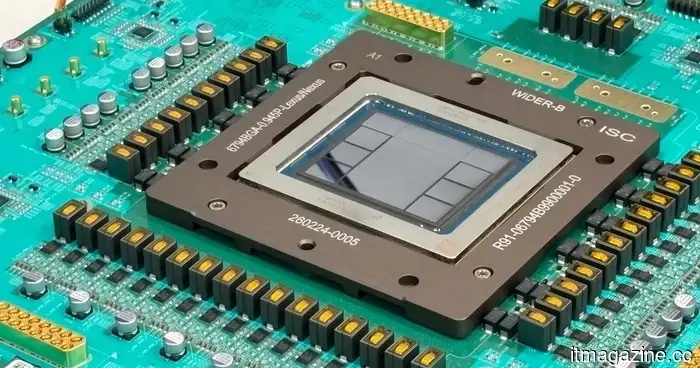 OpenAI claims that its Jalapeno AI chip provides quicker responses compared to competitors such as Nvidia.
OpenAI published benchmark results indicating that its Jalapeno chip, developed in partnership with Broadcom, provides up to 1.9 times more AI performance per watt and has a latency that is 3.6 times lower than that of Nvidia's leading chips.
OpenAI claims that its Jalapeno AI chip provides quicker responses compared to competitors such as Nvidia.
OpenAI published benchmark results indicating that its Jalapeno chip, developed in partnership with Broadcom, provides up to 1.9 times more AI performance per watt and has a latency that is 3.6 times lower than that of Nvidia's leading chips.
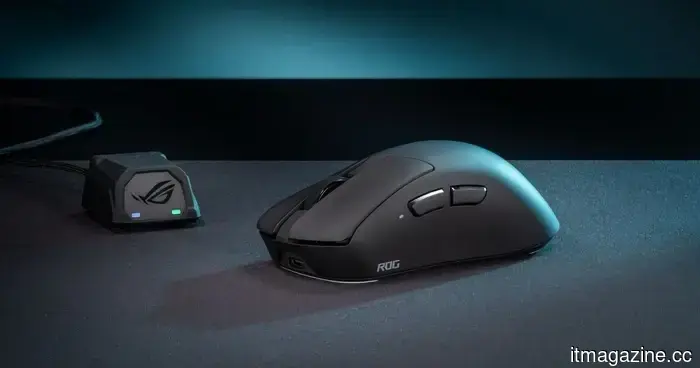 ROG’s latest gaming mice are designed for esports, yet they will also be a great asset for your spreadsheets.
At Gamescom 2026, ASUS ROG unveiled the Gladius IV Ace and Spatha X 65K gaming mice, in addition to announcing new esports collaborations and a new Instagram channel for its fans.
ROG’s latest gaming mice are designed for esports, yet they will also be a great asset for your spreadsheets.
At Gamescom 2026, ASUS ROG unveiled the Gladius IV Ace and Spatha X 65K gaming mice, in addition to announcing new esports collaborations and a new Instagram channel for its fans.
 Apple has significantly enhanced the Mac mini's performance with the M6 chip, along with a substantial increase in pricing.
Apple updated the Mac mini with the brand-new M6 chip and an upgraded M5 Pro variant, claiming up to 4 times faster AI performance within the same compact design.
Apple has significantly enhanced the Mac mini's performance with the M6 chip, along with a substantial increase in pricing.
Apple updated the Mac mini with the brand-new M6 chip and an upgraded M5 Pro variant, claiming up to 4 times faster AI performance within the same compact design.
Emerald AI has secured $150 million at a valuation of $1.05 billion to enhance its data center capabilities.
Emerald AI secured $150 million, achieving a valuation of $1.05 billion for its software that reduces data center power usage during times of grid stress, as stated by the company.