
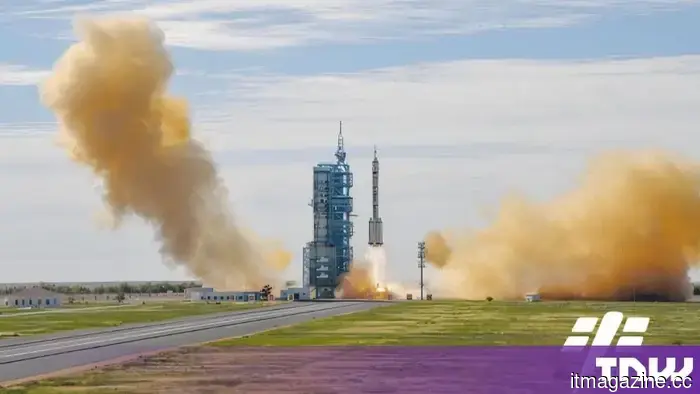
China canceled its ice-hunting lunar mission just one day prior to the scheduled launch.
China canceled its most ambitious lunar mission just a day before its scheduled launch. The statement from the China Manned Space Agency specified in brief that Chang’e 7 does not meet launch conditions and cannot proceed within this year's designated window, without providing any further details.
The agency mentioned that the decision was made after a thorough evaluation, adhering to a principle of careful and reliable progress. The communication concluded with a Chinese idiom that has been interpreted as both absolute success and absolute safety, implying no margin for failure.
The payload on the rocket included four spacecraft: an orbiter, a lander, a wheeled rover, and a small hopper. These were assembled on a Long March 5 rocket at the Wenchang launch site on Hainan Island, having already been moved to the launch pad in a vertical position. Preparatory work had been ongoing for several weeks, with Xinhua describing the mission as focused on achieving breakthroughs in essential technologies.
The orbiter is designed to transmit data and conduct its own observations, as reported by Simon Sharwood for The Register. The hopper is particularly noteworthy, as China intends to determine whether it can leap over crater rims to search for ice inside and then retreat to continue its exploration.
No other missions have attempted such maneuvers on the Moon. The vehicles are engineered to endure multiple lunar nights, which last over two weeks without sunlight, where temperatures can plunge below minus 200 degrees Celsius. The lander is equipped with technology for precise autonomous landings, which are complicated due to the terrain.
The intended landing site was near Shackleton Crater, located nearly at the lunar South Pole, which spans about 21 kilometers. The high rims create areas of permanent shadow, where scientists believe water ice has accumulated over millions of years. Soft-landing a spacecraft at either lunar pole has yet to be achieved by any nation.
Richard de Grijs, an astrophysics professor at Macquarie University, emphasized that Chang’e 7 represents a shift from lunar exploration towards determining the usability of its resources. He mentioned that Chinese researchers are not searching for signs of water, as substantial evidence already exists for water at the lunar poles. Instead, they are focusing on the specifics of its location, form, concentration, and the feasibility of extraction.
While an official reason for the delay has not been provided, Eric Berger of Ars Technica noted that Typhoon Narra was present in the waters between Hainan and the Chinese mainland, with winds around 45 mph. The Joint Typhoon Warning Center anticipated that the storm would remain in the area for an additional two to three days. Some local media attributed the launch cancellation to adverse weather, while the agency itself remained silent on the issue.
Another possibility raised by Berger was the recent failure of a Long March 7A rocket during ascent, as the Long March 5 employs the same YF-100 engine. However, he deemed an engine issue unlikely, given the progress towards launch leading up to the cancellation.
Scrubbing the launch can result in a significant delay, as windows for flying to the lunar South Pole occur only once or twice a year, with no further openings in 2026. Discussions on social media suggest that the next window might be in February or March, though no official confirmation has been made. The timing is further complicated by the requirement for suitable sunlight conditions at the polar landing site and a mission plan that calls for 90 days of reconnaissance from lunar orbit before the lander descends.
This delay could allow NASA to reach the target area first using Blue Origin's Blue Moon Mark 1 lander, which is set to carry two NASA probes to the South Pole. Although Blue Moon was initially planned for this year, the company experienced setbacks following the loss of its launch pad and the New Glenn rocket during a static fire test in May. Since then, Blue Origin has been working on reconstructing Launch Complex 36A and has committed an additional $600 million to its Florida facility. The company aims to conduct another New Glenn flight by the end of this year, although Berger considered this timeline ambitious. Blue Moon may potentially launch in the first half of 2027.
If Chang’e 7 launches in February and spends three months in lunar orbit before landing, both missions could arrive around the same time. Neither mission is crewed, but both serve as precursors for future manned landings, making the order of their launches significant for both nations.
China plans to have astronauts on the Moon by 2030 and to start constructing the International Lunar Research Station with Russia from 2031. In comparison, NASA has Artemis IV tentatively scheduled for early 2028 and envisions a lunar colony by 2036. South Korea has set a target of 2030 for its own lunar landing, and SpaceX has discussed establishing factories on the Moon.
The agency has not disclosed a new launch date or specified which window it is targeting. It has also not clarified whether the delay was due to weather,
Other articles
 Liner secures $36.1 million to bring its evidence-first AI search to corporate clients.
South Korean AI search startup Liner has completed a $36.1 million Series C funding round, spearheaded by LB Investment. With a user base of 14 million across 220 countries and the deployment of HUMAIN ONE for enterprises, the company is wagering that a citation-based search approach will attract corporate and government clients.
Liner secures $36.1 million to bring its evidence-first AI search to corporate clients.
South Korean AI search startup Liner has completed a $36.1 million Series C funding round, spearheaded by LB Investment. With a user base of 14 million across 220 countries and the deployment of HUMAIN ONE for enterprises, the company is wagering that a citation-based search approach will attract corporate and government clients.
 A robot capable of drawing blood could become the most significant AI health development of 2026.
The FDA has approved the first robotic system for conducting blood draws autonomously. While it may not be the most glamorous AI story of the year, it is certainly one of the most compelling.
A robot capable of drawing blood could become the most significant AI health development of 2026.
The FDA has approved the first robotic system for conducting blood draws autonomously. While it may not be the most glamorous AI story of the year, it is certainly one of the most compelling.
 Oura is aiming for up to $3 billion in an IPO that would give it a valuation exceeding $16 billion.
Oura is said to be aiming for an IPO in September, seeking to raise up to $3 billion with a valuation exceeding $16 billion, an increase from last September's $10.9 billion.
Oura is aiming for up to $3 billion in an IPO that would give it a valuation exceeding $16 billion.
Oura is said to be aiming for an IPO in September, seeking to raise up to $3 billion with a valuation exceeding $16 billion, an increase from last September's $10.9 billion.
 A disclosure reveals that Trump purchased shares in SpaceX two weeks following its IPO.
A financial disclosure reveals that Trump purchased as much as $50,000 in SpaceX stock on June 23, two weeks following the record IPO.
A disclosure reveals that Trump purchased shares in SpaceX two weeks following its IPO.
A financial disclosure reveals that Trump purchased as much as $50,000 in SpaceX stock on June 23, two weeks following the record IPO.
 MH Ventures and Mapleblock Capital jointly lead a $3 million investment in Oro to expand agentic finance.
Oro has secured $3 million to transform straightforward financial guidance into non-custodial, multi-step transactions. The platform boasts over 350,000 active users across 80 languages and aims for user-driven DeFi execution, especially considering that wallet breaches resulted in losses of $444 million in the first half of 2026.
MH Ventures and Mapleblock Capital jointly lead a $3 million investment in Oro to expand agentic finance.
Oro has secured $3 million to transform straightforward financial guidance into non-custodial, multi-step transactions. The platform boasts over 350,000 active users across 80 languages and aims for user-driven DeFi execution, especially considering that wallet breaches resulted in losses of $444 million in the first half of 2026.
 Meta employed Luke Metz seven months after OpenAI re-hired him.
According to Axios, Luke Metz has started working at Meta Superintelligence Labs and is reporting to Alexandr Wang. This marks his third lab in just eight months.
Meta employed Luke Metz seven months after OpenAI re-hired him.
According to Axios, Luke Metz has started working at Meta Superintelligence Labs and is reporting to Alexandr Wang. This marks his third lab in just eight months.
China canceled its ice-hunting lunar mission just one day prior to the scheduled launch.
China has postponed the Chang'e 7 lunar launch, stating that it does not satisfy launch conditions. The next opportunity for launch might not arise until February.