
Harvey has introduced its initial in-house model for legal work.
Harvey has introduced Tenet, its inaugural proprietary model aimed at legal tasks, which has been fine-tuned on Kimi K3, the open-weight model launched by the Chinese startup Moonshot. This initiative comes with the backing of OpenAI, whose models Tenet aims to replace within Harvey’s product lineup.
The company has ceased to rely on external sources that its business depends on. After years of utilizing models from OpenAI, Anthropic, and Google for customer projects, the legal software firm has rolled out Tenet, its first proprietary model.
The choice of a foundational model is noteworthy. Tenet has been fine-tuned on Kimi K3, released in July by Moonshot and refined through collaboration with Fireworks AI, according to Harvey.
It's important to note the investors involved. OpenAI backs Harvey, alongside Sequoia and Andreessen Horowitz, meaning a company valued at $15.5 billion has developed its flagship model on a Chinese foundation to reduce reliance on its own investor.
The commercial rationale is clear-cut. Each model invocation Harvey performs on behalf of a client incurs a fee from a competitor, hence having ownership of the model converts a variable expense into a fixed one.
Quality is another consideration. Co-founder Gabe Pereyra, previously with Google DeepMind, mentions that Harvey already assigns tasks to various models based on suitability, and Tenet enhances this by offering an option specifically tailored for legal applications.
The training materials were fabricated. Harvey engaged lawyers, both in-house and from firms like Mercor and Snorkel, to create mock disputes and case files, subsequently evaluating how well the models handled them.
Sweden's Legora stands as Europe's counterpart to Harvey, targeting a $10 billion valuation while catering to many of the same clients. This makes the choice of a base model not only a technical issue but also a competitive one.
For European customers, the AI Act is the next consideration. A business altering a general-purpose model is recognized as the provider of the modified version only if the change is substantial, with the Commission's guidelines suggesting that a modification utilizing about one-third of the original training compute qualifies.
Typically, a post-training modification likely falls short of this threshold. This implies that most responsibilities remain with the upstream chain, meaning that a European law firm implementing Tenet must depend on documentation originating from Beijing.
The licensing structure has its own conditions. Kimi K3 allows for derivative models, but requires a separate agreement with Moonshot for model-as-a-service providers generating over $20 million in revenue within any 12-month period, while Harvey operates at more than $350 million annually, in a market that is already influenced by free Chinese models.
The discussion around open-weight models has largely revolved around capability and cost. However, Harvey has subtly shifted it to a consideration of who the counterparty is when the work is subject to privilege.
Other articles
 A lawsuit claims that Oura's sleep stage assessments are merely AI predictions with the same probability as a coin flip.
A proposed class action claims that Oura's sleep stages are merely AI estimates. The Finnish parent company has been named as a defendant, just months ahead of the firm's intended listing in the US.
A lawsuit claims that Oura's sleep stage assessments are merely AI predictions with the same probability as a coin flip.
A proposed class action claims that Oura's sleep stages are merely AI estimates. The Finnish parent company has been named as a defendant, just months ahead of the firm's intended listing in the US.
 ChatGPT for iPhone can now access your recent photos with a long press.
OpenAI introduced a long-press shortcut for attaching recent photos in ChatGPT on the iPhone, although Apple's camera assistant remains unavailable in the EU.
ChatGPT for iPhone can now access your recent photos with a long press.
OpenAI introduced a long-press shortcut for attaching recent photos in ChatGPT on the iPhone, although Apple's camera assistant remains unavailable in the EU.
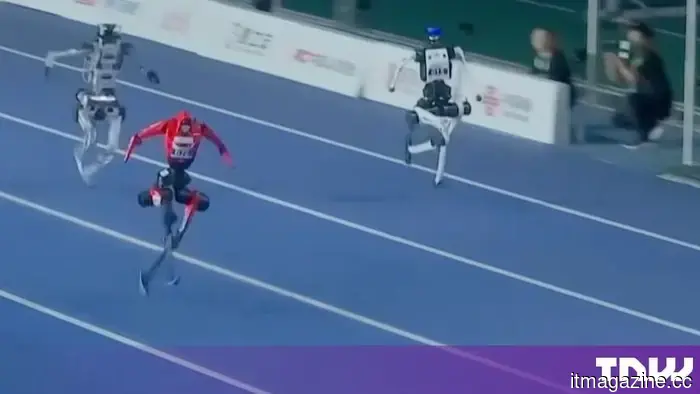 A humanoid robot has surpassed Usain Bolt’s 100m record, but roboticists are not particularly impressed, and for valid reasons.
A humanoid robot completed a 100m dash in 9.39 seconds in Beijing. Experts in robot construction claim that sprinting is actually the simpler aspect of the challenge.
A humanoid robot has surpassed Usain Bolt’s 100m record, but roboticists are not particularly impressed, and for valid reasons.
A humanoid robot completed a 100m dash in 9.39 seconds in Beijing. Experts in robot construction claim that sprinting is actually the simpler aspect of the challenge.
 Alibaba is securing $10.2 billion and intends to invest the entire amount in AI.
Alibaba is offering HK$80 billion worth of new shares in Hong Kong, with all net proceeds directed towards AI infrastructure, just days after reporting a 75% decline in profit attributed to the same expenses.
Alibaba is securing $10.2 billion and intends to invest the entire amount in AI.
Alibaba is offering HK$80 billion worth of new shares in Hong Kong, with all net proceeds directed towards AI infrastructure, just days after reporting a 75% decline in profit attributed to the same expenses.
Harvey has introduced its initial in-house model for legal work.
Harvey's initial proprietary model, Tenet, has undergone post-training using Kimi K3 from China's Moonshot, establishing a Chinese foundation for work protected by legal privilege.