
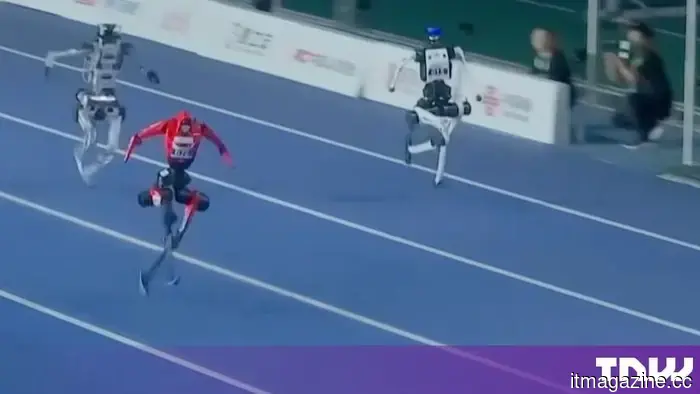
A humanoid robot has surpassed Usain Bolt’s 100m record, but roboticists are not particularly impressed, and for valid reasons.
A robot created by X-Humanoid from Beijing took 100 meters in 9.39 seconds at the World Humanoid Robot Games, surpassing Usain Bolt's record of 9.58 seconds. Experts in robotics emphasize that achieving speed on a defined track is much simpler for a machine than performing tasks like folding laundry.
This robot is the fastest to cover the 100 meters, completing it in 9.39 seconds during the second World Humanoid Robot Games, beating Bolt’s 2009 time of 9.58 seconds. It wasn't just human speed records that were broken; the same company’s robot jumped 2.88 meters in the high jump, exceeding Javier Sotomayor's 2.45 meters, while a robot from Honor achieved a time of 9.32 seconds in trials.
The event is significant, featuring over 2,000 robots from 16 nations competing in 51 events at Beijing’s Olympic speed skating venue. The remarkable improvement in performance year after year is notable. In the inaugural games in 2025, Unitree’s H1 completed the 400 meters in 88 seconds, compared to a human record of 43 seconds, with much of the earlier robot activity being remotely controlled—a field that is now evolving thanks to China's smartphone supply chain.
The progress to this stage has involved constructing better sprinters. For instance, Honor extended its robot’s legs by 10 centimeters to 1.05 meters before the competition, targeting a specific performance metric.
Professionals in robotics have been candid about the implications of these advancements. Rodney Brooks, an emeritus professor at MIT and co-founder of iRobot, labeled a previous robot race in Beijing as a "publicity stunt" that lacked practical applications due to safety concerns.
The statistics on autonomy back up his perspective. In the half marathon held in April, just 38% of entries operated autonomously, while the rest were managed remotely, and even the autonomous robots followed pre-determined paths.
Yanran Ding from the University of Michigan precisely identified the misconception: people tend to underestimate the difficulty of tasks like folding laundry compared to running a half marathon, which isn't accurate. Meanwhile, Europe is strategizing based on this misconception.
Alan Fern from Oregon State expresses a similar view, attributing improvements to engineering and investment rather than groundbreaking innovations. He asserts that meaningful advancement entails robots navigating unfamiliar environments.
This is the challenge that European firms have adopted. NEURA Robotics is developing training facilities for robots in disordered physical spaces, while London’s Humanoid secured $152 million, with Bosch set to mass-produce their technology.
However, none of these developments will create a more impactful image than a robot outpacing Bolt. This version of progress is the only one that culminates in a machine accomplishing tasks that humans truly need.
Other articles
 The Blood of Dawnwalker won’t put a strain on your old gaming PC, but your PS5 could face some difficulties.
The PC requirements for The Blood of Dawnwalker are quite reasonable, but console gamers will be restricted to 30fps or 40fps, even on the PS5 Pro.
The Blood of Dawnwalker won’t put a strain on your old gaming PC, but your PS5 could face some difficulties.
The PC requirements for The Blood of Dawnwalker are quite reasonable, but console gamers will be restricted to 30fps or 40fps, even on the PS5 Pro.
 Alibaba is securing $10.2 billion and intends to invest the entire amount in AI.
Alibaba is offering HK$80 billion worth of new shares in Hong Kong, with all net proceeds directed towards AI infrastructure, just days after reporting a 75% decline in profit attributed to the same expenses.
Alibaba is securing $10.2 billion and intends to invest the entire amount in AI.
Alibaba is offering HK$80 billion worth of new shares in Hong Kong, with all net proceeds directed towards AI infrastructure, just days after reporting a 75% decline in profit attributed to the same expenses.
 HP's $600 OmniBook 3 OLED laptop presents itself as an appealing alternative to the MacBook Neo, boasting notable battery performance claims.
HP's newest OmniBook 3 presents a strong argument against the MacBook Neo, featuring OLED, Snapdragon X, and a significantly lower cost.
HP's $600 OmniBook 3 OLED laptop presents itself as an appealing alternative to the MacBook Neo, boasting notable battery performance claims.
HP's newest OmniBook 3 presents a strong argument against the MacBook Neo, featuring OLED, Snapdragon X, and a significantly lower cost.
 AMD's upcoming Medusa APUs are preparing for their release, and Linux has just revealed some details.
AMD has released RDNA 4m firmware for Linux prior to the launch of its Ryzen AI 500 "Medusa Point," providing additional insights into its upcoming Zen 6 APUs.
AMD's upcoming Medusa APUs are preparing for their release, and Linux has just revealed some details.
AMD has released RDNA 4m firmware for Linux prior to the launch of its Ryzen AI 500 "Medusa Point," providing additional insights into its upcoming Zen 6 APUs.
 ChatGPT for iPhone can now access your recent photos with a long press.
OpenAI introduced a long-press shortcut for attaching recent photos in ChatGPT on the iPhone, although Apple's camera assistant remains unavailable in the EU.
ChatGPT for iPhone can now access your recent photos with a long press.
OpenAI introduced a long-press shortcut for attaching recent photos in ChatGPT on the iPhone, although Apple's camera assistant remains unavailable in the EU.
 A lawsuit claims that Oura's sleep stage assessments are merely AI predictions with the same probability as a coin flip.
A proposed class action claims that Oura's sleep stages are merely AI estimates. The Finnish parent company has been named as a defendant, just months ahead of the firm's intended listing in the US.
A lawsuit claims that Oura's sleep stage assessments are merely AI predictions with the same probability as a coin flip.
A proposed class action claims that Oura's sleep stages are merely AI estimates. The Finnish parent company has been named as a defendant, just months ahead of the firm's intended listing in the US.
A humanoid robot has surpassed Usain Bolt’s 100m record, but roboticists are not particularly impressed, and for valid reasons.
A humanoid robot completed a 100m dash in 9.39 seconds in Beijing. Experts in robot construction claim that sprinting is actually the simpler aspect of the challenge.