
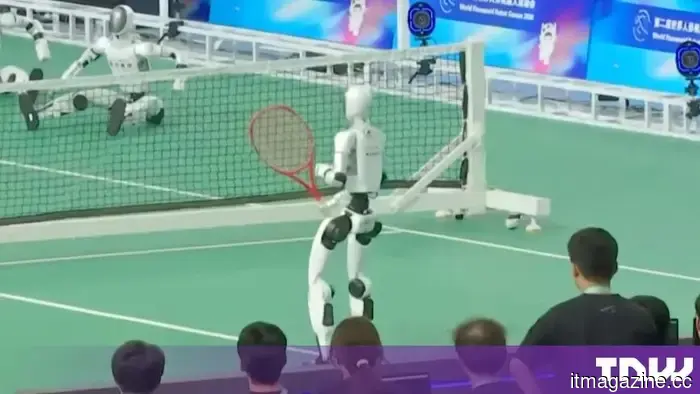
Galbot Robots finish 100 back-to-back rallies with a tennis champion.
Galbot reports that its robot successfully completed over 100 consecutive autonomous tennis rallies with former world number 15 Zheng Jie at the World Humanoid Robot Games in Beijing. The claims about the rally count, the assertion of autonomy, and the robot's identity are based solely on the company's own statements.
On Saturday, a robot engaged in rallies with a former Wimbledon semi-finalist. According to the Beijing-based company Galbot, its robot managed to sustain more than 100 consecutive exchanges with Zheng Jie at the World Humanoid Robot Games, all without teleoperation or a pre-scripted sequence.
This level of performance is noteworthy. Chinese state media indicated that serves exceeded 100 kilometers per hour and reported that the robot fell backward after a high looping shot but managed to right itself within seconds.
Engaging in tennis is a more meaningful test than the sprint records established at the same event. A rally involves tracking a speedy object, planning a full-body response, and adapting to an opponent's movements in a fraction of a second, representing a challenge more aligned with what European robot manufacturers typically tackle than running in a straight line.
Moreover, there are concerns regarding sourcing. The tally of rallies, the context of the world record, and the no-teleoperation assertion all originate from Galbot's press release, which has been echoed by Chinese state broadcasters, without any independent verification or published data on interventions or success rates.
It is worth noting Zheng Jie's credentials. She achieved a career-high ranking of world number 15 and reached the semi-finals at Wimbledon in 2008 before retiring from professional tennis a decade ago.
There is also ambiguity regarding which specific robot was used. None of the sources we found specify the model, and Galbot's commercial robot, the G1, is a wheeled dual-arm manipulator that lacks legs to fall or stand back up.
CGTN mentions that the system was developed in collaboration with Tsinghua University, suggesting that the machine on court may differ from the one Galbot markets.
The G1 serves a more practical purpose, operating in warehouses, hospital pharmacies, and over 30 cities in China under the Galbot Store brand. The company has raised $800 million, achieving a valuation of $3 billion in a sector where competitors have valuations exceeding $2 billion.
Europe is already integrated into this supply chain, with Galbot listing Bosch as one of its partners, alongside CATL, Toyota, and Hyundai.
Interestingly, Bosch finds itself on both sides of this competition, as it is also set to manufacture for Humanoid, a London startup that secured $152 million to develop robots for factory tasks.
Thus, the verifiable aspect of this story lies not on the tennis court but in whether a wheeled robot can restock a pharmacy shelf for an entire year without human intervention, which is the actual product Galbot offers, yet is not something that garners media attention.
Other articles
 AMD's upcoming Medusa APUs are preparing for their release, and Linux has just revealed some details.
AMD has released RDNA 4m firmware for Linux prior to the launch of its Ryzen AI 500 "Medusa Point," providing additional insights into its upcoming Zen 6 APUs.
AMD's upcoming Medusa APUs are preparing for their release, and Linux has just revealed some details.
AMD has released RDNA 4m firmware for Linux prior to the launch of its Ryzen AI 500 "Medusa Point," providing additional insights into its upcoming Zen 6 APUs.
 EXCLUSIVE: Joel Edgerton and Jennifer Connelly hint at ‘beautiful chaos’ in the second season of Dark Matter.
Joel Edgerton and Jennifer Connelly share insights on what viewers can anticipate from the second season of Dark Matter, the dynamics of Jason and Daniela’s relationship, and the possibility of a third season.
EXCLUSIVE: Joel Edgerton and Jennifer Connelly hint at ‘beautiful chaos’ in the second season of Dark Matter.
Joel Edgerton and Jennifer Connelly share insights on what viewers can anticipate from the second season of Dark Matter, the dynamics of Jason and Daniela’s relationship, and the possibility of a third season.
 The design of the Xperia 10 VIII has been revealed, and Sony is not making significant alterations.
A recent leak has revealed Sony's forthcoming Xperia 10 VIII, showcasing a design that closely resembles last year's version.
The design of the Xperia 10 VIII has been revealed, and Sony is not making significant alterations.
A recent leak has revealed Sony's forthcoming Xperia 10 VIII, showcasing a design that closely resembles last year's version.
 The speculated camera-equipped AirPods from Apple may introduce exciting AI functionalities along with several privacy issues.
The speculated AirPods from Apple, which might feature built-in cameras, are expected to incorporate small sensors for AI and Visual Intelligence, yet privacy issues could pose significant challenges for the technology.
The speculated camera-equipped AirPods from Apple may introduce exciting AI functionalities along with several privacy issues.
The speculated AirPods from Apple, which might feature built-in cameras, are expected to incorporate small sensors for AI and Visual Intelligence, yet privacy issues could pose significant challenges for the technology.
 AMD's upcoming Medusa APUs are poised for release, and Linux has just revealed the details.
AMD has released RDNA 4 firmware for Linux prior to the launch of its Ryzen AI 500 “Medusa Point,” providing further details about its upcoming Zen 6 APUs.
AMD's upcoming Medusa APUs are poised for release, and Linux has just revealed the details.
AMD has released RDNA 4 firmware for Linux prior to the launch of its Ryzen AI 500 “Medusa Point,” providing further details about its upcoming Zen 6 APUs.
 The design of the Xperia 10 VIII has been revealed, and Sony is making minimal changes.
The leaked design of Sony's forthcoming Xperia 10 VIII resembles that of last year's version closely.
The design of the Xperia 10 VIII has been revealed, and Sony is making minimal changes.
The leaked design of Sony's forthcoming Xperia 10 VIII resembles that of last year's version closely.
Galbot Robots finish 100 back-to-back rallies with a tennis champion.
Galbot asserts that its robot achieved 100 rallies against a tennis champion without any teleoperation involved. This statement comes from the company itself, and the robot has not been given a name.