
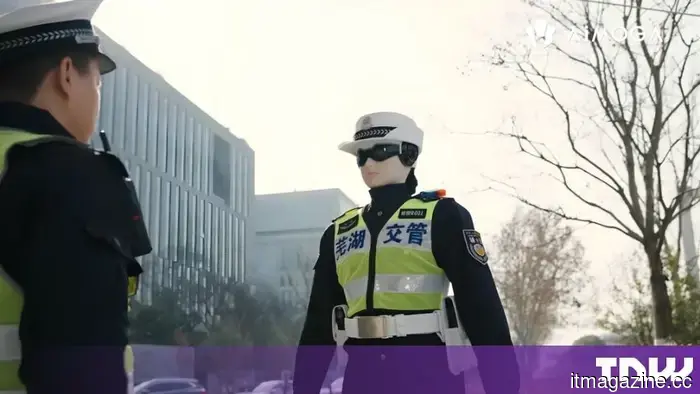
China's robotic traffic police are capable of nearly everything except for pulling you over.
China’s robotic traffic police are capable of directing vehicles, admonishing jaywalkers, and providing lost tourists with directions to the nearest metro station. However, they lack the ability to stop anyone, a limitation intentionally designed rather than left to the machine’s judgment.
The most prominent deployment is in Hangzhou, where local traffic authorities stationed 15 humanoid robots around the West Lake tourist area starting May 1, in anticipation of the Labour Day crowds. State media referred to this as the nation's first robotic traffic police unit, functioning alongside human officers rather than as replacements, a narrative upheld by cities across China since the introduction of the first AI-operated police station.
The scope of their duties is more limited than the term RoboCop might imply. These robots assist in guiding pedestrians and non-motorized vehicle riders to avoid infractions, help regulate traffic flow, and respond to navigation inquiries from tourists by utilizing advanced speech models connected to live traffic data.
They also monitor the situation. Their visual recognition capabilities detect violations in real-time, and the robots signal traffic commands in sync with the traffic light cycles, a feat that becomes notable when considering the tendency of machines to misinterpret complex intersections.
The enforcement aspect is particularly intriguing. When a robot detects an infringement, it does not impose any penalties nor detain individuals; instead, it logs the incident and sends the information to the traffic police bureau’s early warning center, where a human decides on the next steps. This setup renders the robots as high-priced witnesses with commendable posture.
Additionally, this arrangement aligns with Chinese policing laws, which allocate coercive authority to human officers rather than machines, and avoids the dilemma that arises if an autonomous system misidentifies a situation.
Another limitation is operational endurance. The units in Hangzhou function for eight to nine hours daily, indicating a shift rather than continuous surveillance, a notion that early reports may have misrepresented.
The trend is expanding. Xinhua reported in January that AI-driven robots began handling traffic responsibilities in multiple Chinese cities, and by the May holiday, the same news source referred to robotic police patrols as an element of urban management rather than a trial initiative.
The significance of this development lies in the hardware suppliers. China exported tens of thousands of humanoid robots in the first half of this year, with municipal contracts serving as one of the few profitable avenues for these machines, a fact that underpins Unitree’s listing in Shanghai and the overall sector’s valuations.
Robotics companies in China have faced difficulties in finding commercial interest outside of research environments, and the issue of commercialization persists, even if a city acquires 15 units. However, public procurement tends to be more patient compared to consumer markets.
Determining the effectiveness of these machines is more complex than merely confirming their existence. Most accounts concerning the Hangzhou deployment come from state media; there has been no independent assessment of the accuracy of their violation detection, and the traffic bureau hasn’t disclosed how many robot referrals led to penalties.
China has also recently experienced the public failure of autonomous systems, evidenced by over 100 Baidu robot taxis freezing in traffic in Wuhan. By that measure, a robot capable only of submitting reports represents a conservative engineering approach.
There is also a public relations aspect that Beijing has been somewhat transparent about. Placing humanoid robots in uniform along a tourist path is an inexpensive method to visibly promote a domestic industrial program, especially at West Lake during a public holiday, which is about as prominent as it gets in China.
Conversely, every hour a robot spends managing traffic at an intersection translates into real-world data collected under conditions no laboratory can replicate, which is precisely what the sector claims is lacking.
More cities are anticipated to follow Hangzhou's lead, with the currently operational units serving effectively as a field trial for public acceptance. For the time being, the power to arrest remains with the humans.
Other articles
 A professor from Berkeley discussed students who take shortcuts, but her op-ed was flagged by a detector.
An op-ed by a mathematics professor at UC Berkeley regarding declining standards was marked as being partially generated by AI, but she claims that she utilized AI solely for editing purposes.
A professor from Berkeley discussed students who take shortcuts, but her op-ed was flagged by a detector.
An op-ed by a mathematics professor at UC Berkeley regarding declining standards was marked as being partially generated by AI, but she claims that she utilized AI solely for editing purposes.
 Looking to purchase a new Pixel 11? Here are the top cases available right now.
Ranging from a $13.49 magnetic case that offers great value for its cost to Google's own $49.99 official case, these are the Pixel 11 cases that truly made it into my shopping cart.
Looking to purchase a new Pixel 11? Here are the top cases available right now.
Ranging from a $13.49 magnetic case that offers great value for its cost to Google's own $49.99 official case, these are the Pixel 11 cases that truly made it into my shopping cart.
 AI could be acquiring knowledge from countless images without replicating any of them.
A study by MIT reveals that images generated by AI frequently cannot be linked to particular training images, since larger datasets diminish the impact of specific examples.
AI could be acquiring knowledge from countless images without replicating any of them.
A study by MIT reveals that images generated by AI frequently cannot be linked to particular training images, since larger datasets diminish the impact of specific examples.
 Meta, Google, TikTok, and LinkedIn are now subject to an Australian news law, regardless of whether they distribute news content or not.
Australia has implemented a 2.5% levy on the local advertising revenue of Meta, Google, TikTok, and LinkedIn, unless they reach agreements with eight news organizations.
Meta, Google, TikTok, and LinkedIn are now subject to an Australian news law, regardless of whether they distribute news content or not.
Australia has implemented a 2.5% levy on the local advertising revenue of Meta, Google, TikTok, and LinkedIn, unless they reach agreements with eight news organizations.
 A face-recognition tool exposed over 9 million photos without adequate protection.
A security researcher discovered over 9 million facial images stored in an unsecured ClarityCheck database that did not require a password for access.
A face-recognition tool exposed over 9 million photos without adequate protection.
A security researcher discovered over 9 million facial images stored in an unsecured ClarityCheck database that did not require a password for access.
 A "private and secure" facial recognition tool has inadvertently exposed 9 million images.
ClarityCheck, a tool for searching people that claims to offer “private and secure” searches, was discovered by a security researcher to have left over 9 million image files unprotected.
A "private and secure" facial recognition tool has inadvertently exposed 9 million images.
ClarityCheck, a tool for searching people that claims to offer “private and secure” searches, was discovered by a security researcher to have left over 9 million image files unprotected.
China's robotic traffic police are capable of nearly everything except for pulling you over.
In May, Hangzhou deployed 15 humanoid robots to manage traffic. They help direct vehicles and identify violations, but the enforcement remains the responsibility of human officers.