
Alibaba's profit dropped by 75% as its quarterly expenditures on AI reached $10 billion.
Alibaba's net profit dropped by 75% in the June quarter, amounting to $1.54 billion. This decline was not due to poor business performance, but rather the expense associated with building it. Capital expenditures reached $9.98 billion within three months, marking a 75% increase compared to the same quarter last year, as reported in the results announcement. The cloud division, which this spending supports, reported a segment profit that surged by 133%.
Revenue increased by 9% to $39.64 billion, slightly exceeding the LSEG consensus forecast of RMB268.88 billion, according to CNBC. However, free cash flow moved in the opposite direction, showing an outflow of $6.58 billion, compared to $2.77 billion a year prior. Following the market opening, Alibaba's shares in the US fell by approximately 5%.
The cloud segment is proving successful. AI Cloud and Compute Services generated $7.14 billion in revenue, a year-on-year rise of 45%. This marks the highest growth rate for the division in 22 quarters, as calculated by the South China Morning Post. Revenue from AI-related products within this sector reached $1.82 billion and has increased by triple digits for the twelfth consecutive quarter.
Additionally, the unit was profitable, with adjusted EBITA reaching $830 million, up 133%. Chief Financial Officer Toby Xu stated that the cloud segment's EBITA margin stands at 12%. According to the company, Alibaba Cloud commands the largest share of China's AI cloud market, at 38.1%, based on data from research firm Omdia.
A note of caution regarding comparisons: Alibaba restructured its reporting segments this quarter, integrating its chip division T-Head into the cloud business and creating a new unit for its model labs and consumer AI applications. Year-on-year figures have been adjusted for consistency, but the segments differ from those previously modeled by analysts.
Regarding the increase in capital expenditures, the company cited three main reasons. There were fluctuations in procurement cycles, an addition of CPU-compute capacity in anticipation of customer adoption of AI agents, and rising costs for various chip components impacted by a similar pinch that affected Chinese hardware firms this quarter.
This spending is what resulted in negative cash flow. Property and equipment purchases totaled $9.97 billion, while operating cash flow was $3.38 billion. This situation mirrors what was seen at Meta last quarter, where AI-related capital expenditures led to cash-flow issues, while Microsoft managed to convert similar spending into cloud revenue. Alibaba is currently attempting to do both simultaneously.
On the other hand, the new AI Labs and Applications segment, which includes the model labs, the Qwen consumer app, and the QwenWork agent, reported revenue of $492 million, growing by 16%. However, it experienced a loss of $2.04 billion in adjusted EBITA, compared to a loss of $475 million the previous year. The company attributed this to AI-related investments and the costs associated with running inference for the Qwen app.
Alibaba is not the only company facing such challenges. Tencent also significantly increased its AI spending last week, which unsettled investors. Analysts noted similar concerns; Citigroup pointed out that rising capital expenditures and negative free cash flow could lead to worries regarding capital requirements and investment returns. Bloomberg Intelligence elaborated further, stating that AI will likely continue to suppress returns, rather than enhance them, for leading AI companies in China, with Alibaba’s AI division projected to incur cash losses for the next three years, according to their estimates.
In contrast, Chief Executive Eddie Wu presented a different viewpoint during the analyst call, claiming that the capacity of the AI business to self-fund and sustain itself is improving, thereby increasing confidence in continued investments. He stated that AI has become a vital growth driver for the company.
He provided financial projections, estimating that revenue from AI products could approach $10 billion this quarter, up from around $7.3 billion in the April to June period, as reported by Bloomberg. Executives indicated that the group expects to recover its overall AI investment within the three-year timeframe it initially set for early 2025, with a pledge exceeding RMB380 billion.
The headline figure of a 75% decline can misrepresent the company's situation. Non-GAAP net income, excluding share-based compensation, investment fluctuations, and impairments, fell by 38% to $3.05 billion. The adjusted EBITA of $4.03 billion exceeded expectations. While Nikkei interpreted the quarter as missing estimates, the South China Morning Post viewed it as surpassing expectations, highlighting the differing interpretations of the results.
One figure that was not addressed in the day's coverage was the spike in general and administrative expenses, which rose to 4.7% of revenue from 3.0%. The company explicitly stated that this increase was due to a provision for the €550 million fine imposed by the European Commission under the Digital Services Act. This
Other articles
 Alibaba's profits declined by 75% as its quarterly expenditures on AI reached $10 billion.
Alibaba's expenditure on AI reached $9.98 billion in the June quarter, while profits decreased by 75%. Meanwhile, the cloud division, which incurs costs, achieved a segment profit increase of 133%.
Alibaba's profits declined by 75% as its quarterly expenditures on AI reached $10 billion.
Alibaba's expenditure on AI reached $9.98 billion in the June quarter, while profits decreased by 75%. Meanwhile, the cloud division, which incurs costs, achieved a segment profit increase of 133%.
 Milan's Domyn secures over $1 billion in what is Europe's largest funding round for AI, primarily through debt financing.
Domyn, located in Milan, has secured approximately $1.1 billion, with about 90% of that being debt, to enhance the Colosseum supercomputer it developed in collaboration with Nvidia in southern Italy.
Milan's Domyn secures over $1 billion in what is Europe's largest funding round for AI, primarily through debt financing.
Domyn, located in Milan, has secured approximately $1.1 billion, with about 90% of that being debt, to enhance the Colosseum supercomputer it developed in collaboration with Nvidia in southern Italy.
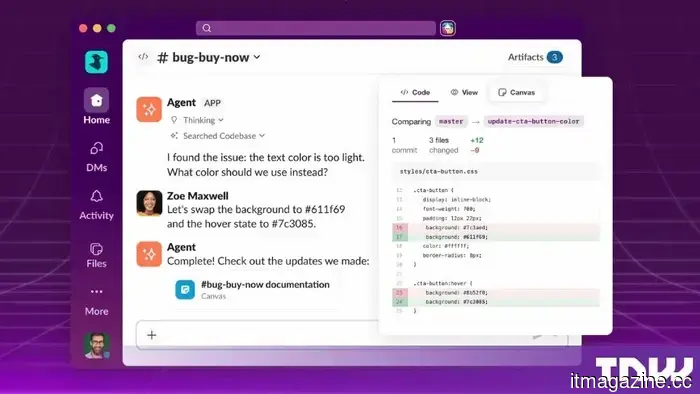 Slack unveils Slack Code, a platform where teams and AI agents collaborate.
Slack Code enables teams and AI agents to collaborate on writing, reviewing, and deploying code within a single channel. Founding partners include Claude, ChatGPT, Devin, and Copilot.
Slack unveils Slack Code, a platform where teams and AI agents collaborate.
Slack Code enables teams and AI agents to collaborate on writing, reviewing, and deploying code within a single channel. Founding partners include Claude, ChatGPT, Devin, and Copilot.
 Android 17 prefers to slow down a single problematic app instead of affecting the performance of your entire phone.
Android 17 implements tougher memory limits for individual apps, which can either slow down or shut down apps that are using excessive memory. This provides Google with a fresh method to safeguard overall phone performance before a single memory-intensive app leads to broader issues.
Android 17 prefers to slow down a single problematic app instead of affecting the performance of your entire phone.
Android 17 implements tougher memory limits for individual apps, which can either slow down or shut down apps that are using excessive memory. This provides Google with a fresh method to safeguard overall phone performance before a single memory-intensive app leads to broader issues.
 Cinemas, educational institutions, and ICE are all prohibiting Meta smart glasses.
Cinemas, US educational institutions, and ICE are all imposing limitations on Meta smart glasses, each for reasons that are unrelated. The regulation in cinemas goes back to 2014.
Cinemas, educational institutions, and ICE are all prohibiting Meta smart glasses.
Cinemas, US educational institutions, and ICE are all imposing limitations on Meta smart glasses, each for reasons that are unrelated. The regulation in cinemas goes back to 2014.
 Alibaba's profits decreased by 75% as its quarterly expenditure on AI reached $10 billion.
Alibaba's expenditure on AI reached $9.98 billion in the June quarter, while profits plummeted by 75%. However, the cloud division it finances reported a segment profit increase of 133%.
Alibaba's profits decreased by 75% as its quarterly expenditure on AI reached $10 billion.
Alibaba's expenditure on AI reached $9.98 billion in the June quarter, while profits plummeted by 75%. However, the cloud division it finances reported a segment profit increase of 133%.
Alibaba's profit dropped by 75% as its quarterly expenditures on AI reached $10 billion.
Alibaba's expenditure on AI reached $9.98 billion in the June quarter, while profits declined by 75%. However, the cloud division, for which it incurs costs, achieved a segment profit increase of 133%.