
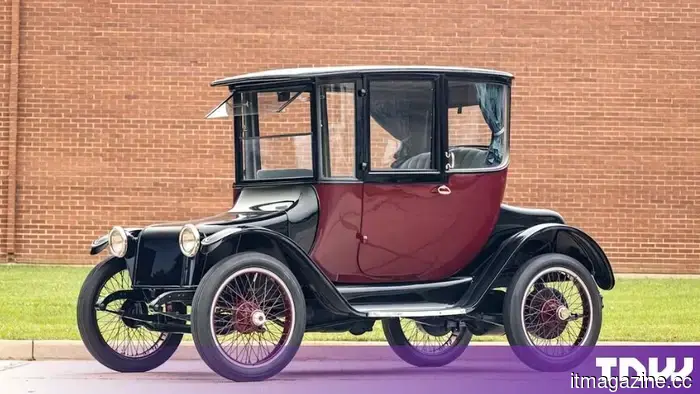
This 1918 electric vehicle was equipped with 42 batteries and offered a greater range than a 2011 Leaf.
A 1918 Detroit Electric Model 75B was auctioned off at Monterey Car Week, boasting an original range of 80 miles, compared to the 73 miles rated for the first Nissan Leaf. The format declined not due to range, but because of the introduction of the electric starter and a price that was five times higher than a Model T.
At the auction, the 1918 Detroit Electric claimed an 80-mile range, while the Nissan Leaf, introduced in 2011, had an EPA rating of 73 miles.
The comparison needs careful consideration. The 80 miles figure was a promotional claim for a vehicle that had a maximum speed of 20 mph, while the Leaf's 73 miles was determined through a standardized testing cycle, and this specific Model 75B has since been updated with modern batteries.
The original design was not unique. According to the auction description, the vehicle used forty-two lead-acid batteries—21 in the front and 21 in the rear—powering a single 4.28 horsepower motor positioned beneath the floor and operating the rear differential.
There was no traditional steering wheel. Instead, a long lever was used for steering and a shorter one for adjusting speed, both of which could be conveniently folded away when parked.
Detroit Electric was a legitimate manufacturer with actual orders. The Anderson Electric Car Company produced approximately 13,000 vehicles from 1907 to 1939, selling 1,000 to 2,000 cars annually at its peak, with notable customers including Thomas Edison, John D. Rockefeller Jr., and Clara Ford.
There were instances when the vehicles exceeded their marketing claims. One test car achieved 211.3 miles on a single charge, a distance that a modern city car would find acceptable, illustrating that range may not be as significant to buyers as they tend to think.
Distance was not what led to their downfall. It was Cadillac's introduction of an electric self-starter in 1912, eliminating the crank handle, which had been a primary practical reason for choosing electric cars.
Price was a significant factor as well. The Model 75 was priced at $2,175 in 1918, while a Model T touring car cost $450 and a runabout was $435, making the electric vehicle roughly five times more expensive.
Thus, it was the availability of inexpensive gasoline and lower-priced competitors, rather than a failure of technology, that contributed to this decline. This is a question that TNW was still pondering a century later, during a time when electric cars were not yet mainstream.
Detroit Electric delivered its final vehicle on February 23, 1939, continuing to produce electric cars for 27 years after the supposed demise of the market due to starter motors, indicating how slowly market trends evolve.
The current state of the market reflects this. This year, U.S. electric vehicle prices saw their first increase as incentives decreased, with cost once again becoming a more critical factor than the specifications listed on paper.
Other articles
 China is eliminating Microsoft’s Windows 10 from government agencies.
According to Bloomberg, China's Ministry of State Security has instructed state agencies to remove a customized version of Windows 10 earlier than planned.
China is eliminating Microsoft’s Windows 10 from government agencies.
According to Bloomberg, China's Ministry of State Security has instructed state agencies to remove a customized version of Windows 10 earlier than planned.
 Google and the UK will guide aircraft to avoid contrails in the Atlantic.
Operation Blue Skies is a UK initiative utilizing Google's AI to navigate North Atlantic aircraft around warming contrails. It will take place over two winter seasons starting in 2026.
Google and the UK will guide aircraft to avoid contrails in the Atlantic.
Operation Blue Skies is a UK initiative utilizing Google's AI to navigate North Atlantic aircraft around warming contrails. It will take place over two winter seasons starting in 2026.
 SK Hynix will repurchase $28.6 billion of its own shares, marking the largest buyback in the history of Korean corporations.
SK Hynix has authorized a 40 trillion won ($28.6 billion) share repurchase, marking the largest buyback by a publicly traded company in Korea, after a record-breaking quarter did not boost its stock price.
SK Hynix will repurchase $28.6 billion of its own shares, marking the largest buyback in the history of Korean corporations.
SK Hynix has authorized a 40 trillion won ($28.6 billion) share repurchase, marking the largest buyback by a publicly traded company in Korea, after a record-breaking quarter did not boost its stock price.
 China is eliminating Microsoft’s Windows 10 from governmental departments.
China's Ministry of State Security has instructed state agencies to remove a tailored version of Windows 10, according to Bloomberg, and this action has been taken sooner than expected.
China is eliminating Microsoft’s Windows 10 from governmental departments.
China's Ministry of State Security has instructed state agencies to remove a tailored version of Windows 10, according to Bloomberg, and this action has been taken sooner than expected.
 ChatGPT is introducing a version for teenagers, and I have many questions.
Teenagers are currently utilizing AI for their homework and beyond. OpenAI's latest ChatGPT experience aims to ensure that they are genuinely learning from it — with significant safeguards in place.
ChatGPT is introducing a version for teenagers, and I have many questions.
Teenagers are currently utilizing AI for their homework and beyond. OpenAI's latest ChatGPT experience aims to ensure that they are genuinely learning from it — with significant safeguards in place.
 Medly AI secures $8 million to place an AI tutor in front of every student taking exams in the UK.
Medly AI has secured an $8 million seed round, led by Felix Capital, just weeks after obtaining a £300,000 contract from the UK government to trial AI tutoring for students who are lagging behind.
Medly AI secures $8 million to place an AI tutor in front of every student taking exams in the UK.
Medly AI has secured an $8 million seed round, led by Felix Capital, just weeks after obtaining a £300,000 contract from the UK government to trial AI tutoring for students who are lagging behind.
This 1918 electric vehicle was equipped with 42 batteries and offered a greater range than a 2011 Leaf.
A 1918 Detroit Electric advertised at Monterey boasted a range of 80 miles, surpassing that of the first Nissan Leaf. The factor that led to its downfall was its price, rather than its range.