
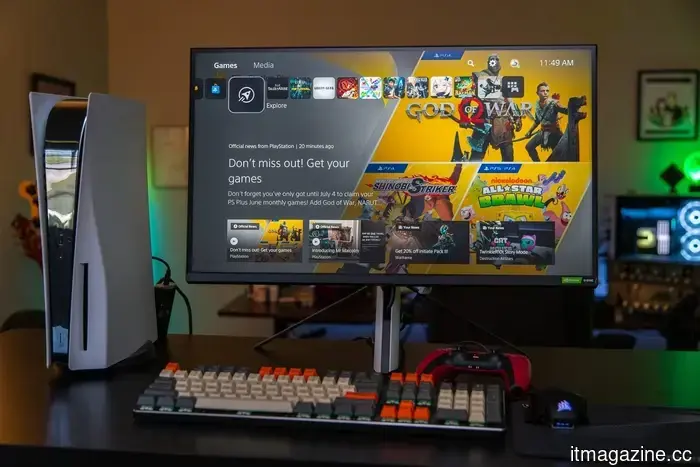
I don't believe that eliminating PlayStation discs will lead to lower game prices.
There’s an optimistic perspective circulating regarding Sony’s choice to discontinue physical PlayStation game discs: perhaps the cost of digital games will finally decrease. Jacob Navok, the former business development director at Square Enix, suggests that by eliminating manufacturing and distribution expenses, along with increasing competition among publishers, digital prices could drop, creating a Steam-like marketplace on the PlayStation Store.
Navok asserts that pricing pressure arises from competition among publishers rather than rivalry between digital stores. This is because publishers set the prices on digital storefronts. Competition between platforms like Epic Games Store and Steam benefits developers by improving their revenue shares, but it doesn't directly affect consumer prices.
While this theory is intriguing, I remain skeptical, particularly regarding PlayStation.
The Steam analogy falls short
The primary flaw in Navok’s reasoning is that PlayStation operates distinctly from Steam.
Steam is situated in a much more open PC environment. Customers can purchase games from Steam, the Epic Games Store, GOG, the Microsoft Store, and numerous other authorized retailers. If a publisher sets a game’s price too high at one location, alternative stores can vie for that customer's business.
PlayStation, however, does not function in this manner. There is no Epic Games Store for PS5, no GOG equivalent, and no authorized third-party digital marketplace where PS5 games can be offered at lower prices. When a gamer chooses to buy a digital PS5 game, Sony has sole control over the storefront conducting that transaction. This is a crucial difference—publisher competition exists, but storefront competition does not on PlayStation.
Digital savings don’t guarantee consumer benefits
Another significant issue with this argument is that digital games are already available alongside physical versions.
A digital copy does not require a disc to be manufactured, packaged, shipped, or displayed at a retailer. These costs have already been eliminated, yet a new digital PS5 game can still be priced the same as its physical counterpart. So, what would lead to a drop in price if the physical version is phased out?
Companies do not typically reduce costs out of a sense of compassion for their customers; they do so to enhance profit margins.
Of course, it’s possible that publishers might choose to pass a larger portion of these savings on to consumers. However, they could just as easily use the increased margins to enhance their profits, support rising development costs, or maintain current launch prices.
Physical games have a broader role than assumed
This is where the move away from physical media raises particular concerns.
A physical game serves a purpose beyond being just an alternative format. It also participates in a secondary market. Players have the ability to sell games, purchase them used, lend them to others, trade them in, or seek out discounted copies. This creates an additional layer of price competition around the official launch price that digital games cannot replicate. Retailers also have incentives to discount physical games that digital storefronts lack. For instance, if Spider-Man 2 has been on store shelves for six months, a retailer might lower the price to clear inventory.
The PlayStation Store does not face such issues. Sony doesn’t need to clear digital stock to make way for new arrivals. A digital copy can remain available indefinitely at whatever price Sony and the publisher decide. This is why I believe that physical games actually afford consumers more leverage than recognized.
Sony’s history does not build trust
Then we have Sony’s own track record. The company has faced significant legal challenges regarding its dominance in digital PlayStation game sales.
The Dutch consumer group Stichting Massaschade & Consument claims that Sony’s exclusive control of the PlayStation Store has led consumers to pay inflated prices, with their campaign arguing that digital games and DLC can be as much as 47% pricier than physical versions. While these claims are yet to be substantiated in court, the case is gaining traction alongside other antitrust actions—including Alex Neill’s UK class action, regulatory investigations in Portugal, and U.S. litigation challenging Sony’s closed storefront policies.
Now, contrasting this with Sony’s announcement to stop producing physical discs for new PlayStation games in January 2028 raises flags. Sony states that this shift aligns with the industry’s movement toward digital media, assuring that new games will still be available digitally through the PlayStation Store and physical retailers.
This does not instill much confidence that Sony will be inclined to share any savings with gamers.
Additionally, Sony’s recent pricing experiments complicate matters further. Reports indicate that Sony has been conducting A/B tests where different users receive varying prices or discounts for the same games. These experiments have reportedly included over 190 titles across more than 70 regions, including Sony’s own games.
To clarify, these experiments do not prove Sony plans to raise prices for everyone. However, they highlight an important point: a digital storefront grants Sony considerably more control over game pricing and promotions. Moving entirely away from physical media may not only provide opportunities for cheaper games but could also facilitate much more complex pricing strategies.
Concerns about ownership

Other articles
 The United States is poised to force its allies to choose a side in the AI cold war.
A leaked letter from the State Department alerts 35 allied nations that they cannot participate in both American and Chinese AI initiatives, transforming the Pax Silica agreement into a measure of loyalty.
The United States is poised to force its allies to choose a side in the AI cold war.
A leaked letter from the State Department alerts 35 allied nations that they cannot participate in both American and Chinese AI initiatives, transforming the Pax Silica agreement into a measure of loyalty.
 Alibaba is divesting its Lingxi games division to finance a complete investment in AI.
Alibaba is divesting its gaming subsidiary Lingxi Games to private-equity firm Trustar Capital in a transaction worth between $1.5 billion and $2 billion, to fund its transition towards AI and cloud technologies.
Alibaba is divesting its Lingxi games division to finance a complete investment in AI.
Alibaba is divesting its gaming subsidiary Lingxi Games to private-equity firm Trustar Capital in a transaction worth between $1.5 billion and $2 billion, to fund its transition towards AI and cloud technologies.
 The vacation pictures you share may assist scammers in pinpointing your exact location.
Artificial intelligence can detect locations from vacation pictures shared on Instagram and Facebook, which provides scammers with sufficient data to craft believable phishing messages related to travel and credit card activity.
The vacation pictures you share may assist scammers in pinpointing your exact location.
Artificial intelligence can detect locations from vacation pictures shared on Instagram and Facebook, which provides scammers with sufficient data to craft believable phishing messages related to travel and credit card activity.
 The SafePal breach exposes the addresses, but doesn't compromise the cryptocurrency, which could be the more significant issue.
SafePal, the cryptocurrency wallet creator backed by Binance, has revealed a security breach that has compromised the names and physical addresses of almost 40,000 customers, increasing the risks of phishing and physical attacks.
The SafePal breach exposes the addresses, but doesn't compromise the cryptocurrency, which could be the more significant issue.
SafePal, the cryptocurrency wallet creator backed by Binance, has revealed a security breach that has compromised the names and physical addresses of almost 40,000 customers, increasing the risks of phishing and physical attacks.
 Alibaba divests its Lingxi games division to finance a comprehensive investment in AI.
Alibaba is divesting its gaming subsidiary Lingxi Games to the private-equity firm Trustar Capital in a transaction worth between $1.5 billion and over $2 billion, to support its shift towards AI and cloud initiatives.
Alibaba divests its Lingxi games division to finance a comprehensive investment in AI.
Alibaba is divesting its gaming subsidiary Lingxi Games to the private-equity firm Trustar Capital in a transaction worth between $1.5 billion and over $2 billion, to support its shift towards AI and cloud initiatives.
 Robotic firms are transitioning into AI companies as AgiBot unveils the emerging dynamics of competition in embodied AI.
Reflecting on a few years ago, the competition among companies producing humanoid robots appeared fairly simple: the one that could create a robot had an opportunity to
Robotic firms are transitioning into AI companies as AgiBot unveils the emerging dynamics of competition in embodied AI.
Reflecting on a few years ago, the competition among companies producing humanoid robots appeared fairly simple: the one that could create a robot had an opportunity to
I don't believe that eliminating PlayStation discs will lead to lower game prices.
A former executive from Square Enix claims that discontinuing PlayStation discs could lower the prices of digital games, yet Sony's restricted storefront and pricing trials indicate the opposite.