
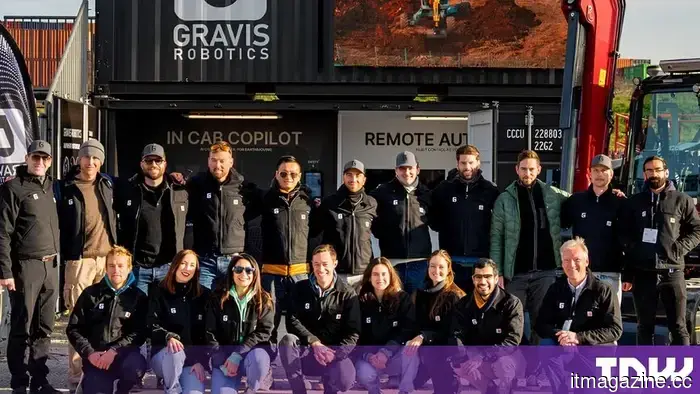
Gravis Robotics has secured $200 million in a Series A funding round, which was led by SoftBank.
Gravis Robotics, a spinout from ETH Zurich that develops software enabling excavators and diggers to operate autonomously, has secured a $200 million Series A investment led by SoftBank, which it claims is the largest funding round in the construction robotics sector to date. This agreement confirms earlier reports that the conglomerate, headed by Masayoshi Son, was interested in the fledgling company.
Founded in 2022 and based in Zürich, with additional locations in Austin and Oxford, Gravis does not manufacture its own machinery. Instead, it creates the technology that can be attached to existing machines: a retrofitting control kit named Gravis Rack, and an assistance system called Gravis Copilot, which together can convert a varied fleet of diggers into autonomous or semi-autonomous vehicles.
The software is marketed as being compatible across various manufacturers, claiming functionality with equipment from brands such as Caterpillar, John Deere, Volvo, JCB, Hitachi, and others, thus avoiding the limitation of a single-brand dependency. The company emphasizes that while most robotics teaches machines to navigate the environment without making alterations, construction requires an opposite approach: the primary task is to modify the terrain.
Gravis asserts that its models are extensively trained in simulation to address the well-known “sim-to-real” challenge, enabling an excavator to operate with near factory-level precision even on challenging and unpredictable sites. It claims productivity improvements of up to 30% compared to manual operations, deployments on four continents, and participation in an $8 million UK-government-supported autonomy initiative with the plant-hire company Flannery.
For SoftBank, this investment aligns with a larger strategy. Son has spent the last year building what appears to be one of the most ambitious robotics and AI portfolios outside of China, from rumored discussions to support an $800 million funding round for Germany’s Agile Robots to significant investments in data centers and chips. His belief is that “physical AI” will be the next frontier for investment, which necessitates companies like Gravis that create software enabling existing industrial machinery to operate autonomously.
The construction industry serves as an astute testing ground for this concept. It is a trillion-dollar industry facing a persistent shortage of skilled labor, and the risks associated with human operators make the prospect of automation appealing. Furthermore, the repetitive nature of tasks like digging and grading makes it a suitable candidate for automation.
A retrofitting kit also circumvents one of the most challenging aspects of robotics—developing reliable hardware from the ground up—by utilizing machinery that is already trusted within the sector, allowing Gravis to integrate into existing fleets without requiring operators to abandon their current equipment.
While the company claims to have achieved “the largest Series A in construction robotics history” and offers promises of “up to 30% productivity gains,” these assertions are crafted in the context of funding announcements and a significant improvement observed on a controlled site may not reflect average performance across diverse conditions. Additionally, autonomous heavy machinery faces considerable challenges regarding safety, liability, and regulation, which cannot be resolved overnight, regardless of venture capital backing.
There’s also a cautionary note regarding SoftBank's investment history. Son’s track record in robotics has not been flawless; for instance, the consumer robot Pepper was discreetly phased out, and the company’s tendency to issue large investments has led to a mix of both outstanding successes and significant failures.
A $200 million Series A investment signals strong belief in Gravis and may serve as a preemptive measure to secure a promising team before competitors can intervene, but it nonetheless represents a wager on a market that has long promised full autonomy yet has only delivered it incrementally. Nevertheless, the trend is clear: with the influx of funds targeting physical AI—from affordable Chinese humanoids to warehouse automation and now self-driving excavators—SoftBank aims to be the leading investor, even as Son expresses skepticism about the term “bubble.”
Ultimately, the pressing question for the upcoming years, and a substantial portion of that capital, will be whether Gravis can transform this $200 million endorsement into effective autonomous diggers that can consistently operate across numerous complex job sites.
Other articles
 Instagram has restricted the search terms, but its algorithm continues to display the videos regardless.
Instagram pledged to eliminate videos featuring harassment related to Meta glasses. However, after a month, many of these videos remain online, and Reels has started recommending them without any prompt.
Instagram has restricted the search terms, but its algorithm continues to display the videos regardless.
Instagram pledged to eliminate videos featuring harassment related to Meta glasses. However, after a month, many of these videos remain online, and Reels has started recommending them without any prompt.
 Instagram has restricted the search terms, but its algorithm still delivers the videos.
Instagram committed to eliminating harassment videos featuring Meta glasses. A month later, many are still available, and Reels now suggests them without any prompting.
Instagram has restricted the search terms, but its algorithm still delivers the videos.
Instagram committed to eliminating harassment videos featuring Meta glasses. A month later, many are still available, and Reels now suggests them without any prompting.
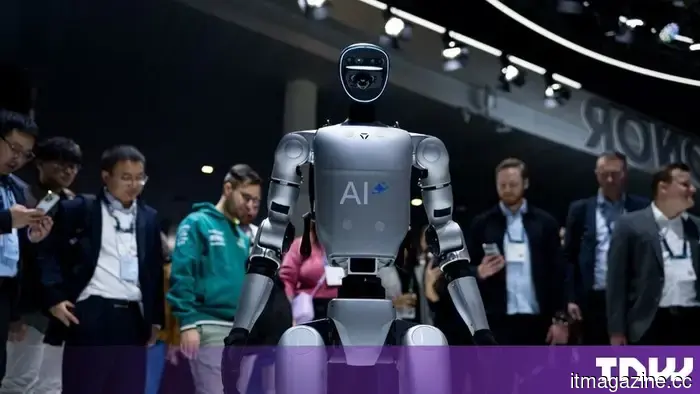 Unitree, the leading humanoid robot company in China, is set to be listed in Shanghai on August 19 following unprecedented demand.
Unitree Robotics is set to launch on Shanghai’s STAR Market on August 19, with an estimated valuation of nearly $9 billion after raising approximately 6.1 billion yuan.
Unitree, the leading humanoid robot company in China, is set to be listed in Shanghai on August 19 following unprecedented demand.
Unitree Robotics is set to launch on Shanghai’s STAR Market on August 19, with an estimated valuation of nearly $9 billion after raising approximately 6.1 billion yuan.
 MelGeek MADE68 Ultra V2 Review: Excellent for gaming and surprisingly better than anticipated for typing.
After a month of daily usage, I was impressed by the gaming performance and software of the MADE68 Ultra V2, but the most surprising aspect was its typing experience.
MelGeek MADE68 Ultra V2 Review: Excellent for gaming and surprisingly better than anticipated for typing.
After a month of daily usage, I was impressed by the gaming performance and software of the MADE68 Ultra V2, but the most surprising aspect was its typing experience.
 The AI mathematical advancements that are frequently referenced are counterexamples rather than proofs.
Fields medalist Timothy Gowers asserts that the renowned AI mathematics findings surfaced as counterexamples rather than proofs. In fact, one of them is not even that.
The AI mathematical advancements that are frequently referenced are counterexamples rather than proofs.
Fields medalist Timothy Gowers asserts that the renowned AI mathematics findings surfaced as counterexamples rather than proofs. In fact, one of them is not even that.
 Synchrony aims to integrate your Amazon and Walmart store cards into ChatGPT.
Synchrony is collaborating with OpenAI to enable shoppers to make payments using store cards within ChatGPT, but one of its executives stated that the integration process could take as long as a year.
Synchrony aims to integrate your Amazon and Walmart store cards into ChatGPT.
Synchrony is collaborating with OpenAI to enable shoppers to make payments using store cards within ChatGPT, but one of its executives stated that the integration process could take as long as a year.
Gravis Robotics has secured $200 million in a Series A funding round, which was led by SoftBank.
Gravis Robotics, a spinout from ETH Zurich, has secured a $200 million Series A funding round, led by SoftBank. This fundraising is touted as the largest ever in the construction robotics sector and aims to implement self-driving software on excavators from companies like Caterpillar and Volvo.