
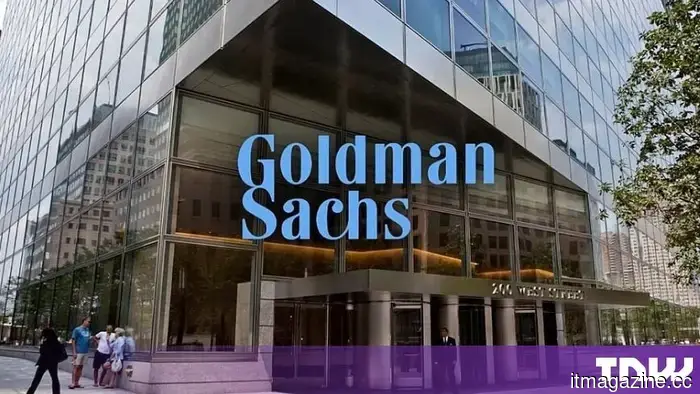
Goldman Sachs is seeking investors for Nvidia's $500 billion financing agreement related to AI computing.
Goldman Sachs has obtained the position that every Wall Street firm desired and is currently making calls. The bank is engaged in discussions with investors regarding Nvidia’s $500 billion AI-compute financing agreement, having secured a coveted mandate that places it as the primary and for now, almost exclusive, lender involved in one of the largest infrastructure funding initiatives the sector has ever seen.
This mandate did not come about by chance. Goldman has a longstanding relationship with Nvidia, having led the chipmaker’s $25 billion bond issuance in June 2025, and this prior connection played a key role in positioning it at the forefront of a project that is central to the current collaborative effort among six firms to finance AI development.
Goldman’s involvement spans its various business sectors. The bank is providing junior capital and private credit through its asset management division, while its investment bankers are working to place the debt in private credit funds and ultimately in public debt markets.
The bank is in discussions with U.S. insurers, money managers, other banks, asset managers, and private credit firms, and it intends to retain a significant share of the paper itself.
The intelligent aspect, which might raise doubts among skeptics, is the structure. The deal aims to establish an asset-backed market for AI compute, allowing the debt to be traded like a conventional security and potentially reducing funding costs. This represents a clear shift from previous AI infrastructure agreements, which relied heavily on vendor guarantees rather than establishing a legitimate tradable market.
In simpler terms, Goldman is attempting to convert Nvidia’s chips into a distinct asset class. Just as mortgages were once bundled into securities for investors to buy and sell, the plan is to package the machines operating within data centers into instruments that act like bonds, complete with a secondary market and, as the idea goes, lower borrowing costs for all involved.
Such comparisons may not be favorable to those old enough to recall what transpired the last time a bank claimed that an unproven asset would trade as securely as a government bond.
The broader initiative was revealed on August 10. The $500 billion platform is a collaboration between Apollo, BlackRock, Blackstone, Brookfield, Goldman Sachs, and KKR, aimed at mobilizing third-party capital instead of locking up the founders’ own balance sheets.
Nvidia, now valued at approximately $5.2 trillion, isn’t just a passive participant; Jensen Huang has indicated that the company has the option to backstop up to $125 billion, or 25%, of the potential deals.
David Solomon, Goldman’s CEO, openly described how this arrangement materialized. “Jensen came, approached us with the idea, and we said we’d love to talk to you about it," he shared with CNBC, reflecting what any banker would likely say about a lucrative mandate coming their way.
The fees are a significant factor in this scenario. By being at the core of the AI debt boom, Goldman benefits from the origination, structuring, placement, and whatever it retains on its balance sheet, creating a variety of income streams that renders the arrangement genuinely desirable and largely buffered, regardless of the ultimate outcome of the underlying investment in compute.
This situation, however, is inevitably financial engineering that causes unease among European observers.
The AI economy is increasingly interconnected through cycles where the same few companies finance, supply, and guarantee one another, a trend already evident when Nvidia sought to secure $250 billion of OpenAI data-center debt while its equity investments exceeded $40 billion this year.
The market has already shuddered once; Nvidia’s $750 billion of announced AI agreements recently elevated its own credit-default swaps to an all-time high, subtly indicating that even the chipmaker’s supporters are factoring in the risk that this interconnected network might not hold.
Goldman’s role, in essence, is to render that risk tradable. Whether it appears safe is a question that prospective buyers will need to resolve themselves.
Other articles
 The Pixel 11 Pro is an impressive device, and its camera has finally inspired me to try new things.
Hands-on with the Google Pixel 11 Pro and Pixel 11 Pro XL: Initial thoughts on Google’s latest flagship devices.
The Pixel 11 Pro is an impressive device, and its camera has finally inspired me to try new things.
Hands-on with the Google Pixel 11 Pro and Pixel 11 Pro XL: Initial thoughts on Google’s latest flagship devices.
 Apple developed its own AI model for China and then provided the technology to Alibaba.
Apple, with assistance from Alibaba, has developed a large language model exclusively for China, making it the first foreign company authorized to provide a proprietary AI model in mainland China.
Apple developed its own AI model for China and then provided the technology to Alibaba.
Apple, with assistance from Alibaba, has developed a large language model exclusively for China, making it the first foreign company authorized to provide a proprietary AI model in mainland China.
 Goldman Sachs is reaching out to investors regarding Nvidia's $500 billion financing arrangement for AI computing.
Goldman Sachs is seeking investors for Nvidia's $500 billion AI-compute financing arrangement after securing a leading position, and it aims to develop chips into a tradable asset class akin to bonds.
Goldman Sachs is reaching out to investors regarding Nvidia's $500 billion financing arrangement for AI computing.
Goldman Sachs is seeking investors for Nvidia's $500 billion AI-compute financing arrangement after securing a leading position, and it aims to develop chips into a tradable asset class akin to bonds.
 Pixel 11 Pro Fold vs. Galaxy Z Fold 8 Ultra: Google takes a cautious approach while Samsung fully commits.
The Pixel 11 Pro Fold and Galaxy Z Fold 8 Ultra pursue different approaches to achieve a similar objective. Here’s a comparison to help you decide which foldable suits you better.
Pixel 11 Pro Fold vs. Galaxy Z Fold 8 Ultra: Google takes a cautious approach while Samsung fully commits.
The Pixel 11 Pro Fold and Galaxy Z Fold 8 Ultra pursue different approaches to achieve a similar objective. Here’s a comparison to help you decide which foldable suits you better.
 Silver Lake is said to be in discussions to acquire Workday and take it private for $43 billion.
Silver Lake is said to be negotiating to acquire Workday and take it private for approximately $43 billion, which would make it one of the biggest software buyouts in history and the first significant take-private deal involving a prominent SaaS company.
Silver Lake is said to be in discussions to acquire Workday and take it private for $43 billion.
Silver Lake is said to be negotiating to acquire Workday and take it private for approximately $43 billion, which would make it one of the biggest software buyouts in history and the first significant take-private deal involving a prominent SaaS company.
 OpenAI’s new Ultrafast mode operates GPT-5.6 Sol at a speed 14 times quicker, utilizing Cerebras chips.
OpenAI has unveiled Ultrafast, an API tier that operates GPT-5.6 Sol at speeds of up to 14 times faster on Cerebras hardware, claiming that latency, in addition to intelligence, is crucial for the usability of AI agents.
OpenAI’s new Ultrafast mode operates GPT-5.6 Sol at a speed 14 times quicker, utilizing Cerebras chips.
OpenAI has unveiled Ultrafast, an API tier that operates GPT-5.6 Sol at speeds of up to 14 times faster on Cerebras hardware, claiming that latency, in addition to intelligence, is crucial for the usability of AI agents.
Goldman Sachs is seeking investors for Nvidia's $500 billion financing agreement related to AI computing.
Goldman Sachs is seeking investors for Nvidia's $500 billion AI-compute financing arrangement after securing a leadership position, with the aim of transforming chips into a tradable asset class similar to bonds.