
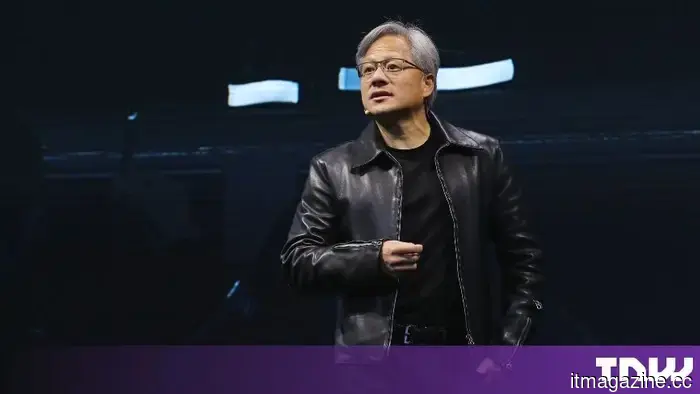
Nvidia reassures its credit market following Jensen Huang's clarification of the $500 billion financing strategy.
The chip manufacturer’s credit-default swaps soared to unprecedented levels due to concerns over circular financing. They calmed down after Jensen Huang reframed the plan as involving other people's money, thus limiting Nvidia's own exposure.
Following several weeks during which the cost of insuring its debt reached all-time highs amidst fears of so-called circular financing, that cost subsided when CEO Jensen Huang clarified how his $500 billion strategy for funding the AI expansion actually functions.
Nvidia's five-year credit-default swaps, essentially bets on the likelihood of the company failing to meet its debt obligations, rose from approximately 40 basis points at the beginning of the month to a record near 82 in late July, marking the largest single-day fluctuation since the contract began trading. Concurrently, its shares dropped nearly 5%, momentarily costing Nvidia its title as the world's most valuable company. As previously mentioned during the initial tremors in its credit market, traders were unsettled by the extensive nature of Nvidia’s connections with its customers.
Nvidia has been acquiring equity stakes in, and providing debt guarantees to, the very firms that utilize its chips, with reported amounts extending to a $250 billion backstop for OpenAI’s Ohio data centers and tens of billions in AI equity investments, all of which boosts demand for its hardware. According to Bloomberg, Nvidia announced around $540 billion in such arrangements this year alone, and both the IMF and the Bank for International Settlements have identified this trend as a potential systemic risk.
The $500 billion platform, formalized this week with major financial players such as Apollo, BlackRock, Blackstone, Brookfield, Goldman Sachs, and KKR, utilizes third-party capital rather than Nvidia's own funds. This allows AI labs, companies, and cloud providers to lease GPUs and construct data centers without reflecting those assets on their balance sheets. With six finance giants backing the initiative, each conducts its own due diligence, and Nvidia limits its residual-value support to a maximum of 25% on certain agreements, which Huang asserted is significantly lower than typical compute-financing deals.
The proposal is based on an ambitious concept: that a graphics chip has now become a financial asset in its own right. “This is really the first time that technology chips are an investable asset class,” said Jensen Huang, characterizing them as revenue-generating, durable, fungible, and adaptable enough for lenders to underwrite similarly to real estate.
Goldman Sachs' David Solomon called it a new credit market supported by Nvidia compute, while BlackRock's Larry Fink likened it to the inception of mortgage-backed securities in the 1970s. However, that analogy carries risks, as mortgage-backed securities also contributed to the 2008 financial crisis.
Short-seller Jim Chanos compared the structure to financial engineering prior to the crisis, while Michael Burry, known for his role in "The Big Short," contended that the rapid depreciation of chips renders the residual-value assumptions more precarious than they appear. Meanwhile, the Bank of England has cautioned about heavily leveraged AI firms and the opaque nature of banks' indirect exposure to them.
Nevertheless, the clarification served its purpose in the short term. By asserting that the $500 billion represents a cumulative, multi-year objective rather than Nvidia’s revenue or a singular fund, and by indicating that both the capital and the majority of the risk lie with outside investors, Jensen Huang provided the credit market with a reason to relax, which it subsequently did.
For a company whose valuation now hinges equally on confidence as on silicon, this was a significant development. However, the underlying concern remains unaddressed. The entire framework still relies on the premise that the infrastructure being financed will ultimately generate sufficient returns to validate the trillions being invested, with Morgan Stanley estimating $3.5 trillion in hyperscaler spending through 2028.
Jensen Huang has eased market tensions by suggesting that the risk is disseminated broadly rather than confined to Santa Clara. Whether this reflects true prudence or is merely a more sophisticated iteration of the same cycle is something swap traders will continue to scrutinize.
Other articles
 Oracle is installing a Quantinuum quantum computer within its own data center.
Quantinuum's Helios machine is set to be installed in a data center operated by Oracle Cloud in the US, with a preview service anticipated in the upcoming months.
Oracle is installing a Quantinuum quantum computer within its own data center.
Quantinuum's Helios machine is set to be installed in a data center operated by Oracle Cloud in the US, with a preview service anticipated in the upcoming months.
 Oracle is integrating a Quantinuum quantum computer within its data center.
Quantinuum's Helios machine is set to be installed in a data center of Oracle Cloud in the US, with a preview service expected to launch in the coming months.
Oracle is integrating a Quantinuum quantum computer within its data center.
Quantinuum's Helios machine is set to be installed in a data center of Oracle Cloud in the US, with a preview service expected to launch in the coming months.
 Ryanair has entered into a five-year agreement for AI services with Google Cloud, along with securing a secondary cloud option for backup.
The largest airline in Europe is introducing Gemini Enterprise and Google Workspace to 35,000 employees and is developing a dual-cloud infrastructure.
Ryanair has entered into a five-year agreement for AI services with Google Cloud, along with securing a secondary cloud option for backup.
The largest airline in Europe is introducing Gemini Enterprise and Google Workspace to 35,000 employees and is developing a dual-cloud infrastructure.
 Top HR software featuring predictive turnover analytics for 2026.
Nine HR platforms were evaluated based on their effectiveness in predicting employee turnover. The platforms assessed include HiBob, Visier, Workday, isolved, Paycor, Crunchr, Lattice, BambooHR, and Deel, with ratings given for signal depth, data foundation, and time to value.
Top HR software featuring predictive turnover analytics for 2026.
Nine HR platforms were evaluated based on their effectiveness in predicting employee turnover. The platforms assessed include HiBob, Visier, Workday, isolved, Paycor, Crunchr, Lattice, BambooHR, and Deel, with ratings given for signal depth, data foundation, and time to value.
 Top HR software featuring predictive turnover analytics for 2026.
Nine HR platforms were evaluated based on their ability to anticipate employee turnover. The platforms—HiBob, Visier, Workday, isolved, Paycor, Crunchr, Lattice, BambooHR, and Deel—were assessed on signal depth, data foundation, and time to value.
Top HR software featuring predictive turnover analytics for 2026.
Nine HR platforms were evaluated based on their ability to anticipate employee turnover. The platforms—HiBob, Visier, Workday, isolved, Paycor, Crunchr, Lattice, BambooHR, and Deel—were assessed on signal depth, data foundation, and time to value.
 Spotify will label AI artist profiles and exclude them from your recommendations.
Starting in mid-September, Spotify will be identifying AI-generated artist identities and removing them from both editorial and algorithmic recommendations.
Spotify will label AI artist profiles and exclude them from your recommendations.
Starting in mid-September, Spotify will be identifying AI-generated artist identities and removing them from both editorial and algorithmic recommendations.
Nvidia reassures its credit market following Jensen Huang's clarification of the $500 billion financing strategy.
Nvidia's credit-default swaps surged to an all-time high due to concerns over circular financing. However, they stabilized after Jensen Huang rephrased the $500 billion plan, describing it as third-party capital and limiting Nvidia's exposure.