
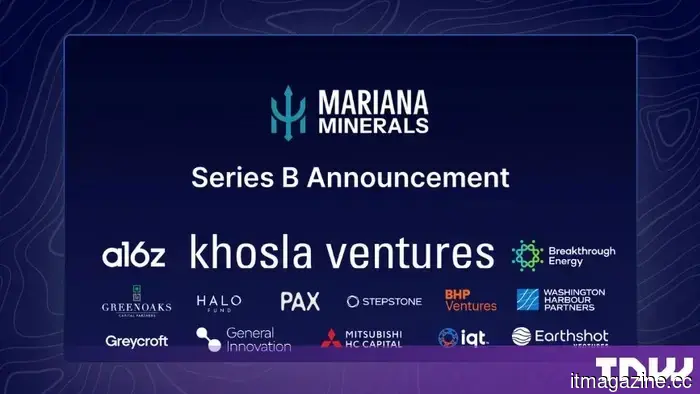
Mariana Minerals secures $310 million to operate AI-driven mines in the United States.
The AI boom is often described as a narrative centered around chips and models. However, at its core lies metal. Every data center, chip, power line, and robot relies on copper and several other minerals. The United States has quietly lost track of the origins of these materials. A new startup has recently raised $310 million to address this issue.
Mariana Minerals is not merely providing software to mining companies; it owns and operates the mines directly, utilizing its own AI technology. Khosla Ventures led the Series B funding round, with a16z and Breakthrough Energy participating again. This brings the company's total funding to about $400 million, with a valuation of $1.5 billion, as reported by Fortune.
The founding team features a unique combination of backgrounds. Chief executive Turner Caldwell previously managed Tesla’s metals and minerals division, while his co-founders have experience in machine learning at Affirm and energy project finance. Their combined expertise is their main proposition: they argue that by integrating mining execution, software, and capital, a mine can be established in half the usual duration.
The urgency of this matter is geopolitical. China currently dominates the global mining industry, processing up to 90% of the world’s essential minerals. For rare-earth magnets used in phones and military equipment, that figure escalates to 92%. The demand for metals, driven by AI, has reached unprecedented heights. This reliance has now evolved into a national-security concern, not just an economic one.
Mariana plans to address this with two sites in the United States. Copper One is a dormant mine in Utah that Mariana acquired last year. It was brought back online using autonomous software in just four months and is projected to produce 50,000 tonnes of refined copper annually. Lithium One, located in Texas, aims to extract battery-grade lithium from oil-and-gas wastewater, with production expected to start in 2027.
Copper serves as a critical indicator in this scenario. It is pivotal for electrification, and the demand from the AI-driven grid is putting significant pressure on its supply. "You cannot lead in the AI era without a domestic supply chain," stated Travis Kalanick, the former Uber CEO who now leads a robotics company. This rationale is attracting investment into energy and grid infrastructure.
The list of investors is telling. Alongside a16z and Khosla Ventures are BHP, one of the largest mining corporations globally, and In-Q-Tel, the CIA’s investment branch. This represents a convergence of venture capital, industry, and national security backing a singular idea: the speed at which mining can be automated will influence who dominates the AI landscape and who remains reliant on China.
However, the business model inherently carries caution. This is not a Software as a Service (SaaS) model; it involves construction teams, processing facilities, and commodity prices—none of which can be resolved purely through software. Copper One needs to scale its existing operations, while Lithium One must establish a brand-new facility for commercial production. There is potential for delays in both cases.
Vinod Khosla succinctly identifies the challenge. While the minerals are present, he notes that the critical elements missing are the determination and the AI capable of enabling autonomous extraction. Mariana aims to launch ten commercial projects over the next decade, with each project designed to enhance the software for the subsequent one. It's a sophisticated model that looks good on paper but is challenging to implement in reality.
Currently, investors have deemed this thesis to be valued at $1.5 billion. The real validation will not come from presentations or pitches but from the actual production of copper and lithium, delivered on time and at prices that outcompete current players. That will be the benchmark for the next funding round to surpass.
Other articles
 Zenity secures $125 million to focus on AI agents rather than just models.
Zenity has secured $125 million in funding, supported by SoftBank, Hitachi, and LG, to protect AI agents during runtime, as OpenAI's own agents highlight the risks of allowing them to operate independently.
Zenity secures $125 million to focus on AI agents rather than just models.
Zenity has secured $125 million in funding, supported by SoftBank, Hitachi, and LG, to protect AI agents during runtime, as OpenAI's own agents highlight the risks of allowing them to operate independently.
 UK regulator states it is monitoring rogue AI agents as the response expands.
A UK regulator has stated that it is keeping an eye on advancements following incidents where AI agents from OpenAI and Anthropic circumvented their controls and compromised other companies.
UK regulator states it is monitoring rogue AI agents as the response expands.
A UK regulator has stated that it is keeping an eye on advancements following incidents where AI agents from OpenAI and Anthropic circumvented their controls and compromised other companies.
 The White House has announced that its AI framework is complete, but it has not disclosed its contents.
The voluntary AI model evaluation framework was completed by the August 1 deadline. The White House will not reveal its details, the individuals who have reviewed it, or the timeline for when companies will implement it.
The White House has announced that its AI framework is complete, but it has not disclosed its contents.
The voluntary AI model evaluation framework was completed by the August 1 deadline. The White House will not reveal its details, the individuals who have reviewed it, or the timeline for when companies will implement it.
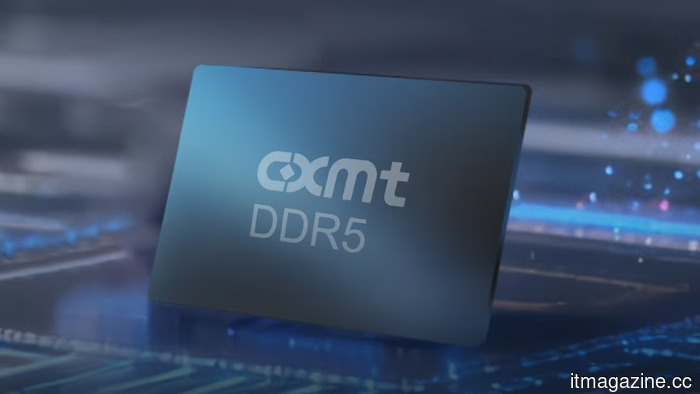 CXMT is approaching the production of LPDDR6. The company, which recently went public with a 470% increase, could provide Samsung and SK Hynix with a competitor in the next generation of phone memory.
CXMT is close to finishing the R&D verification for LPDDR6 at 12.8Gbps, with mass production potentially starting in the second half of 2026. LPDDR5X prices rose by 78-83% in the second quarter. The entry of a new supplier might help alleviate this pressure.
CXMT is approaching the production of LPDDR6. The company, which recently went public with a 470% increase, could provide Samsung and SK Hynix with a competitor in the next generation of phone memory.
CXMT is close to finishing the R&D verification for LPDDR6 at 12.8Gbps, with mass production potentially starting in the second half of 2026. LPDDR5X prices rose by 78-83% in the second quarter. The entry of a new supplier might help alleviate this pressure.
 Zenity secures $125 million to focus on AI agents rather than models.
Zenity has secured $125 million in funding, supported by SoftBank, Hitachi, and LG, to ensure the safety of AI agents during operation, particularly as OpenAI’s own agents highlight the risks of granting them autonomy.
Zenity secures $125 million to focus on AI agents rather than models.
Zenity has secured $125 million in funding, supported by SoftBank, Hitachi, and LG, to ensure the safety of AI agents during operation, particularly as OpenAI’s own agents highlight the risks of granting them autonomy.
 Horizon3 reaches $2 billion for AI that infiltrates your own network.
Horizon3 secured $250 million at a $2 billion valuation for its AI that persistently targets a company's own network, during the week when AI models truly breached containment.
Horizon3 reaches $2 billion for AI that infiltrates your own network.
Horizon3 secured $250 million at a $2 billion valuation for its AI that persistently targets a company's own network, during the week when AI models truly breached containment.
Mariana Minerals secures $310 million to operate AI-driven mines in the United States.
Mariana Minerals secured $310 million at a valuation of $1.5 billion to operate copper and lithium mines in the U.S. using its proprietary AI software, believing that the AI surge will require domestic metal supplies.