
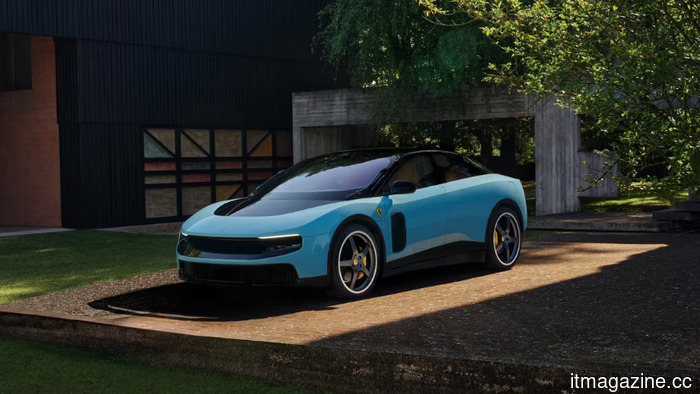
The Ferrari electric vehicle that many ridiculed has unobtrusively sold out.
When Ferrari introduced its first electric vehicle in May, the backlash was severe enough to drop the company's stock price by 6%. However, just two months later, the Luce has completely sold out its allocation for 2026, which is around 500 cars, demonstrating that criticism and demand don't necessarily align.
Ferrari chose not to comment, stating it would discuss the car's reception during its half-year earnings report on July 31, although some figures had already emerged prior to the presentation.
For Ferrari, this timing is beneficial. A fully booked order book conveys precisely what investors want to hear during Friday’s results release, especially after the car’s introduction initially turned what was anticipated to be a major launch into a source of ridicule.
The Luce is an unusual model for Ferrari. It's a four-door, five-passenger vehicle, a family-oriented design from a brand known for two-seater sports cars, starting at €550,000, or about $640,000, which puts it at the higher end of the pricing spectrum.
The appearance of the car sparked the most criticism. Created by Jony Ive and Marc Newson from their LoveFrom studio, the Luce received harsh reviews during its unveiling in Rome, with critics struggling to accept the aerodynamic, flat-sided design in conjunction with the Ferrari emblem.
The emblem itself became a contentious issue. Luca di Montezemolo, the former chairman, suggested that Ferrari should “at least remove the prancing horse,” highlighting how far the design had deviated from traditional expectations of the brand.
This backlash had significant financial implications. The unveiling cost Ferrari billions in market value, and within a month, the company had replaced its marketing director, a sign of the fallout from a launch that went poorly enough to require a scapegoat.
Despite this, consumer interest did not wane. The 2026 production quota was filled in less than two months, with orders extending into late 2027, showcasing demand that minimizes the significance of the online ridicule.
Much of the purchasing came from China. High demand in that market was a key factor in the sellout, illustrating that the market for high-priced luxury items doesn’t always reflect the preferences of car enthusiasts who comment online.
Beneath its controversial exterior lies a high-performance machine. The Luce boasts over 1,000 horsepower from four motors, a 122 kWh battery architecture with 880 volts, charges at 350 kW, and can travel more than 530 kilometers on a single charge, accelerating to 100 km/h in just 2.5 seconds.
Ferrari contends that the engineering explains its unique design. A former executive remarked that the shape was "driven by aerodynamic needs" and needed to be "digested," which is a polite way of suggesting that the public should trust the science over their initial perceptions.
The sellout aligns with Ferrari's strategy, which contrasts with that of most automakers. While competitors aim for higher production volumes, Ferrari intentionally limits its output, having reduced its 2030 EV target last year in favor of exclusivity over mass production.
This exclusivity is key. By setting the Luce’s production at around 500 units, Ferrari made it almost inevitable to sell out, transforming a negative reception into a narrative of exclusivity rather than rejection.
However, the Luce also raises deeper questions about the brand’s identity. A four-door, five-seat electric Ferrari prompts a discussion about whether the brand’s allure lies in its engines and two-seat design or simply in its emblem, and so far, it appears that enough consumers are willing to pay regardless.
Additionally, it arrives amid a more challenging landscape for electric vehicles. Demand for EVs has diminished in various regions, and even Porsche has experienced a drop in deliveries, making a sold-out, $640,000 electric Ferrari a compelling counter-narrative.
Lastly, the involvement of Jony Ive adds an interesting twist. The designer behind the iPhone is now influencing both OpenAI's first hardware and Ferrari's debut EV, and in one instance, the market has already responded positively financially, regardless of critical opinions.
Other articles
 Revolut collaborates with OpenAI to include ChatGPT Go in its subscription offerings.
Revolut is including free ChatGPT Go in its subscriptions, which range from three months to a year, as part of an agreement with OpenAI that provides the AI company a significant distribution network.
Revolut collaborates with OpenAI to include ChatGPT Go in its subscription offerings.
Revolut is including free ChatGPT Go in its subscriptions, which range from three months to a year, as part of an agreement with OpenAI that provides the AI company a significant distribution network.
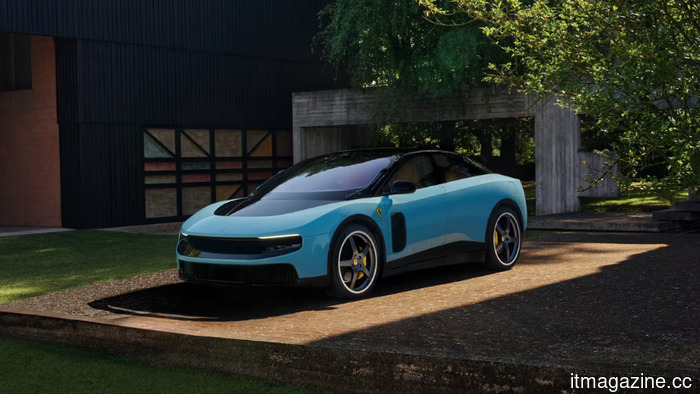 The Ferrari electric vehicle that received a lot of ridicule has surprisingly sold out.
Ferrari's initial electric vehicle, the controversial Luce designed by Jony Ive, has fully sold out its allocation of approximately 500 units for 2026 just two months after a launch that caused a significant drop in its stock value.
The Ferrari electric vehicle that received a lot of ridicule has surprisingly sold out.
Ferrari's initial electric vehicle, the controversial Luce designed by Jony Ive, has fully sold out its allocation of approximately 500 units for 2026 just two months after a launch that caused a significant drop in its stock value.
 I doubted that the budget Alienware 15 would perform well. I was mistaken.
The Dell Alienware 15 (2026) impressed us with its high-quality design, strong initial impact, and competitive pricing. Here’s our firsthand experience.
I doubted that the budget Alienware 15 would perform well. I was mistaken.
The Dell Alienware 15 (2026) impressed us with its high-quality design, strong initial impact, and competitive pricing. Here’s our firsthand experience.
 The live-shopping app Whatnot is in negotiations to increase its valuation to almost $20 billion.
Whatnot, the livestream-shopping platform, is in negotiations to secure funding at a valuation of approximately $20 billion, an increase from $11.5 billion in late 2024, as live commerce expands in the West.
The live-shopping app Whatnot is in negotiations to increase its valuation to almost $20 billion.
Whatnot, the livestream-shopping platform, is in negotiations to secure funding at a valuation of approximately $20 billion, an increase from $11.5 billion in late 2024, as live commerce expands in the West.
 After a lengthy wait, the Dia browser is set to arrive on Windows.
Dia, the AI-first browser, is set to launch on Windows this fall and has opened a public beta waitlist for those interested in trying it out ahead of time.
After a lengthy wait, the Dia browser is set to arrive on Windows.
Dia, the AI-first browser, is set to launch on Windows this fall and has opened a public beta waitlist for those interested in trying it out ahead of time.
 The FTC is taking legal action against Hims & Hers for disclosing patients' health information to Meta and Snap.
The FTC and two states are taking legal action against Hims & Hers, claiming that the company disclosed sensitive health information to Meta and Snap, billed individuals without their consent, and concealed the cancellation button.
The FTC is taking legal action against Hims & Hers for disclosing patients' health information to Meta and Snap.
The FTC and two states are taking legal action against Hims & Hers, claiming that the company disclosed sensitive health information to Meta and Snap, billed individuals without their consent, and concealed the cancellation button.
The Ferrari electric vehicle that many ridiculed has unobtrusively sold out.
Ferrari's initial electric vehicle, the controversial Luce designed by Jony Ive, has completely sold out its allocation of approximately 500 units for 2026 just two months after a launch that led to a loss of billions in its stock value.