
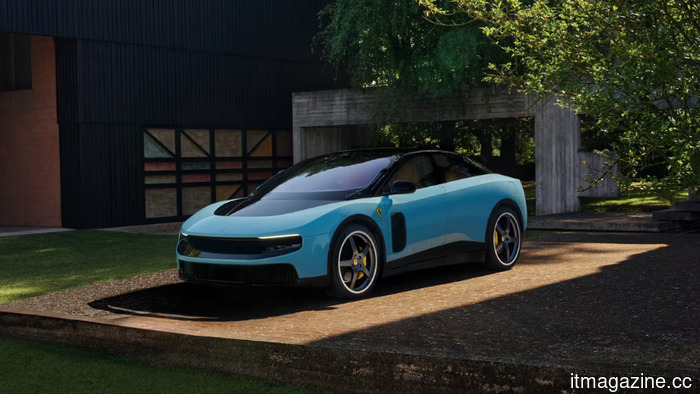
The Ferrari electric vehicle that received a lot of ridicule has surprisingly sold out.
When Ferrari unveiled its inaugural electric vehicle in May, the backlash was severe enough to cause a 6% drop in the company’s stock price. However, just two months later, the Luce has completely sold out its 2026 allocation of approximately 500 units, highlighting that mockery and actual demand can diverge significantly.
Ferrari opted not to comment on the situation, stating it would address the car's reception during its half-year results on 31 July, although the figures had already leaked prior to the presentation.
For Ferrari, this timing is fortuitous. A completely sold-out order book is precisely the message investors will want to hear during Friday's results, especially after an unveiling that briefly turned the company’s most eagerly awaited launch into a joke.
The Luce stands out as an unusual creation for Ferrari. It features a four-door, five-seat configuration, a family-oriented design from a brand that traditionally focuses on two-seat sports cars, and it starts at €550,000, or about $640,000, positioning it near the upper end of the market.
The design was the aspect that sparked controversy. Crafted by Jony Ive and Marc Newson through their LoveFrom studio, the Luce received harsh criticism during its unveiling in Rome, as critics struggled to align its aerodynamic, flat-sided design with the Ferrari emblem.
The emblem itself became a contentious issue. Former Ferrari chairman Luca di Montezemolo suggested that the company should "at least take the prancing horse off," a comment reflecting how far the design deviated from what customers expect from the brand.
This backlash had real repercussions. The debut erased billions from Ferrari’s market value, and within a month, the company had replaced its marketing chief, a move attributed to a launch that went poorly enough to necessitate a scapegoat.
Despite all of this, it turned out that the negative reception did not deter buyers. The 2026 allocation was filled in less than two months, and orders are now extended into late 2027, indicating a level of demand that renders the online criticism inconsequential.
Much of the purchasing came from China. The strong demand there contributed to the sellout, illustrating that the market for high-priced status symbols does not always reflect the preferences of the passionate fans who populate comment sections.
Beneath the polarizing exterior lies a formidable vehicle. The Luce produces over 1,000 horsepower from four motors, is equipped with a 122 kWh battery built on an 880-volt architecture, supports charging at 350 kW, and can cover over 530 kilometers on a single charge, achieving 100 km/h in just 2.5 seconds.
Ferrari argues that its engineering justifies its design. A former executive mentioned that the shape was “driven by aerodynamic requirements” and needed to be “digested,” the diplomatic way of asking the public to prioritize physics over first impressions.
The sellout aligns with Ferrari’s strategy, which contrasts with that of most automakers. While competitors focus on volume, Ferrari intentionally produces fewer vehicles than it could sell and halved its 2030 EV target last year, favoring scarcity over scale.
This scarcity is the essential strategy. By limiting the Luce to around 500 units, Ferrari ensured that selling out was almost inevitable, transforming an initially hostile reception into a narrative of exclusivity rather than rejection.
The Luce also prompts deeper questions about identity. A four-door, five-seat electric Ferrari challenges whether the brand’s allure lies in its engines and two-seat designs or simply in the badge itself, and for now, it appears that enough buyers are willing to pay for either.
Additionally, this comes at a time of uncertainty for electric vehicles. Interest in EVs has decreased in many parts of the world, and even Porsche has experienced a drop in deliveries, making a sold-out, $640,000 electric Ferrari an effective counter-narrative.
The involvement of Jony Ive adds another layer to the story. The designer behind the iPhone is simultaneously shaping both OpenAI’s first hardware and Ferrari’s first EV, and in at least one of those cases, the market has already expressed its preference with its wallet, notwithstanding any criticism of the designs.
Other articles
 Blue Owl’s Stack is pursuing a $5.9 billion loan, contributing to the surge in debt for AI data centers.
According to a report by Bloomberg, Blue Owl’s data-centre division, Stack, is looking to secure a loan of approximately $5.9 billion, just months after finalizing a $2.1 billion agreement, as the push to increase AI capabilities through borrowing intensifies.
Blue Owl’s Stack is pursuing a $5.9 billion loan, contributing to the surge in debt for AI data centers.
According to a report by Bloomberg, Blue Owl’s data-centre division, Stack, is looking to secure a loan of approximately $5.9 billion, just months after finalizing a $2.1 billion agreement, as the push to increase AI capabilities through borrowing intensifies.
 After a lengthy wait, the Dia browser is set to arrive on Windows.
Dia, the AI-first browser, is set to launch on Windows this fall and has opened a public beta waitlist for those interested in trying it out ahead of time.
After a lengthy wait, the Dia browser is set to arrive on Windows.
Dia, the AI-first browser, is set to launch on Windows this fall and has opened a public beta waitlist for those interested in trying it out ahead of time.
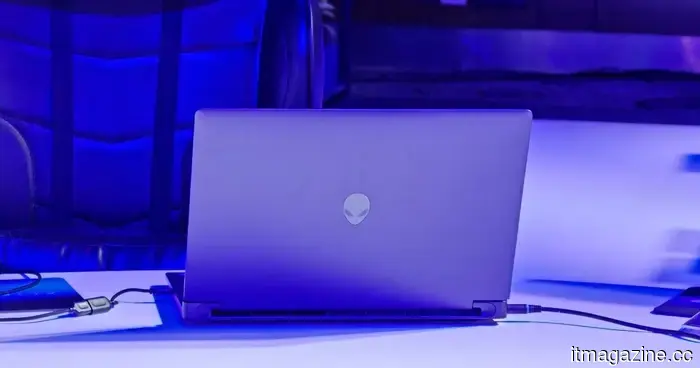 I doubted that the budget Alienware 15 would perform well. I was mistaken.
The Dell Alienware 15 (2026) impressed us with its high-quality design, strong initial impact, and competitive pricing. Here’s our firsthand experience.
G2A.COM's AI agent, Dave, assists sellers in addressing 14,400 support tickets within a span of 63 days.
G2A.COM introduces Dave, an AI support agent that operates independently, successfully resolving 54% of seller issues and reducing ticket volume by 30% during a 63-day trial conducted in 180 countries. The system integrates with transaction data to prevent inaccuracies.
I doubted that the budget Alienware 15 would perform well. I was mistaken.
The Dell Alienware 15 (2026) impressed us with its high-quality design, strong initial impact, and competitive pricing. Here’s our firsthand experience.
G2A.COM's AI agent, Dave, assists sellers in addressing 14,400 support tickets within a span of 63 days.
G2A.COM introduces Dave, an AI support agent that operates independently, successfully resolving 54% of seller issues and reducing ticket volume by 30% during a 63-day trial conducted in 180 countries. The system integrates with transaction data to prevent inaccuracies.
 Meta claims that its AI is increasing the amount of time you spend on Instagram.
According to Meta, time spent on Instagram increased by double digits last quarter, fueled by enhanced personalized AI recommendations, despite the company facing lawsuits concerning that design.
Meta claims that its AI is increasing the amount of time you spend on Instagram.
According to Meta, time spent on Instagram increased by double digits last quarter, fueled by enhanced personalized AI recommendations, despite the company facing lawsuits concerning that design.
 After an extended wait, the Dia browser is at last arriving on Windows.
Dia, the AI-first browser, will be launching on Windows this fall and has opened a public beta waitlist for users interested in getting an early access.
After an extended wait, the Dia browser is at last arriving on Windows.
Dia, the AI-first browser, will be launching on Windows this fall and has opened a public beta waitlist for users interested in getting an early access.
The Ferrari electric vehicle that received a lot of ridicule has surprisingly sold out.
Ferrari's initial electric vehicle, the controversial Luce designed by Jony Ive, has fully sold out its allocation of approximately 500 units for 2026 just two months after a launch that caused a significant drop in its stock value.