
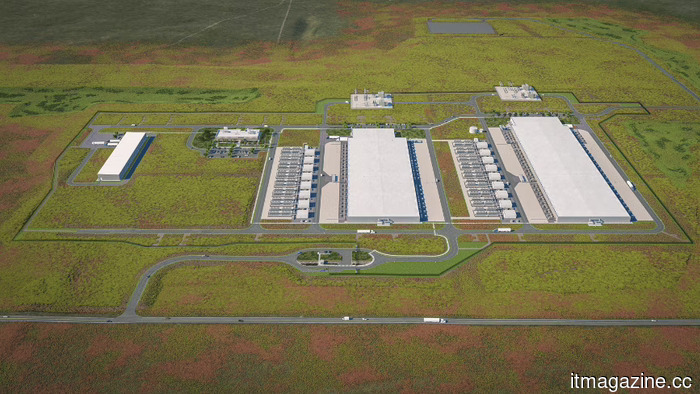
Trump grants exemptions from environmental regulations for data centers and rockets.
The Trump administration used Tuesday to eliminate environmental regulations in favor of the technology boom, making two significant moves with a common rationale.
The first action removes data centres from the protections against acid rain. The second action removes federal environmental assessments for rocket launches. Together, these decisions illustrate how far the government is willing to adapt its regulations to accelerate the infrastructure needed for AI and space ventures.
Data centres, excluded from acid rain regulations
According to Engadget, which cited Reuters, the Environmental Protection Agency (EPA) has exempted power plants serving data centres from the Acid Rain Program of the Clean Air Act. This exemption applies to "islanded" plants that supply energy exclusively to a specific data centre rather than the broader public grid.
As a result of this exemption, these plants are no longer required to reduce emissions of sulfur dioxide and nitrogen oxides, the pollutants responsible for acid rain. Nearly 60 of these plants are either operational or under construction, many of them on a fast track for completion.
The EPA's rationale is quite narrow; the Acid Rain Program is intended for electric utilities. A plant connected to a sole data centre does not qualify as a utility since it does not serve public customers. Aaron Szabo, the assistant administrator for air, framed the exemption in terms of national priorities. He stated, “Maintaining the United States' dominance in artificial intelligence is crucial for national security and economic prosperity.” The agency described this decision as a "commonsense" approach to regulation.
However, the scale of the situation poses a significant concern. Bloomberg anticipates that data centres will consume 20% of America's electricity in approximately eight years. Acid rain depletes soil nutrients, contaminates bodies of water, and harms crops. The emissions also exacerbate asthma and heart issues for those living in proximity, a concern supported by information from the EPA's own website.
Rocket launches, exempt from reviews
The second action was taken by the Federal Aviation Administration (FAA), which suggested bypassing environmental assessments for commercial rocket launch sites, launches, and reentries, as reported by the Wall Street Journal.
The agency is preparing for an increase in launches, predicting a rise from 214 launches and reentries this fiscal year to over 500 within a decade, driven by companies like SpaceX, Blue Origin, Rocket Lab, and Stoke Space.
Rocket launches can have significant impacts, generating noise, disrupting wildlife habitats, and altering nearby land, which is why such reviews are mandated. Companies argue that these reviews can take over a year, delaying their projects. SpaceX has referred to the environmental assessment of its Starbase site in Texas as "superfluous," while residents nearby have claimed that the reviews are insufficiently thorough.
Transportation Secretary Sean Duffy commented that this initiative would “supercharge commercial space activity,” as reported by CNBC. This follows a recent FCC action to ease satellite licensing.
The consistent reasoning
The underlying theme in both cases is the justification focused on national competitiveness, whether related to AI or space. The concerns mostly arise from local residents living near the affected infrastructure. This aligns with a larger deregulatory trend during the development phase.
The administration has already supported xAI’s gas turbines in Memphis and encouraged towns contesting data centres to concede. “You can’t fight it,” President Trump recently told them. “You have to go with it.”
What communities sacrifice is the regulatory paperwork that informs them about upcoming projects. Environmental assessments and emissions limits are slow processes. They also provide communities with insight into what emissions nearby facilities will produce or the potential impacts of a launch site on the coastline. Removing these requirements expedites development, while the resulting costs and consequences fall on those least capable of opting out.
Other articles
 eBay agrees to pay $56 million regarding its harassment campaign involving bloody pig masks.
eBay and three former executives will compensate the couple they harassed with cockroaches and a bloody pig mask nearly $56 million. The more significant consequence: no non-disclosure agreement.
PwC is the most recent Big Four firm to be found releasing low-quality AI content.
PwC released Middle East reports containing numerous fictitious footnotes and invented sources, with one URL ending in “chatgpt.com.” This marks the fourth instance of a Big Four firm being caught using subpar AI content.
eBay agrees to pay $56 million regarding its harassment campaign involving bloody pig masks.
eBay and three former executives will compensate the couple they harassed with cockroaches and a bloody pig mask nearly $56 million. The more significant consequence: no non-disclosure agreement.
PwC is the most recent Big Four firm to be found releasing low-quality AI content.
PwC released Middle East reports containing numerous fictitious footnotes and invented sources, with one URL ending in “chatgpt.com.” This marks the fourth instance of a Big Four firm being caught using subpar AI content.
 The need for verification in the trust crisis of recruitment
The use of AI-generated resumes has increased by 239% since the introduction of chatbots, and 67% of HR leaders indicate that this trend is delaying the hiring process. Ramu Donikana, founder of Invent Artificial, contends that what recruitment truly requires at this moment is verification, rather than improved screening methods.
The need for verification in the trust crisis of recruitment
The use of AI-generated resumes has increased by 239% since the introduction of chatbots, and 67% of HR leaders indicate that this trend is delaying the hiring process. Ramu Donikana, founder of Invent Artificial, contends that what recruitment truly requires at this moment is verification, rather than improved screening methods.
 Apple Upgrade offers the option to lease an iPhone starting at $17.99 per month.
Apple Upgrade enables US customers to lease an iPhone starting at $17.99 per month via Klarna, while discontinuing the 2015 iPhone Upgrade Program. It alters the perception of the price without changing the actual amount.
Apple Upgrade offers the option to lease an iPhone starting at $17.99 per month.
Apple Upgrade enables US customers to lease an iPhone starting at $17.99 per month via Klarna, while discontinuing the 2015 iPhone Upgrade Program. It alters the perception of the price without changing the actual amount.
 DoorDash receives FAA approval for its internal drone initiative, DoorDash Air.
DoorDash holds FAA Part 135 certification for its internal drone program, DoorDash Air, although it acknowledges that the majority of deliveries will still be managed by humans.
DoorDash receives FAA approval for its internal drone initiative, DoorDash Air.
DoorDash holds FAA Part 135 certification for its internal drone program, DoorDash Air, although it acknowledges that the majority of deliveries will still be managed by humans.
 Anthropic stands alone in every AI battle, yet still manages to succeed.
Anthropic stands out as the distinct entity in almost every AI policy debate, whether it concerns open weights or the Pentagon. Furthermore, it remains the most valuable startup globally.
Anthropic stands alone in every AI battle, yet still manages to succeed.
Anthropic stands out as the distinct entity in almost every AI policy debate, whether it concerns open weights or the Pentagon. Furthermore, it remains the most valuable startup globally.
Trump grants exemptions from environmental regulations for data centers and rockets.
In a single day, the Trump administration took steps to exclude power plants at data centers from acid-rain regulations and to exempt rocket launches from environmental assessments.