

Research indicates that depending on AI can transform uncertainty into mistaken confidence.
AI is making it increasingly difficult for individuals to say "I don't know."
One might assume that receiving incorrect advice would make individuals more cautious. However, new research indicates the contrary when that guidance comes from AI. A study led by Valerio Capraro, a psychology professor at the University of Milan-Bicocca, revealed that inaccurate AI recommendations resulted in people being less precise while simultaneously feeling significantly more confident in their responses (via IBM Think).
The research also uncovered that those who were given incorrect AI guidance showed a marked decrease in their willingness to acknowledge they did not know an answer, even when they could remain silent and were incentivized for accuracy.
What causes misguided AI advice to instill such confidence?
Researchers posed six questions concerning obscure film details, intentionally selecting ones that the AI model frequently answered incorrectly. This approach allowed them to examine the impact of consulting AI independently of the quality of its advice.
The findings were notable. When not using AI, participants opted not to answer about 36 to 44% of the time across two experiments. However, when AI was available, this dropped to only 3 to 6%. The accuracy of their answers also suffered, plummeting from 27.5 percent when working solo to just 9.2 percent when AI was involved.
Capraro speculates that AI may reduce the amount of confidence required before individuals commit to an answer, essentially altering how they perceive their own certainty. Interestingly, this phenomenon occurred even when AI responses were provided spontaneously, suggesting that the effect is not solely related to actively seeking assistance.
Does increasing the stakes influence the outcome?
Introducing financial incentives and penalties made people slightly more cautious and accurate, yet the overarching trend remained apparent. Capraro clearly differentiates that AI should complement human judgment rather than completely replace it.
He expresses concern that this issue affects children as well, as growing up with immediate answers might hinder their ability to experience doubt as a key part of learning. Recent reports indicate that the younger generation, who are heavily reliant on AI, are even consulting chatbots for help with face-to-face conversations. As Capraro notes, doubt isn't a lack of knowledge; it often marks the true beginning of genuine understanding.





Other articles
 What is the cost of Apple's Upgrade plan for leasing devices, and is it worth it?
From iPhones to MacBooks, here’s how Apple’s Upgrade Program performs and where it has limitations.
What is the cost of Apple's Upgrade plan for leasing devices, and is it worth it?
From iPhones to MacBooks, here’s how Apple’s Upgrade Program performs and where it has limitations.
 Research indicates that depending on AI may transform uncertainty into misplaced assurance.
A recent study discovered that erroneous AI guidance led to decreased accuracy while significantly increasing participants' confidence, as they rarely acknowledged any uncertainty.
Research indicates that depending on AI may transform uncertainty into misplaced assurance.
A recent study discovered that erroneous AI guidance led to decreased accuracy while significantly increasing participants' confidence, as they rarely acknowledged any uncertainty.
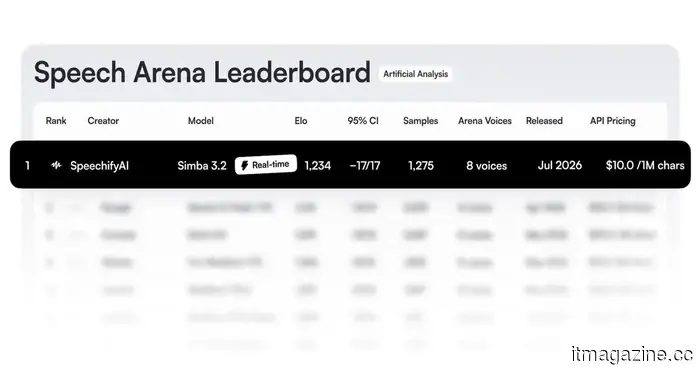 AI Voice Models Are Becoming Less Expensive
Text-to-speech has moved away from just being a feature in accessibility menus over the last few years and has now become a key element of contemporary software. The voice-first application sector is expanding daily, and these specialized digital tools play a vital role in the text-to-speech movement. This technology also drives audiobooks, meeting assistants, and customer service...
AI Voice Models Are Becoming Less Expensive
Text-to-speech has moved away from just being a feature in accessibility menus over the last few years and has now become a key element of contemporary software. The voice-first application sector is expanding daily, and these specialized digital tools play a vital role in the text-to-speech movement. This technology also drives audiobooks, meeting assistants, and customer service...
 How AI Search Is Transforming Online Discovery Standards
Traditional searches involve entering a query, reviewing a ranked list of links, and clicking on a website. In contrast, AI is enhancing the search process by making it quicker. AI search provides AI-generated summaries, includes conversational follow-up questions, and delivers direct links without unnecessary steps. For businesses, publishers, and […]
How AI Search Is Transforming Online Discovery Standards
Traditional searches involve entering a query, reviewing a ranked list of links, and clicking on a website. In contrast, AI is enhancing the search process by making it quicker. AI search provides AI-generated summaries, includes conversational follow-up questions, and delivers direct links without unnecessary steps. For businesses, publishers, and […]
 What is the cost of Apple’s Upgrade plan for leasing devices, and is it a worthwhile investment?
From iPhones to MacBooks, here's an overview of the areas where Apple's Upgrade Program is effective and where it has limitations.
What is the cost of Apple’s Upgrade plan for leasing devices, and is it a worthwhile investment?
From iPhones to MacBooks, here's an overview of the areas where Apple's Upgrade Program is effective and where it has limitations.
 X asserts that Australia’s enforcement on under-16s violates international law.
X, the platform owned by Elon Musk, claims that Australia's initiative to strengthen the enforcement of its social media ban for individuals under 16 would violate international law.
X asserts that Australia’s enforcement on under-16s violates international law.
X, the platform owned by Elon Musk, claims that Australia's initiative to strengthen the enforcement of its social media ban for individuals under 16 would violate international law.
Research indicates that depending on AI can transform uncertainty into mistaken confidence.
A recent study revealed that erroneous AI recommendations led individuals to be less accurate while simultaneously becoming significantly more confident, with participants rarely acknowledging any uncertainty.