

What is the cost of Apple’s Upgrade plan for leasing devices, and is it a worthwhile investment?
Apple has introduced a new method to acquire an iPhone, iPad, Mac, or Apple Watch without an upfront purchase. The recently launched Apple Upgrade program allows you to lease Apple devices through Klarna instead of paying the full price all at once, and I must admit, the monthly payments are quite appealing.
I explored Apple’s published prices for each device individually to determine where this might save you money and where it might just extend the payment period for something you won’t actually own.
Who is eligible for the Apple Upgrade program?
Nadeem Sarwar / Digital Trends
The Apple Upgrade program depends on Klarna as the leasing provider. Applying for a device initiates only a soft credit check. To be eligible, applicants must be 18 or older, reside in the US, be verified via SMS, and possess an eligible credit or debit card along with their Social Security number.
Under this program, iPhones and Apple Watches can be leased for either 12 or 24 months, whereas iPads and Macs can be leased for 24 or 36 months.
Most current models qualify, with the exception of the iPhone 16, iPhone 16 Plus, Apple Watch SE, MacBook Neo, Mac mini, the standard iPad, and Studio Display.
Rachit Agarwal / Digital Trends
Additionally, leasing an iPhone requires an active plan with AT&T, T-Mobile, or Verizon, although the phone itself will be unlocked upon shipping. AppleCare+ is no longer included; it must be paid for separately.
What are your options when the lease ends?
At the conclusion of the lease, you have three choices regarding the device: return it and upgrade, pay to own it, or simply walk away without it.
Apple allows up to six months after the lease ends to make your decision. If you do not take any action, Klarna will automatically charge you the purchase-option fee.
ChoicesProsConsBest For…Return & UpgradeGet the latest features every 1–2 yearsContinuous monthly paymentsTech enthusiasts wanting the newest model each year.No need to sell old devicesNo equity built in devices, risking trade-in valueFresh battery lifeMiss out on carrier offersPay to OwnNo monthly payments after purchaseTotal cost may be higherThose planning to keep their devices for more than 4 years.Maintain a valuable assetExtra cost to buy outPossibility to sell or trade laterWalk AwayClear end to paymentsHired thousands for a rentalFee for someone leaving Apple’s ecosystem.No future payment obligationsNo device to keep
iPhone: Can leasing really save you money?
For instance, if you lease the iPhone 17e, priced at $599, for 24 months at $17.99 a month, you’ll pay about $432 before returning the phone. Essentially, you haven't owned anything; it's been a two-year rental.
If you opt to keep the phone, you would need to pay an additional $165 to $170 for the 17e. When added to your lease payments, the total comes to approximately $599—the exact amount you would have paid if you had bought the iPhone outright.
In my opinion, this is where Apple Upgrade truly shines. It allows you to spread out the expense, keeping your funds available for other needs, while still leaving the option to own the device later on. However, I believe this program is more advantageous for higher-end Pro models than for entry-level iPhones, where the initial investment is easier to handle.
iPad: Is the monthly investment worthwhile?
Since buyers generally keep their iPads longer than their iPhones, Apple offers longer lease terms of 24 or 36 months for iPads. For students or entry-level professionals seeking an iPad for school or daily tasks, leasing makes sense.
For example, instead of paying $599 for an iPad mini or $749 for an iPad Air upfront, you could pay $11.99 or $15.99 monthly over 36 months. Depending on your needs, you can either pay the remaining balance to own it or upgrade to the newest model without any extra charges.
Again, this program offers convenience without financial discounts.
Mac: Is it a better deal or just higher payments?
If you're looking to upgrade from an old Intel MacBook or even an M1 or M2-powered MacBook Air but lack the upfront funds, the Apple Upgrade program allows you to make monthly payments starting at $24.99 over 36 months.
However, it's important to note that the M5 chip family has enough performance to remain relevant for four to five years, likely keeping resale values high.
For this reason, I would suggest opting for the full 36 months of payments and then paying the remaining amount to retain the MacBook. Unlike an iPhone, I see a MacBook as a long-term investment that I would keep for several years instead of constantly upgrading.
Apple Watch: The one category where leasing might be beneficial
Personally, I think it


Other articles
 X asserts that Australia’s enforcement on under-16s violates international law.
X, the platform owned by Elon Musk, claims that Australia's initiative to strengthen the enforcement of its social media ban for individuals under 16 would violate international law.
X asserts that Australia’s enforcement on under-16s violates international law.
X, the platform owned by Elon Musk, claims that Australia's initiative to strengthen the enforcement of its social media ban for individuals under 16 would violate international law.
 Sony is introducing two new budget-friendly headphones that come in a variety of color options.
Import filings indicate that Sony is getting ready to launch the WH-CH730N and WH-CH530, the next generation of its well-liked budget wireless headphones.
Sony is introducing two new budget-friendly headphones that come in a variety of color options.
Import filings indicate that Sony is getting ready to launch the WH-CH730N and WH-CH530, the next generation of its well-liked budget wireless headphones.
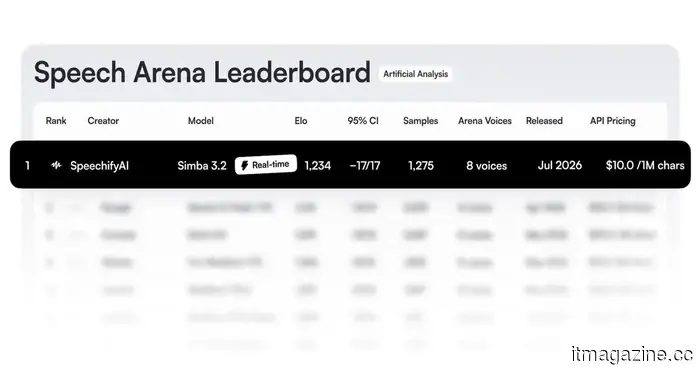 AI Voice Models Are Becoming Less Expensive
Text-to-speech has moved away from just being a feature in accessibility menus over the last few years and has now become a key element of contemporary software. The voice-first application sector is expanding daily, and these specialized digital tools play a vital role in the text-to-speech movement. This technology also drives audiobooks, meeting assistants, and customer service...
AI Voice Models Are Becoming Less Expensive
Text-to-speech has moved away from just being a feature in accessibility menus over the last few years and has now become a key element of contemporary software. The voice-first application sector is expanding daily, and these specialized digital tools play a vital role in the text-to-speech movement. This technology also drives audiobooks, meeting assistants, and customer service...
 Netflix surpasses the BBC as the top choice for UK viewers.
According to Ofcom's Media Nations report, Netflix is the preferred option for 26% of viewers in the UK, slightly surpassing the BBC as traditional broadcasting falls behind streaming services and YouTube.
Netflix surpasses the BBC as the top choice for UK viewers.
According to Ofcom's Media Nations report, Netflix is the preferred option for 26% of viewers in the UK, slightly surpassing the BBC as traditional broadcasting falls behind streaming services and YouTube.
 What is the cost of Apple's Upgrade plan for leasing devices, and is it worth it?
From iPhones to MacBooks, here’s how Apple’s Upgrade Program performs and where it has limitations.
What is the cost of Apple's Upgrade plan for leasing devices, and is it worth it?
From iPhones to MacBooks, here’s how Apple’s Upgrade Program performs and where it has limitations.
 Research indicates that depending on AI can transform uncertainty into mistaken confidence.
A recent study revealed that erroneous AI recommendations led individuals to be less accurate while simultaneously becoming significantly more confident, with participants rarely acknowledging any uncertainty.
Research indicates that depending on AI can transform uncertainty into mistaken confidence.
A recent study revealed that erroneous AI recommendations led individuals to be less accurate while simultaneously becoming significantly more confident, with participants rarely acknowledging any uncertainty.
What is the cost of Apple’s Upgrade plan for leasing devices, and is it a worthwhile investment?
From iPhones to MacBooks, here's an overview of the areas where Apple's Upgrade Program is effective and where it has limitations.