
AI Voice Models Are Becoming Less Expensive
Text-to-speech technology has moved beyond accessibility menus in recent years and is now recognized as a key element of contemporary software systems. The sector focused on voice-first applications is expanding daily, with these specialized digital assets playing a significant role in the text-to-speech movement. This technology also supports audiobooks, meeting assistants, and customer service representatives. As demand has increased, developers of models are under greater pressure to produce voices that sound convincingly human, without latency issues or per-character pricing that render production deployments impractical.
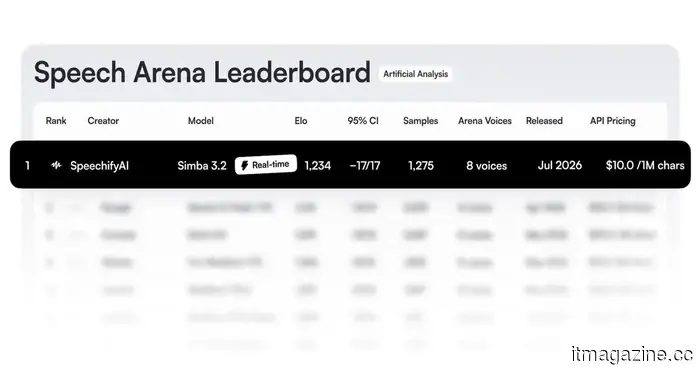
Eliminating obstacles allows developers and businesses to appreciate the benefits of integrating voice into their offerings, enabling them to avoid having to compromise on quality, speed, or cost. In the broader conversation surrounding the evolving text-to-speech market, such products may offer improved cost-effectiveness, quality, and latency, creating new opportunities for both business and consumer applications. SpeechifyAI’s Simba 3.2 is one model competing in these areas, currently holding the top position on the Artificial Analysis text-to-speech leaderboard.
Common Trade-Offs in Voice AI
Developers have historically encountered three main issues when assessing text-to-speech providers. A significant trade-off exists among the three most common models in the text-to-speech market. The models that sound the most natural are often the costliest, making it financially challenging for high-volume products—like long-form content, real-time agents, or global consumer applications. Cheaper, faster alternatives sometimes sacrifice quality, resulting in voices that sound more robotic and lacking in emotion and pacing. Additionally, models designed for low latency, particularly those optimized for streaming, also have drawbacks; they frequently fall short of the fidelity standards expected by studios and enterprises.
This situation creates a market where teams may resort to multiple providers for different use cases, or they may have to accept limitations on the product’s voice capabilities. These constraints have become a significant frustration as voice agents scale into production.
A Shift Toward All-in-One Performance
Advancements in model architecture and training efficiency are allowing some providers to lessen these trade-offs. SpeechifyAI, a company focused on voice AI research, has been striving for several years to eliminate barriers to building with speech through its model, Simba 3.2. The model achieved the top ranking on Artificial Analysis’s independent text-to-speech leaderboard, which evaluates commercially available models based on standardized criteria.
Speechify Founder and CEO Cliff Weitzman announced this launch by highlighting the collaboration of these elements. “Simba 3.2 is our most advanced model yet, now available on Speechify.ai,” he stated. “It is designed to support voice agents at scale and has been refined through millions of A/B tests conducted on our consumer platform. In TTS APIs, three factors are crucial: cost, quality, and latency. Simba 3.2 has reached state-of-the-art levels in this trifecta, leading the Artificial Analysis TTS leaderboard at $6 for 1 million characters on our scaled plan.” This model is being effectively utilized, also powering SpeechifyAI Agents, the company’s new platform for voice agents aimed at businesses, which can be accessed along with its developer tools at speechify.ai.
Empowerment Through Voice
The goal for creators is that anyone developing the next wave of software should have access to expressive and dependable voice models. These resources should not be restricted to teams with the largest budgets. While access is widening, the market remains in its early stages. Voice capabilities are increasingly becoming a standard feature in digital communications alongside text and images. Models like Simba 3.2 help level the playing field, eliminating the trade-offs that have traditionally characterized the category. This shift has opened new avenues for the youngest generation of developers, creators, and businesses, enabling them to craft products that transform the digital landscape.
Prices and availability are accurate as of the publication date and may change without notice. For the latest pricing information, please visit the retailer’s website.
Digital Trends collaborates with external contributors, and all contributed content is reviewed by the Digital Trends editorial team.
Other articles
 Your AI business plan may appear impressive, but caution is essential in certain areas.
Starting a business is a significant undertaking. It requires extensive preparation and planning, which is often encapsulated in a business plan. Creating a business plan demands considerable time and research, making it tempting to rely on AI for assistance. While this can be beneficial to some extent, generative search tools can rapidly […]
Your AI business plan may appear impressive, but caution is essential in certain areas.
Starting a business is a significant undertaking. It requires extensive preparation and planning, which is often encapsulated in a business plan. Creating a business plan demands considerable time and research, making it tempting to rely on AI for assistance. While this can be beneficial to some extent, generative search tools can rapidly […]
 Netflix surpasses the BBC as the top choice for UK viewers.
According to Ofcom's Media Nations report, Netflix is the preferred option for 26% of viewers in the UK, slightly surpassing the BBC as traditional broadcasting falls behind streaming services and YouTube.
Netflix surpasses the BBC as the top choice for UK viewers.
According to Ofcom's Media Nations report, Netflix is the preferred option for 26% of viewers in the UK, slightly surpassing the BBC as traditional broadcasting falls behind streaming services and YouTube.
 While your AI business plan may appear persuasive, it's important to exercise caution in certain areas.
Starting a business is a significant endeavor. It requires extensive preparation and planning, which is frequently encapsulated in a business plan. Compiling business plans demands time and research, and it's easy to consider utilizing AI for assistance. While this can be beneficial to some extent, generative search tools can rapidly […]
While your AI business plan may appear persuasive, it's important to exercise caution in certain areas.
Starting a business is a significant endeavor. It requires extensive preparation and planning, which is frequently encapsulated in a business plan. Compiling business plans demands time and research, and it's easy to consider utilizing AI for assistance. While this can be beneficial to some extent, generative search tools can rapidly […]
 AI voice models are becoming increasingly cost-effective.
In recent years, text-to-speech has shifted from accessibility menus and now takes center stage as a key element of the contemporary software ecosystem. The category of voice-first applications continues to expand daily, and these specialized digital resources play a significant role in the text-to-speech movement. This technology also supports audiobooks, meeting assistants, and customer service...
AI voice models are becoming increasingly cost-effective.
In recent years, text-to-speech has shifted from accessibility menus and now takes center stage as a key element of the contemporary software ecosystem. The category of voice-first applications continues to expand daily, and these specialized digital resources play a significant role in the text-to-speech movement. This technology also supports audiobooks, meeting assistants, and customer service...
 How AI Search Is Transforming Online Discovery Standards
Traditional searches involve entering a query, reviewing a ranked list of links, and clicking on a website. In contrast, AI is enhancing the search process by making it quicker. AI search provides AI-generated summaries, includes conversational follow-up questions, and delivers direct links without unnecessary steps. For businesses, publishers, and […]
How AI Search Is Transforming Online Discovery Standards
Traditional searches involve entering a query, reviewing a ranked list of links, and clicking on a website. In contrast, AI is enhancing the search process by making it quicker. AI search provides AI-generated summaries, includes conversational follow-up questions, and delivers direct links without unnecessary steps. For businesses, publishers, and […]
 Research indicates that depending on AI can transform uncertainty into mistaken confidence.
A recent study revealed that erroneous AI recommendations led individuals to be less accurate while simultaneously becoming significantly more confident, with participants rarely acknowledging any uncertainty.
Research indicates that depending on AI can transform uncertainty into mistaken confidence.
A recent study revealed that erroneous AI recommendations led individuals to be less accurate while simultaneously becoming significantly more confident, with participants rarely acknowledging any uncertainty.
AI Voice Models Are Becoming Less Expensive
Text-to-speech has moved away from just being a feature in accessibility menus over the last few years and has now become a key element of contemporary software. The voice-first application sector is expanding daily, and these specialized digital tools play a vital role in the text-to-speech movement. This technology also drives audiobooks, meeting assistants, and customer service...