
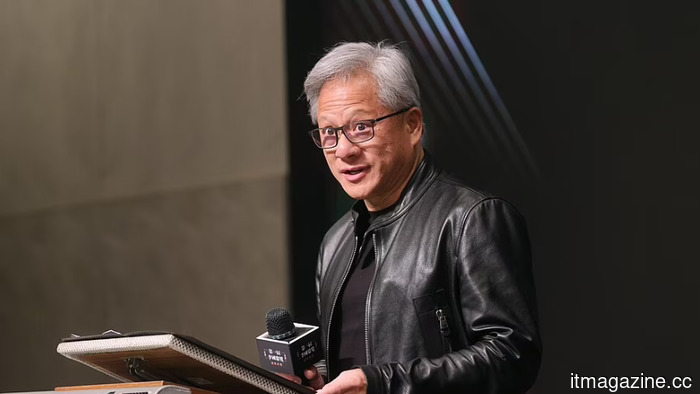
Nvidia's $750 billion AI agreements have driven its credit default swaps to an all-time high.
Nvidia is pursuing a new series of AI infrastructure agreements that could exceed $750 billion, according to Bloomberg, continuing an investment trend that critics argue is driving up demand and valuations in the sector. The debt market reacted strongly to this news.
Nvidia's five-year credit default swap spread jumped to a record 82 basis points on Monday, marking the largest single-day intraday increase since trading on the contract began in November 2025, as reported by ICE Data Services figures referenced by Bloomberg. Credit default swaps serve as a form of insurance against a bond issuer's failure to make payments.
Details of the $750 billion
An AI collaboration with SK Group, the parent company of chipmaker SK Hynix, was announced late Friday and is projected to be valued at over $500 billion according to Nvidia’s own calculations. Together, they plan to construct over two gigawatts of AI data centers on the Korean Peninsula, which is approximately the energy needed for 1.5 million homes.
In addition, Nvidia is negotiating to provide guarantees of up to $250 billion to enable OpenAI to lease a 10-gigawatt data center campus that a SoftBank subsidiary is developing in southern Ohio. Nvidia is also discussing financing an additional $350 billion for OpenAI's chip purchases.
On Friday, Nvidia disclosed plans to invest $1 billion in Naver Corp to help finance an AI data center currently being built in South Korea, in partnership with Brookfield. This funding will allow Naver to significantly expand the size of the facility, leading to an over 8% increase in its stock price in Seoul.
The Sutskever partnership
On Monday, Nvidia revealed a long-term collaboration with Safe Superintelligence, the lab created by OpenAI co-founder Ilya Sutskever, reportedly valued at $5 billion. Nvidia indicated that this partnership provides it with “rare access to the company’s closely held research.”
The agreement allows SSI to use Nvidia's Vera Rubin platform, enhancing its computing capabilities significantly. For a company that has not launched a product and remained largely silent for two years, this validation may be as valuable as the hardware itself.
Market reaction explained
The issues at play are structural rather than ethical. Nvidia takes equity positions or guarantees loans for clients like OpenAI and CoreWeave, which in turn invest that capital in Nvidia's hardware, creating a cycle that may give the appearance of stronger demand than what end users actually desire.
"While Nvidia’s investments and partnerships bolster confidence in the long-term development of AI, investors are still wary of the circular financing," stated Gary Tan, a portfolio manager at Allspring Global Investments. "Funds are increasingly being utilized to support future AI clients and infrastructure projects."
Billy Leung, an investment strategist at Global X Management, suggested that the OpenAI guarantees signal caution rather than optimism, stating, “It’s as much a reminder of funding strain in the AI development as it is a demand indicator."
Both the IMF and the Bank for International Settlements have identified AI circular financing as a systemic risk.
Huang's response
Jensen Huang has consistently dismissed this narrative, asserting that Nvidia’s stakes are minimal compared to the amounts its partners are raising elsewhere. He remarked on the CoreWeave investment in January, stating, “It’s a small percentage of the total capital they need to secure,” adding that the notion of it being circular is "absurd."
Regarding the Korean agreements, he was expansive, claiming, “This is the golden age for Korea,” and noting that the $500 billion figure encompasses Nvidia's memory chip purchases alongside SK Group's acquisition of Nvidia supercomputers.
This last detail is significant, as the SK deal is reciprocal, with Nvidia requiring high-bandwidth memory predominantly produced by Hynix and Samsung, making it both a supply and demand agreement.
Not limited to Nvidia
Vendor guarantees have proliferated throughout the industry, with Google agreeing to support lease payments for five data center locations for Anthropic, thereby helping the OpenAI competitor secure what is essentially a $35 billion loan.
Nvidia has also extended credit to lesser-known AI startups, providing them with computing resources now while allowing them to pay later—a strategy that assists clients facing cash flow issues while still recognizing revenue.
Much of this resulting debt remains outside traditional disclosure practices. It's estimated that Big Tech's off-balance-sheet AI commitments amount to around $1.65 trillion, which explains the shift towards monitoring guarantees rather than public borrowing.
Current totals
Nvidia has reported over $540 billion in such deals within 2026 alone, not counting the potential arrangement with OpenAI. It has ownership interests in OpenAI, Marvell, IREN, CoreWeave, and Nebius.
On Monday, Nvidia's stock price dropped nearly 5% to $196.51, wiping out approximately $250 billion of its market capitalization and allowing Apple to reclaim its title as the world's most valuable company.
The negotiations with OpenAI are still in the early
Другие статьи
 Amkor plans to invest up to $3 billion, representing nearly 40% of its revenue.
Amkor reported a record revenue of $1.9 billion for Q2 and saw its net income triple. The company's capital expenditure guidance for 2026 is set at $3 billion, which is approximately 40% of its annualized sales.
Amkor plans to invest up to $3 billion, representing nearly 40% of its revenue.
Amkor reported a record revenue of $1.9 billion for Q2 and saw its net income triple. The company's capital expenditure guidance for 2026 is set at $3 billion, which is approximately 40% of its annualized sales.
 Core Scientific shifts to AMD with a 2.5GW AI data center agreement, following the breakdown of the CoreWeave deal just months prior.
Core Scientific has finalized a data-center agreement with AMD that could amount to 2.5GW, just nine months after shareholders turned down a $9 billion acquisition of CoreWeave.
Core Scientific shifts to AMD with a 2.5GW AI data center agreement, following the breakdown of the CoreWeave deal just months prior.
Core Scientific has finalized a data-center agreement with AMD that could amount to 2.5GW, just nine months after shareholders turned down a $9 billion acquisition of CoreWeave.
 Friendsurance was valued for its documentation rather than its innovative concept.
Cover Genius has acquired Friendsurance, the Berlin-based company that launched peer-to-peer insurance in 2010. The terms of the deal remain undisclosed, occurring just two weeks after a $100 million fundraising round.
Friendsurance was valued for its documentation rather than its innovative concept.
Cover Genius has acquired Friendsurance, the Berlin-based company that launched peer-to-peer insurance in 2010. The terms of the deal remain undisclosed, occurring just two weeks after a $100 million fundraising round.
 Queensland and the Northern Territory oppose Australia's regulations on data centre energy usage.
Australia's groundbreaking regulations requiring data centres to supply as much power as they consume have faced resistance, as Queensland and the Northern Territory oppose many of the proposed measures.
Queensland and the Northern Territory oppose Australia's regulations on data centre energy usage.
Australia's groundbreaking regulations requiring data centres to supply as much power as they consume have faced resistance, as Queensland and the Northern Territory oppose many of the proposed measures.
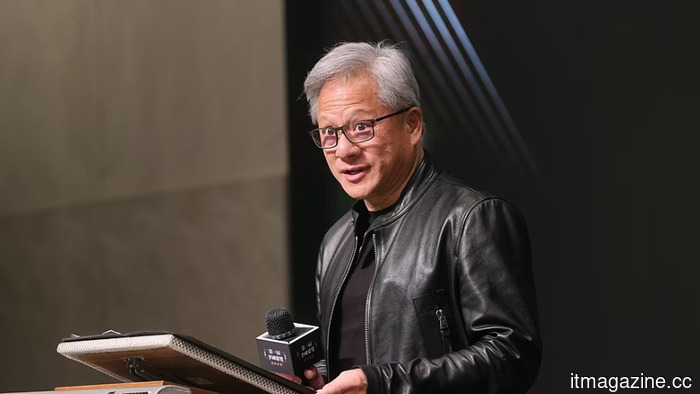 Nvidia's $750 billion AI agreements have driven its credit default swaps to an all-time high.
Nvidia's CDS spread reached an all-time high of 82 bps following $750 billion in AI transactions that sparked concerns about circular financing. Jensen Huang described the criticism as "ridiculous."
Nvidia's $750 billion AI agreements have driven its credit default swaps to an all-time high.
Nvidia's CDS spread reached an all-time high of 82 bps following $750 billion in AI transactions that sparked concerns about circular financing. Jensen Huang described the criticism as "ridiculous."
 Friendsurance was sold for its documentation rather than its innovative concept.
Cover Genius has acquired Friendsurance, the Berlin-based company that pioneered peer-to-peer insurance in 2010. The terms of the deal have not been disclosed, occurring two weeks after a $100 million fundraising round.
Friendsurance was sold for its documentation rather than its innovative concept.
Cover Genius has acquired Friendsurance, the Berlin-based company that pioneered peer-to-peer insurance in 2010. The terms of the deal have not been disclosed, occurring two weeks after a $100 million fundraising round.
Nvidia's $750 billion AI agreements have driven its credit default swaps to an all-time high.
Nvidia's CDS spread reached a historic 82bps following $750 billion in AI transactions, raising concerns about circular financing. Jensen Huang dismissed the criticism as "ridiculous."