
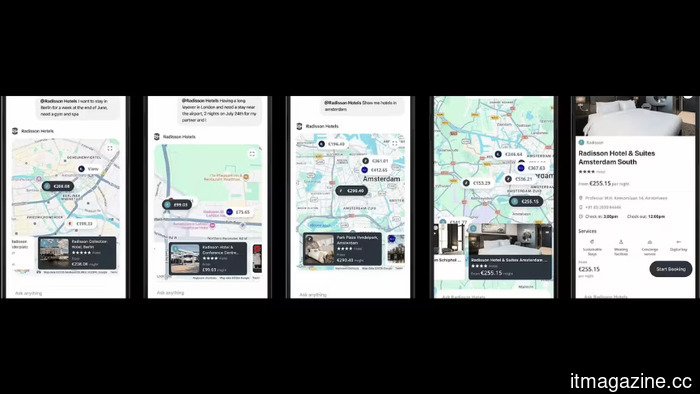
Hotels are adopting ChatGPT, but not for payment processing.
This week, two hotel chains introduced their integrations with ChatGPT, a day apart and at different market segments.
On Tuesday, Radisson Hotel Group launched an app developed with Accenture, featuring over 1,000 hotels across more than 100 countries. Meanwhile, G6 Hospitality released a plugin for Motel 6 on Monday, encompassing nearly 1,500 budget locations in the United States and Canada.
Neither offering allows payments within the chat. Both companies redirect travelers to their websites to finalize reservations. Radisson has announced that in-chat booking, along with loyalty recognition and an AI concierge, will be available later.
“AI is fundamentally altering how people search for and book hotel accommodations, and we aim to be leaders in this transformation,” stated Gianni Di Fede, chief commercial officer of Radisson Hotel Group.
The behavior they are targeting is already established. Travelers have been using ChatGPT for trip planning for some time, and G6 refers to Deloitte research indicating that the use of generative AI for travel planning has tripled in the past two years.
Shashank Jain, global head of technology and online revenue at G6, described the shift more bluntly, stating that large language models are “fundamentally changing how people interact with technology,” making discovery “more intuitive, contextual, and personalized.”
The reason for the halt at the checkout seems more like a business choice than a technical limitation and aligns with consumer tolerances. An Accenture survey of 25,590 individuals across 16 countries conducted in June revealed a clear divide based on tasks.
Approximately 75% would prefer to negotiate a deal or resolve a complaint with an agent, while only 32% would allow one to decide what to purchase. Merely 9% are comfortable with fully autonomous buying. “Payments remain the biggest barrier,” the report states.
Radisson cited similar research but presented a more optimistic perspective: 87% of travelers are willing to collaborate with an AI travel agent, and 71% anticipate that AI will significantly influence their hotel and airline spending within a year. However, both statistics refer to influence and not payment.
The actual goal isn't OpenAI. Radisson is candid about its approach, stating that the app is part of the group’s “broader digital transformation and direct booking strategy.”
Direct booking involves bypassing online travel agencies. Hotels have been paying commissions to Booking.com and Expedia for twenty years and have often contested these fees. A ChatGPT app enables hotels to connect with travelers before agencies do, allowing them to complete bookings on their own websites at their own rates.
There’s also a defensive aspect to this. Radisson has noted that organic and direct web traffic, the channels that historically drove its online bookings, are “giving way to new touchpoints like ChatGPT.” This indicates that the hotel group recognizes its search funnel is weakening and is tracking traffic to its new destination.
The loyalty issue runs deeper than distribution. Accenture’s research on agentic commerce found that 90% of frequent AI users in North America would switch from their preferred brand if their assistant suggested a better option. Radisson Rewards boasts over 28 million members. Loyalty programs operate on the premise that habit prevails over comparison. An assistant that consistently compares options challenges this assumption directly.
Being mentioned in responses has emerged as the new prime positioning, and brands have spent the last year figuring out how to secure citations within AI results. Emily Weiss, Accenture’s global travel lead, directly highlighted the trade-off: “Planning for travel is becoming easier for consumers, yet more competitive for brands.”
Accenture presents the choice as becoming “the agent of choice” versus being merely “the choice of agents.” Both hotel groups opted for the latter.
It's important to clarify Accenture’s role in this context. It published the research referred to in the release, provided the MCP accelerator and AI Merchant Center that Radisson utilized, designed the app experience, and Ndidi Oteh, quoted in the announcement as chief executive of Accenture Song, contributed to both reports.
Additionally, Accenture is an OpenAI Elite Partner and was recently recognized as OpenAI's AI Transformation Partner of the Year. While this doesn’t invalidate the findings, it indicates that the data comes from a vested interest.
The components for in-chat payment already exist. OpenAI has collaborated with Visa on agentic commerce payments, and Stripe’s Patrick Collison has argued that agents will redefine the commerce layer of the internet.
However, the hotels aren’t waiting for these developments; they are seizing the discovery phase, where the agency relationship starts. The two launches within two days at both ends of the pricing spectrum suggest a checklist approach rather than experimentation. A key signal to watch will be the first major chain that allows users to complete bookings without leaving the chat.
Other articles
 Anthropic's latest pharmaceutical agreement focuses on documentation rather than molecules.
ICON plans to implement Claude for its 40,200 personnel involved in clinical trials. Anthropic mentions that enrollment issues, rather than scientific factors, contribute to delays in as much as 80% of these trials.
Anthropic's latest pharmaceutical agreement focuses on documentation rather than molecules.
ICON plans to implement Claude for its 40,200 personnel involved in clinical trials. Anthropic mentions that enrollment issues, rather than scientific factors, contribute to delays in as much as 80% of these trials.
 Queensland and the Northern Territory oppose Australia's regulations on data centre energy usage.
Australia's groundbreaking regulations requiring data centres to supply as much power as they consume have faced resistance, as Queensland and the Northern Territory oppose many of the proposed measures.
Queensland and the Northern Territory oppose Australia's regulations on data centre energy usage.
Australia's groundbreaking regulations requiring data centres to supply as much power as they consume have faced resistance, as Queensland and the Northern Territory oppose many of the proposed measures.
 Foldable phones have developed significantly. PITAKA’s new case collection showcases this change.
Foldable smartphones are setting new standards for high-end mobile design. Selecting the appropriate case is equally important. PITAKA's newest collection adopts an innovative perspective on protection with a series crafted to enhance Samsung's latest foldable devices.
Foldable phones have developed significantly. PITAKA’s new case collection showcases this change.
Foldable smartphones are setting new standards for high-end mobile design. Selecting the appropriate case is equally important. PITAKA's newest collection adopts an innovative perspective on protection with a series crafted to enhance Samsung's latest foldable devices.
 Anthropic's latest pharmaceutical agreement focuses on documentation rather than chemical compounds.
ICON plans to implement Claude for its 40,200 employees involved in clinical trials. According to Anthropic, enrollment issues, rather than scientific factors, are responsible for up to 80% of the delays.
X Money has the ability to terminate your account based on your posted content.
X Money's official support pages state that a suspension due to Child Safety or Violent and Hateful Entities results in the termination of access and the mailing of your remaining balance.
Anthropic's latest pharmaceutical agreement focuses on documentation rather than chemical compounds.
ICON plans to implement Claude for its 40,200 employees involved in clinical trials. According to Anthropic, enrollment issues, rather than scientific factors, are responsible for up to 80% of the delays.
X Money has the ability to terminate your account based on your posted content.
X Money's official support pages state that a suspension due to Child Safety or Violent and Hateful Entities results in the termination of access and the mailing of your remaining balance.
 Friendsurance was sold for its documentation rather than its innovative concept.
Cover Genius has acquired Friendsurance, the Berlin-based company that pioneered peer-to-peer insurance in 2010. The terms of the deal have not been disclosed, occurring two weeks after a $100 million fundraising round.
Friendsurance was sold for its documentation rather than its innovative concept.
Cover Genius has acquired Friendsurance, the Berlin-based company that pioneered peer-to-peer insurance in 2010. The terms of the deal have not been disclosed, occurring two weeks after a $100 million fundraising round.
Hotels are adopting ChatGPT, but not for payment processing.
Radisson and Motel 6 introduced their ChatGPT applications just one day apart. Both focus on discovery, and research from Accenture indicates that only 9% prefer AI to make purchases on their behalf.