
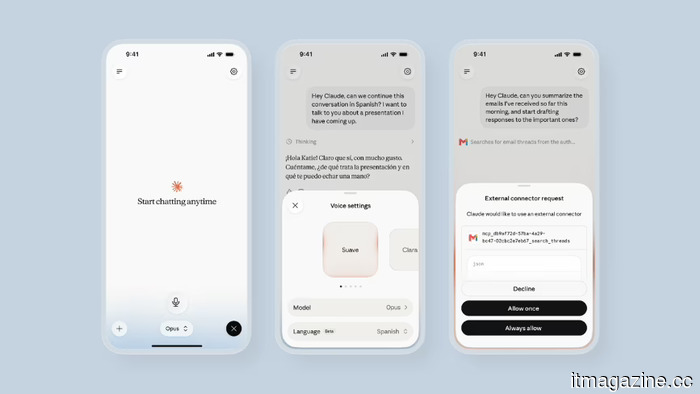
Claude's voice mode now operates using Opus and Sonnet.
Anthropic wants you to interact with Claude and observe its actions. The company announced on Thursday that it has upgraded Claude’s voice mode to operate using its most advanced models, Opus and Sonnet.
Voice mode was introduced last year, initially running only on Haiku, which is Anthropic’s quickest but least complex model. This setup was adequate for brief inquiries. However, as users began leveraging it to discuss more complex issues aloud, Anthropic noted that while Haiku maintained a quick pace, it lacked depth.
The goal is to create a more intelligent sounding board. Opus and Sonnet are designed to tackle challenging problems. You can articulate an incomplete idea, and Claude will respond with follow-up questions that stimulate your thinking instead of merely providing answers.
You can switch between models during a conversation, with the system using the fastest version of your selected model. It automatically defaults to the last text model you used. Anthropic markets this feature as useful for practicing presentations, evaluating two job offers, or verbal brainstorming before an important call.
The significant change is that voice mode can now perform actions. By connecting your applications, you can instruct Claude to schedule a meeting on Google Calendar, summarize today’s emails, draft responses, or transform a spoken pitch into a one-page document in Canva. It also has access to Slack and Notion, and Claude always asks for permission before utilizing any tool.
Voice mode now supports many more languages, including French, German, Italian, Japanese, and both variations of Spanish. However, you need to instruct it to switch languages, as it won’t automatically detect the change.
This distinction marks where Anthropic diverges from OpenAI. Weeks ago, OpenAI enhanced ChatGPT with a more natural, full-duplex voice capable of listening and speaking simultaneously. In contrast, Claude’s voice mode operates on a turn-based system: it listens, pauses to process, and then responds. This often feels less fluid than ChatGPT.
Anthropic did not modify the foundational voice infrastructure, so there are no new features like improved interruption handling. As the company stated to Engadget, “This release focuses on intelligence and tool access,” with promises of “more to share later this year.”
This divergence is significant. OpenAI is striving to make its assistant sound more human, while Anthropic is focusing on enabling its assistant to perform tasks. The new voice mode is currently in beta for all users on mobile, desktop, and web, although it performs best on mobile devices. Free users have access to Haiku and a single connected app, while others benefit from the more advanced models and a full suite of tools, with the assurance that speaking is just the beginning.
Other articles
 Meta exits the RE100 clean energy initiative after ten years of membership as the expansion of gas infrastructure increases.
Meta has exited the RE100 initiative after ten years, failing to satisfy renewable energy criteria while financing ten gas plants for its Hyperion AI data center in Louisiana.
Meta exits the RE100 clean energy initiative after ten years of membership as the expansion of gas infrastructure increases.
Meta has exited the RE100 initiative after ten years, failing to satisfy renewable energy criteria while financing ten gas plants for its Hyperion AI data center in Louisiana.
 Startups are appealing to Trump not to impose a ban on Chinese open-weight AI.
Almost 200 startups in the US, among them Y Combinator and Proton, have cautioned that banning Chinese open-weight AI could eliminate hundreds of these companies and allow Anthropic to dominate the market.
Startups are appealing to Trump not to impose a ban on Chinese open-weight AI.
Almost 200 startups in the US, among them Y Combinator and Proton, have cautioned that banning Chinese open-weight AI could eliminate hundreds of these companies and allow Anthropic to dominate the market.
 Patreon reduces its workforce by 20% while being cautious about AI developments.
Patreon is eliminating 93 positions, which accounts for 20% of its workforce. CEO Jack Conte states that AI is not taking over these roles, but has "fundamentally transformed" the company's operations.
Patreon reduces its workforce by 20% while being cautious about AI developments.
Patreon is eliminating 93 positions, which accounts for 20% of its workforce. CEO Jack Conte states that AI is not taking over these roles, but has "fundamentally transformed" the company's operations.
 Meta withdraws from the RE100 clean energy initiative after ten years of participation as the expansion of gas infrastructure increases.
Meta has exited the RE100 initiative after ten years, failing to fulfill renewable energy requirements as it invests in ten gas plants for its Hyperion AI data center in Louisiana.
Meta withdraws from the RE100 clean energy initiative after ten years of participation as the expansion of gas infrastructure increases.
Meta has exited the RE100 initiative after ten years, failing to fulfill renewable energy requirements as it invests in ten gas plants for its Hyperion AI data center in Louisiana.
 Dassault Systèmes is set to acquire ArisGlobal for as much as $2 billion.
Dassault Systèmes is acquiring the US drug-safety AI company ArisGlobal for as much as $2 billion, marking a significant investment in life sciences from a company concerned that AI might disrupt its fundamental business.
Dassault Systèmes is set to acquire ArisGlobal for as much as $2 billion.
Dassault Systèmes is acquiring the US drug-safety AI company ArisGlobal for as much as $2 billion, marking a significant investment in life sciences from a company concerned that AI might disrupt its fundamental business.
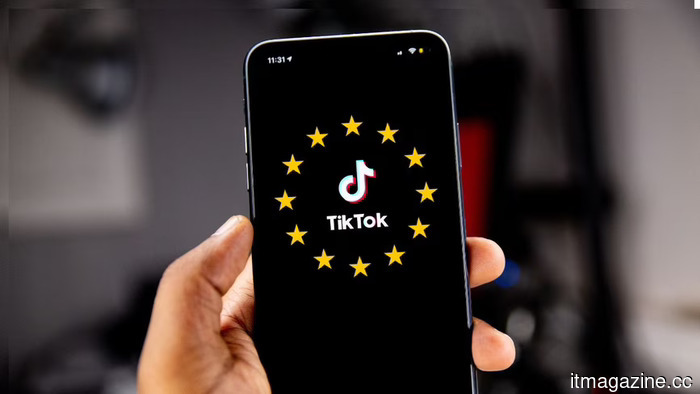 The EU has accused TikTok of not adequately safeguarding children's privacy in accordance with the DSA.
Brussels claims that TikTok allowed minors’ accounts to be accessible to strangers, according to initial findings from the DSA, which could result in a penalty of up to 6% of global revenue.
The EU has accused TikTok of not adequately safeguarding children's privacy in accordance with the DSA.
Brussels claims that TikTok allowed minors’ accounts to be accessible to strangers, according to initial findings from the DSA, which could result in a penalty of up to 6% of global revenue.
Claude's voice mode now operates using Opus and Sonnet.
Anthropic's Claude voice mode now operates on Opus and Sonnet, allowing it to function within Gmail, Slack, and your calendar, focusing on performing tasks rather than merely sounding human like ChatGPT.