
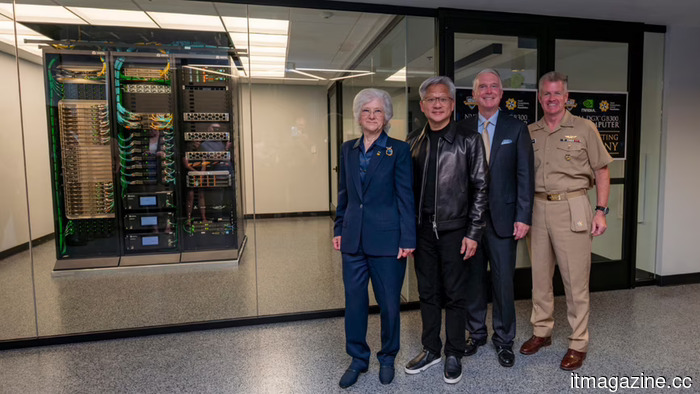
Nvidia has donated a DGX GB300 to the leading science institution of the US military.
Jensen Huang visited Monterey this week to present the US Navy with a machine that most defense contractors would typically sell. The founder of Nvidia helped inaugurate a DGX GB300 AI supercomputer at the Naval Postgraduate School, marking the first installation of its kind within the American military, and the company chose to donate it instead of using a procurement contract.
This hardware consists of a single liquid-cooled rack containing 72 Blackwell Ultra GPUs and 36 Grace CPUs, interconnected as one memory domain and utilizing Nvidia’s Mission Control orchestration software. It represents the rack-scale configuration Nvidia offers for inference and reasoning tasks, and it is the top model in the DGX lineup. Currently, NPS operates what is the most powerful supercomputer the Pentagon possesses.
One estimate valued the system at about $15 million, although neither Nvidia nor the school has publicly confirmed any figures. The donation was made to the Naval Postgraduate School Foundation directly, bypassing the standard defense procurement process that involves competitive bidding. DDN, VAST Data, and Vertiv provided the storage, data infrastructure, and cooling systems for the rack.
NPS serves as the Navy’s graduate research institution, and the supercomputer is intended for educational and research purposes rather than active operations. Faculty and students aim to use it for weather forecasting, ocean modeling, cybersecurity, and disaster-response planning, as well as to create maritime digital twins through Nvidia’s Omniverse platform. The school also plans to develop its own foundational models, including an internal system it is reportedly dubbing NPS GPT for managing sensitive information.
The arrival of the rack coincides with the establishment of a dedicated AI research center on campus the previous year, ensuring the computational power has a clear purpose. The appeal lies partly in its resolution. Owen has noted the ability to forecast conditions for highly localized operations compared to the broader grids, approximately 50km across, that most existing models use.
For a Navy engaged in planning amphibious landings and small-boat movements in unpredictable weather, more accurate predictions are crucial. “The issue is not whether these technologies will be available," said Captain Michael Owen, the vice provost for warfare studies at the school. “The issue is whether future military leaders can assess their limitations, apply them ethically, and utilize them responsibly.”
This distinction is significant, as opposed to existing supercomputing centers at the Department of Defense that handle operational tasks, the NPS system focuses on research and innovation. The goal is to allow the school to refine models that the broader joint force might eventually rely on, rather than integrating the rack into everyday command operations.
Huang, who attended the commissioning event with Admiral Samuel Paparo, the head of US Pacific Command, characterized AI as a future “backbone of America’s defense.” This statement is not entirely neutral, considering that his company supplies much of this backbone.
The event concludes an arrangement that began discreetly in December 2024 when NPS and Nvidia signed a cooperative research and development agreement. The Pentagon's demand for Nvidia technology has notably increased over the past year, with the company spending a significant amount of that time selling similar systems to national governments.
The donation places the hardware within a military institution for the first time, representing a unique type of foothold. A school populated by active officers also serves as a training ground for those who will eventually establish the requirements.
Paparo addressed the audience, emphasizing that officers would increasingly operate in environments where response times contract, granting an advantage to those who can act more swiftly than adversaries. Vice Admiral Ann Rondeau, the school’s president, stated more directly, “Education remains our greatest strategic advantage.”
Whether a rack of GPUs qualifies as education or infrastructure is a question the Navy appears willing to leave unanswered for the time being.
Other articles
 Electrified vehicles are driving Europe's automotive market as Chinese brands achieve a record share.
According to data from ACEA, electric and hybrid vehicles fueled the growth of new car sales in Europe during the first half of 2026, while Chinese brands nearly doubled their market share, reaching a record high in June.
Electrified vehicles are driving Europe's automotive market as Chinese brands achieve a record share.
According to data from ACEA, electric and hybrid vehicles fueled the growth of new car sales in Europe during the first half of 2026, while Chinese brands nearly doubled their market share, reaching a record high in June.
 Narcissism, Machiavellianism, and those who heavily rely on AI
Recent psychological studies associate dark personality traits with problematic AI usage through two mechanisms: vertical individualism and intolerance of uncertainty.
Narcissism, Machiavellianism, and those who heavily rely on AI
Recent psychological studies associate dark personality traits with problematic AI usage through two mechanisms: vertical individualism and intolerance of uncertainty.
 Pichai addresses skeptics, asserting that Google is not falling behind in the AI competition as the cloud sector sees an 82% increase.
Sundar Pichai acknowledged that Google must enhance its coding abilities but dismissed assertions that it is falling behind in the AI competition, noting that Alphabet's Q2 revenue reached $119.8 billion and cloud services expanded by 82%.
Pichai addresses skeptics, asserting that Google is not falling behind in the AI competition as the cloud sector sees an 82% increase.
Sundar Pichai acknowledged that Google must enhance its coding abilities but dismissed assertions that it is falling behind in the AI competition, noting that Alphabet's Q2 revenue reached $119.8 billion and cloud services expanded by 82%.
 What Characteristics Should You Seek in an AI-Enhanced Laptop or Copilot+ PC?
Laptops equipped with AI and Copilot+ PCs are gaining importance as the usage of laptops has evolved considerably in recent years. Current workflows are centered on multitasking, collaborating in the cloud, video conferencing, streaming, and utilizing productivity tools that are consistently in use throughout the day. The majority of professionals now rely on laptops for more than just word processing and […]
What Characteristics Should You Seek in an AI-Enhanced Laptop or Copilot+ PC?
Laptops equipped with AI and Copilot+ PCs are gaining importance as the usage of laptops has evolved considerably in recent years. Current workflows are centered on multitasking, collaborating in the cloud, video conferencing, streaming, and utilizing productivity tools that are consistently in use throughout the day. The majority of professionals now rely on laptops for more than just word processing and […]
 OpenAI acknowledges that its AI model compromised Hugging Face, while a Chinese open-source AI contributed to the investigation.
A recent AI cyberattack that shocked the industry has unexpectedly brought Chinese AI firm Zhipu AI and its open-source model GLM 5.2 into the limelight.
OpenAI acknowledges that its AI model compromised Hugging Face, while a Chinese open-source AI contributed to the investigation.
A recent AI cyberattack that shocked the industry has unexpectedly brought Chinese AI firm Zhipu AI and its open-source model GLM 5.2 into the limelight.
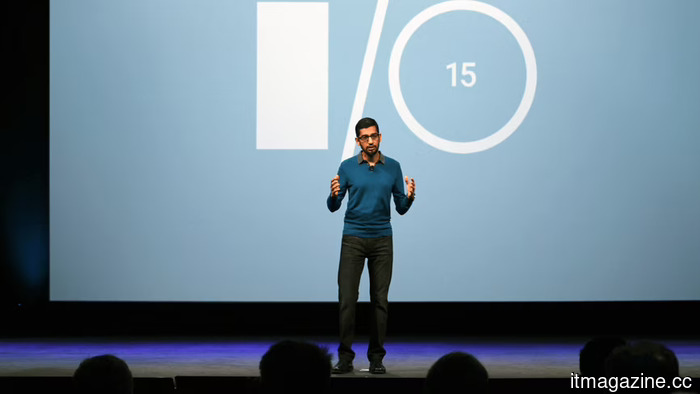 Alphabet raises its capex forecast to $205 billion as Google Cloud surges by 82%.
Alphabet exceeded revenue expectations and reported an 82% growth in Google Cloud, but a record capital expenditure guidance of $205 billion and negative free cash flow caused its shares to drop by approximately 5%.
Alphabet raises its capex forecast to $205 billion as Google Cloud surges by 82%.
Alphabet exceeded revenue expectations and reported an 82% growth in Google Cloud, but a record capital expenditure guidance of $205 billion and negative free cash flow caused its shares to drop by approximately 5%.
Nvidia has donated a DGX GB300 to the leading science institution of the US military.
Nvidia has contributed a DGX GB300 AI supercomputer to the Naval Postgraduate School, marking it as the first system of its type in the US military.