
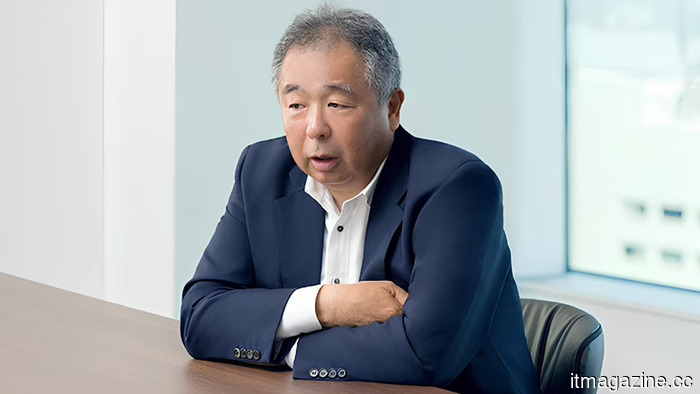
Noetra's CEO describes his robotic AI startup as Japan's 'final opportunity.'
Hironobu Tamba dedicated years at SoftBank to developing large language models, the types of software that respond to inquiries and compose emails. He has since transitioned away from that work to invest in machines that enable movement.
Tamba is now the president and CEO of Noetra, a Tokyo-based company that commenced extensive research in July on developing a domestically-produced foundation model focused on robotics rather than chatbots. In an interview with Reuters, he presented the endeavor in stark terms, declaring it Japan's final opportunity to regain significance in the upcoming wave of artificial intelligence.
The nation is backing this initiative with substantial funding. Noetra is at the heart of a state-supported program that will utilize a 140MW AI factory, with a considerable part of the Japanese robotics sector collaborating on the project. Major contributors include Sony Group, SoftBank, NEC, and Honda Motor, alongside 44 additional companies and organizations, primarily from the manufacturing sector, serving as investors.
The public investment is considerable. Japan's Ministry of Economy, Trade and Industry has allocated ¥387.3 billion, approximately $2.4 billion, for the current fiscal year, as part of an overall commitment of up to ¥1 trillion (around $6 billion) promised over five years, funded by the country’s green transition bonds. This marks one of the largest single investments any government has made in domestic AI, despite relying on a relatively nascent company.
Noetra's approach is gradual rather than abrupt. According to a joint announcement from its partners, the company plans to launch a reasoning model with capabilities in Japanese-language comprehension by fiscal 2027, followed by an omni-modal system that can manage text, images, video, and audio by fiscal 2028, and a so-called “Real-world Native AI” that can understand physical properties by fiscal 2030.
The infrastructure for training these models will be provided by the FRONTia data center, which features 27,500 Nvidia Rubin GPUs and 13,750 Vera CPUs, with construction expected to begin in April 2027 and operations projected to commence in June 2028.
The deliberate choice to focus on robots instead of chatbots aligns with Japan's significant strength in the field. The country already dominates nearly 70% of the global industrial robotics market, and the government believes that future competitions in AI will primarily take place in factories and warehouses rather than online.
This is where humanoid robots and physical AI are anticipated to converge, a domain where Tamba is confident Japan can maintain its leadership. Accordingly, the ambition is ambitious. METI has set a goal of deploying 10 million AI-enabled robots across 18 sectors by 2040 and capturing over 30% of the global market for physical AI, an industry the government values in the tens of trillions of yen.
This strategy emphasizes technological sovereignty, aiming to develop domestic intelligence for the country’s machines instead of relying on companies based in California or Shenzhen.
Beneath the financial figures lies a more subtle narrative about timing. Japan largely observed the race for language models from the sidelines while American and Chinese laboratories surged ahead, and its attempts at a national chatbot received a lukewarm reception both at home and abroad.
Tamba’s reference to a "last chance" suggests an acknowledgment of this reality. He believes that the robotics wave has not yet reached its peak, that Japan’s long-standing expertise in hardware can still be leveraged, and that a locally developed foundation model has the potential to translate manufacturing strengths into software superiority before the opportunity diminishes.
The success of this initiative remains to be seen in the latter part of the decade. The first model is still over a year away, the data center is set for a longer timeline, and many national AI initiatives have faltered in the gap between a well-funded consortium and a functioning product. Nvidia, which will provide the necessary technology, has every reason to support this project. For now, Tamba possesses the funding, the partnerships, and a self-imposed deadline.
Other articles
 Apple has resolved an issue with the Hide My Email feature that revealed users' actual email addresses.
A vulnerability in Hide My Email revealed actual addresses through returned spam messages for more than a year before Apple fixed it, just days after it became public knowledge.
Apple has resolved an issue with the Hide My Email feature that revealed users' actual email addresses.
A vulnerability in Hide My Email revealed actual addresses through returned spam messages for more than a year before Apple fixed it, just days after it became public knowledge.
 Apple is said to be collaborating with Klarna to allow customers to pay for new devices in installments.
Apple is said to be launching a new financing initiative named Apple Upgrade in collaboration with Klarna later this month.
Apple is said to be collaborating with Klarna to allow customers to pay for new devices in installments.
Apple is said to be launching a new financing initiative named Apple Upgrade in collaboration with Klarna later this month.
 Big Tech's investment in AI is aligning with its cash flow.
The combined capital expenditures on AI by the largest cloud companies are expected to surpass the revenue generated by their primary operations, with free cash flow being the first to show the impact.
Big Tech's investment in AI is aligning with its cash flow.
The combined capital expenditures on AI by the largest cloud companies are expected to surpass the revenue generated by their primary operations, with free cash flow being the first to show the impact.
 The University of Tennessee has filed a lawsuit against Anthropic regarding patents related to neural networks.
The University of Tennessee has filed a lawsuit against Anthropic in Delaware regarding two neural network patents, marking what is believed to be the firm's inaugural patent litigation.
The University of Tennessee has filed a lawsuit against Anthropic regarding patents related to neural networks.
The University of Tennessee has filed a lawsuit against Anthropic in Delaware regarding two neural network patents, marking what is believed to be the firm's inaugural patent litigation.
 According to reports, Samsung is getting ready for the largest competition in the foldable market to date.
Samsung has allegedly ramped up production of the Galaxy Z Fold 8, indicating confidence in its new, broader foldable device ahead of Galaxy Unpacked.
According to reports, Samsung is getting ready for the largest competition in the foldable market to date.
Samsung has allegedly ramped up production of the Galaxy Z Fold 8, indicating confidence in its new, broader foldable device ahead of Galaxy Unpacked.
Noetra's CEO describes his robotic AI startup as Japan's 'final opportunity.'
Hironobu Tamba departed from SoftBank to head Noetra, a $6 billion state-supported initiative focused on developing AI for robots in Japan. He refers to it as the nation's last opportunity.