
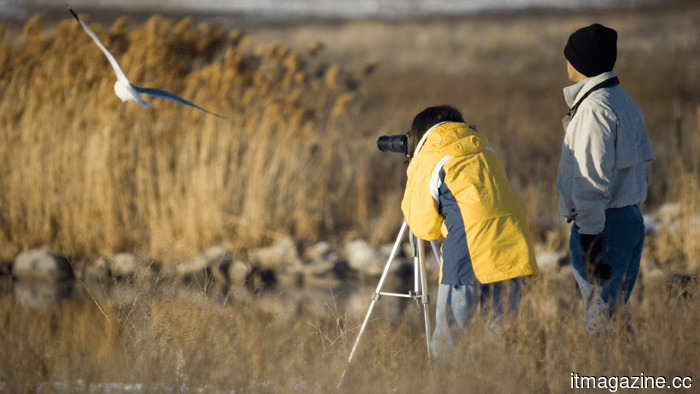
AI-generated misinformation is fabricating rare bird sightings and negatively impacting scientific research.
A rare bird was reported in central Brazil, or so it appeared. A photograph posted on the wildlife platform iNaturalist featured a red-winged blackbird, a species from North America that had never been seen in that region of Brazil. It would have marked a significant first occurrence. However, the sighting was not genuine. The bird depicted in the original image was actually an epaulet oriole, a common species in the area. The photographer had requested an AI tool to enhance the photo, which inadvertently added elements from a different bird.
The issue with 'enhancing' photos
This incident underscores a warning from researchers, articulated in a commentary published in Nature Ecology & Evolution. They argue that generative AI is beginning to contaminate citizen-science records. These crowd-sourced observations provide scientists with information about species distributions and their movements.
There are two primary ways this contamination occurs. The less common instance involves outright forgeries—images that are entirely fabricated and misrepresented as real. The more prevalent issue is subtler: a birdwatcher requests that AI remove an obstruction or clarify a fuzzy image. The AI then reconstructs the bird, often erasing identifying field marks.
According to the researchers, they have identified several hundred suspicious images across platforms like the Macaulay Library, iNaturalist, and Brazil's WikiAves. The actual number is uncertain, as many such images go unnoticed.
Why accurate records are crucial
These platforms serve more than just amateur enthusiasts. For instance, iNaturalist boasts over 610 million images. Scientists utilize this data to monitor how wildlife is responding to climate change. “Ordinary individuals are providing information that scientists could probably never gather on such a scale,” said Tony Iwane from iNaturalist, a co-author of the study. He described the network as “almost like a sensor of what is happening on Earth in real time.” The key point is that the data must be reliable.
If inaccurate data is fed into the system, the resulting conclusions can be flawed. A single AI-generated sighting may misleadingly indicate that a species has altered its habitat range when it has not. There is also an additional downside: altered images used to train AI identification tools can inadvertently compromise their accuracy.
Misinformation meets the natural world
Outright fabrications are generally easy to identify. “Nobody believes a toucan sighting in Siberia,” said Dr. Alexander Lees in an interview with The Guardian. The ecologist from Manchester Metropolitan University, who led the research paper, stated that the subtle edits pose a greater threat. Lees asserted that a significant portion of the wildlife photos he encounters on platforms like Facebook are purely AI-generated. This same AI-generated material is flooding other areas of the internet, but in this context, it undermines scientific records rather than social media feeds. The tools capable of recreating a football match that never happened can also fabricate a bird that was never present.
Responding to the issue
The platforms are beginning to take action. iNaturalist now offers users two ways to flag images. A flag for fully AI-generated images results in the image being hidden, while a flag for those that are overly manipulated downgrades the image to “casual” status, preventing it from entering research databases.
To date, only about 1,400 of its 610 million images have been flagged for AI manipulation, with roughly 600 marked as completely AI-generated. Depending on one's perspective, this might be reassuring or indicative of a significant amount slipping through the cracks. Detection is challenging, as Meta has discovered with its own AI image detection system.
The researchers advocate for enhanced tools, including checks for image authentication and metadata verification. Most importantly, they seek educational initiatives to inform bird watchers that “improving” a photo can compromise scientific integrity. The broader lesson resonates across various sectors of the internet influenced by AI. Once fakes become convincing enough, trust becomes a rare commodity.
Other articles
 Netflix aims for ‘AI fluency’ among all its employees, yet expertise in the field remains limited.
Elizabeth Stone, the technology chief at Netflix, describes AI fluency as a goal for all positions, while noting that exceptional talent is becoming increasingly rare.
Netflix aims for ‘AI fluency’ among all its employees, yet expertise in the field remains limited.
Elizabeth Stone, the technology chief at Netflix, describes AI fluency as a goal for all positions, while noting that exceptional talent is becoming increasingly rare.
 deltaVision secures €10.2M to develop the infrastructure for in-orbit refueling.
The Munich-based startup deltaVision has secured €10.2 million in its initial funding round to expand its spacecraft valves and develop components for refueling satellites in orbit.
deltaVision secures €10.2M to develop the infrastructure for in-orbit refueling.
The Munich-based startup deltaVision has secured €10.2 million in its initial funding round to expand its spacecraft valves and develop components for refueling satellites in orbit.
 Kanishka Narayan is appointed as the UK’s inaugural cabinet-level minister for AI.
Kanishka Narayan is appointed as the inaugural AI minister in the UK, participating in the cabinet following the decision of new Prime Minister Andy Burnham to dissolve the DSIT and restructure Whitehall to focus on technology.
Kanishka Narayan is appointed as the UK’s inaugural cabinet-level minister for AI.
Kanishka Narayan is appointed as the inaugural AI minister in the UK, participating in the cabinet following the decision of new Prime Minister Andy Burnham to dissolve the DSIT and restructure Whitehall to focus on technology.
 Tesla's cash expenditure will challenge investors' confidence in its artificial intelligence investments.
Tesla reports record deliveries for Q2 but is expected to use around $3.25 billion in cash as its $25 billion expenditure on AI, robotaxis, and Optimus strains investor patience.
Tesla's cash expenditure will challenge investors' confidence in its artificial intelligence investments.
Tesla reports record deliveries for Q2 but is expected to use around $3.25 billion in cash as its $25 billion expenditure on AI, robotaxis, and Optimus strains investor patience.
 Xiaohongshu took a risk with a 40-day livestream experiment during the World Cup to investigate the future of long-form content.
When Spain raised the FIFA World Cup trophy on Monday, it marked the conclusion of the 2026 tournament as well as Xiaohongshu's inaugural full-scale World Cup experience.
Xiaohongshu took a risk with a 40-day livestream experiment during the World Cup to investigate the future of long-form content.
When Spain raised the FIFA World Cup trophy on Monday, it marked the conclusion of the 2026 tournament as well as Xiaohongshu's inaugural full-scale World Cup experience.
 The Snapseed Camera now enables Android users to save original images and include geotags.
Google has enhanced the Snapseed Camera for Android by introducing geotag support, saving original photos, and improving file management for photographers.
The Snapseed Camera now enables Android users to save original images and include geotags.
Google has enhanced the Snapseed Camera for Android by introducing geotag support, saving original photos, and improving file management for photographers.
AI-generated misinformation is fabricating rare bird sightings and negatively impacting scientific research.
AI-altered images are creating false reports of rare bird sightings on iNaturalist, and scientists caution that this AI-generated content could compromise biodiversity records.