
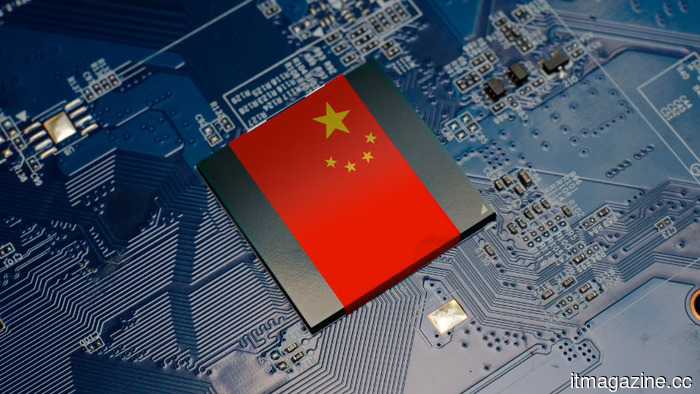
According to the Financial Times, China is considering implementing export restrictions on its artificial intelligence models and chips.
China is contemplating the tightening of export restrictions on its domestically developed artificial intelligence models and the chips that operate them, according to the Financial Times. This potential move would elevate Beijing's technology protections beyond the raw materials and equipment it currently monitors.
The newspaper, referencing two sources involved in the discussions, reported that regulators from the Ministry of Commerce have been engaging with prominent domestic AI and chip manufacturers to discuss possible safeguards. No conclusions have been reached yet, and it remains uncertain when or if any measures will be implemented.
These discussions signify that China's economy, the world's second largest, is beginning to view its top AI assets as something to protect rather than share, reflecting a similar strategy to the American restrictions that initially drove Chinese companies toward custom ASICs.
According to the FT, officials are considering revising the export lists for AI and chip-related products, establishing clearer criteria for license approvals, implementing stricter checks on end users, and setting higher barriers for technology transfers abroad. The goal, as indicated in the report, is to prevent the West from appropriating China’s most advanced technologies and its rapidly developing start-ups.
The aspect concerning chips is a more recent development. While Beijing already controls exports of rare earth elements and certain semiconductor materials, formally including finished AI accelerators and their associated models in a licensing framework would represent a significant shift in its industrial policy approach.
A foundational discussion occurred earlier this month. Reuters reported that the commerce ministry had conferred with Alibaba, ByteDance, and the start-up Z.ai about restricting international access to their leading systems, including Alibaba's Qwen, ByteDance's Doubao, and Z.ai's GLM-5.2. These talks reportedly examined both closed and open-weight models and proposed a tiered review system that could keep advanced technologies entirely within China.
Currently, the details remain sparse. The sources quoted by the FT did not clarify which chips would be included, what performance criteria might be established, or how open-source releases would be managed, and the ministry has not issued a draft version of any regulation.
China's commerce ministry has not publicly addressed the report, and the companies involved have not substantiated the discussions. This silence is noteworthy, as Beijing typically does not signal changes in export policy ahead of their implementation, and officials have indicated to Reuters that any restrictions may apply solely to future models.
The context includes an escalating chip conflict that has intensified over several years. The United States has progressively tightened its controls, recently addressing loopholes that allowed Nvidia's top chips to reach Chinese consumers via overseas subsidiaries while urging allies to restrict chip-making equipment supplies.
In response, Beijing has issued rare-earth export restrictions and initiated antitrust investigations, and now, it appears to be considering its own set of measures.
Should China implement an AI export regime, the repercussions would extend beyond the United States. As noted by The Decoder, European developers and smaller companies that have been utilizing China's freely available models as a cost-effective alternative to American services could face limitations.
Moving forward, if anything materializes, it would likely involve establishing a licensing framework and detailing the specifics of such regulations. Analysts anticipate that any new rules will initially target high-performance systems and future model iterations rather than software currently available, though sources cited by the FT warned that these plans could still evolve or be postponed.
There is also a dimension of negotiation involved. Some analysts interpret the current actions as a strategic move for a broader trade agreement, given that Beijing has concurrently urged Washington to ease its chip restrictions.
For a nation that has spent the last decade criticizing export controls imposed on it, crafting its own regulations would represent a significant shift. The report suggests that it remains uncertain whether this development will solidify into a rigid barrier or serve as a bargaining tool until officials finalize and publicly release their intentions.
Other articles
 New YouTube guidelines aim to eliminate poorly made AI content and clickbait tactics.
In a significant step to safeguard viewer engagement and advertiser investments, YouTube has revised its monetization policies to cut off revenue from subpar, AI-generated content. The streaming powerhouse is adjusting the regulations surrounding its profitable YouTube Partner Program (YPP) to specifically address “inauthentic content” that is created solely for low-effort content farming. Instead of prohibiting artificial intelligence […]
New YouTube guidelines aim to eliminate poorly made AI content and clickbait tactics.
In a significant step to safeguard viewer engagement and advertiser investments, YouTube has revised its monetization policies to cut off revenue from subpar, AI-generated content. The streaming powerhouse is adjusting the regulations surrounding its profitable YouTube Partner Program (YPP) to specifically address “inauthentic content” that is created solely for low-effort content farming. Instead of prohibiting artificial intelligence […]
 Tennessee puts Instagram's compelling design under scrutiny as Meta engages in a jury trial lasting seven weeks.
The seven-week trial in Tennessee regarding allegations that Instagram was designed to be addictive for teenagers has now reached a jury in Nashville, marking a new challenge for Meta.
Tennessee puts Instagram's compelling design under scrutiny as Meta engages in a jury trial lasting seven weeks.
The seven-week trial in Tennessee regarding allegations that Instagram was designed to be addictive for teenagers has now reached a jury in Nashville, marking a new challenge for Meta.
 Volvo is launching Apple Music for more than 2 million vehicles through a straightforward OTA update.
Volvo is introducing native support for Apple Music to more than 2 million vehicles, featuring Spatial Audio in certain models and providing free subscription deals.
Volvo is launching Apple Music for more than 2 million vehicles through a straightforward OTA update.
Volvo is introducing native support for Apple Music to more than 2 million vehicles, featuring Spatial Audio in certain models and providing free subscription deals.
 The Snapseed Camera now enables Android users to save original images and include geotags.
Google has enhanced the Snapseed Camera for Android by introducing geotag support, saving original photos, and improving file management for photographers.
The Snapseed Camera now enables Android users to save original images and include geotags.
Google has enhanced the Snapseed Camera for Android by introducing geotag support, saving original photos, and improving file management for photographers.
 Samsung introduces its inaugural credit card in the US in partnership with Barclays, marking its most significant step into the financial sector to date.
Samsung's inaugural credit card in the US, the Galaxy Card issued by Barclays, offers up to 5% cash back when used within Samsung Wallet. Here's how it functions and what's on the horizon.
Samsung introduces its inaugural credit card in the US in partnership with Barclays, marking its most significant step into the financial sector to date.
Samsung's inaugural credit card in the US, the Galaxy Card issued by Barclays, offers up to 5% cash back when used within Samsung Wallet. Here's how it functions and what's on the horizon.
 After months of anticipation, WhatsApp’s Liquid Glass redesign is finally set to arrive on Mac.
WhatsApp has started implementing its redesign for Mac, inspired by Liquid Glass, which features an updated interface, enhanced navigation, and specific sections for Locked Chats and Communities.
After months of anticipation, WhatsApp’s Liquid Glass redesign is finally set to arrive on Mac.
WhatsApp has started implementing its redesign for Mac, inspired by Liquid Glass, which features an updated interface, enhanced navigation, and specific sections for Locked Chats and Communities.
According to the Financial Times, China is considering implementing export restrictions on its artificial intelligence models and chips.
According to the Financial Times, China is reportedly considering imposing export restrictions on its AI models and the chips that power them, although no decisions have been made yet.