
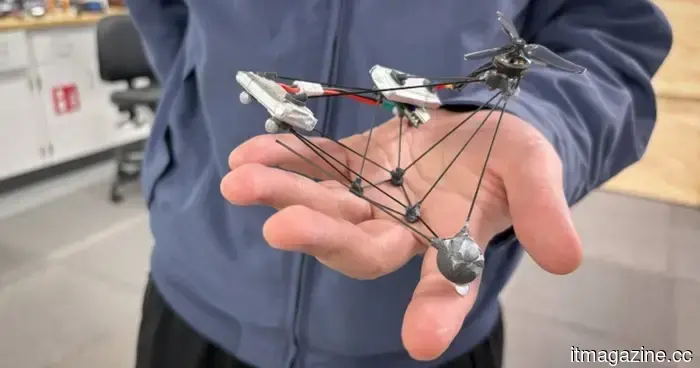
This rotating drone conceals itself in plain view by employing a visual illusion.
For many years, engineers have pursued the vision of an invisible drone. Traditional methods have typically involved the use of transparent materials, camouflage coatings, or sophisticated optical systems to redirect light around an object. Researchers at Northwestern University opted for a radically different approach. Rather than concealing the drone itself, they decided to deceive the human eye.
The outcome is Phantom Twist, an experimental drone that spins at such high speeds that it nearly vanishes against its surroundings. While it isn't truly invisible, it appears more as a faint blur than as an actual flying device to anyone watching.
The findings were shared at Robotics: Science and Systems 2026 in Sydney, Australia, where the team introduced a novel technique for making drones significantly less visible without depending on advanced cloaking technologies.
The key is not invisibility but movement.
If you’ve ever observed a ceiling fan spinning at full speed, you understand the principle behind Phantom Twist. When the blades rotate quickly enough, individual objects become indistinguishable and instead, form a translucent blur. The Northwestern researchers realized that this limitation of human vision could be applied to an entire drone.
In contrast to a standard quadcopter, where only the propellers turn while the body remains visible, Phantom Twist keeps all parts in motion. It features a single motor and propeller. As the propeller spins in one direction, the rest of the drone rotates in the opposite direction at speeds of up to 25 revolutions per second. This constant rotation eliminates stable visual reference points, which our brains typically use to recognize flying objects.
Project lead Michael Rubenstein explains that the team wasn’t focused on making the drone blend in with its environment. Instead, they tailored its design to align with how humans naturally perceive motion. Rather than looking like a solid object, Phantom Twist transforms into what researchers refer to as a ghostly haze that merges with various backgrounds.
AI generated thousands of drone designs before arriving at the final prototype.
Constructing the final version was not just about rearranging existing parts. The team initially created around 20,000 potential drone designs through computational modeling. Artificial intelligence and optimization algorithms consistently repositioned critical components—including the battery, circuit board, motor, propeller, and counterweights—to discover the arrangement that would remain stable while being as inconspicuous as possible from nearly every angle.
Researchers then simulated each design against 100 different real-world environments. A computer vision model, developed to replicate human visual processing, evaluated each design based on its detectability.
The highest scoring candidates underwent additional optimization before the engineers physically constructed the final drone. This design intentionally distributes the drone's components across varying heights and angles, causing the individual parts to visually merge into a semi-transparent blur during rotation instead of forming a recognizable shape.
According to the team’s visibility model, Phantom Twist is about 10 times less noticeable than a standard quadcopter. This technology could be beneficial for scenarios where visibility impacts behavior. Wildlife researchers could study nesting birds without causing disruption. Environmental surveys might become less obtrusive, and infrastructure inspections could draw less public interest.
The drone isn’t flawless yet. It still generates noticeable noise from the propeller, and support rods and wiring remain partially visible. The researchers aspire for future iterations to incorporate quieter propulsion systems and more transparent structural materials. While true invisibility may still reside in the realm of science fiction, Phantom Twist illustrates that sometimes the most effective way to conceal something is not to make it vanish, but to trick the brain into believing it was never there at all.
Other articles
 You can now modify videos in Google Vids just by stating the changes you want.
Google has introduced Gemini Omni and personal avatars to Vids, providing paid users with innovative methods for creating, editing, and presenting videos without the use of conventional editing software.
You can now modify videos in Google Vids just by stating the changes you want.
Google has introduced Gemini Omni and personal avatars to Vids, providing paid users with innovative methods for creating, editing, and presenting videos without the use of conventional editing software.
 You can now connect your favorite applications to AI Mode in Google Search to accomplish tasks.
The AI Mode in Google Search can now interact with applications such as Instacart, Canva, and YouTube Music to perform tasks on your behalf.
You can now connect your favorite applications to AI Mode in Google Search to accomplish tasks.
The AI Mode in Google Search can now interact with applications such as Instacart, Canva, and YouTube Music to perform tasks on your behalf.
 Galaxy Z Fold 8 Ultra: All the information we have on Samsung's upcoming flagship foldable device.
Samsung's upcoming flagship foldable may feature significant enhancements throughout, such as a more visible crease improvement and a noticeably quicker chipset.
Galaxy Z Fold 8 Ultra: All the information we have on Samsung's upcoming flagship foldable device.
Samsung's upcoming flagship foldable may feature significant enhancements throughout, such as a more visible crease improvement and a noticeably quicker chipset.
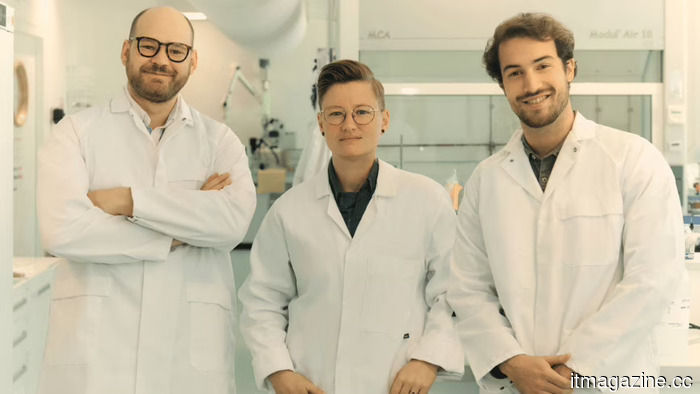 Syntetica secures $30 million to expand nylon recycling efforts.
French deeptech company Syntetica has secured $30 million to enhance its nylon recycling capabilities, allowing for the recycling of two grades simultaneously, with support from Lululemon and Bpifrance among its investors.
Syntetica secures $30 million to expand nylon recycling efforts.
French deeptech company Syntetica has secured $30 million to enhance its nylon recycling capabilities, allowing for the recycling of two grades simultaneously, with support from Lululemon and Bpifrance among its investors.
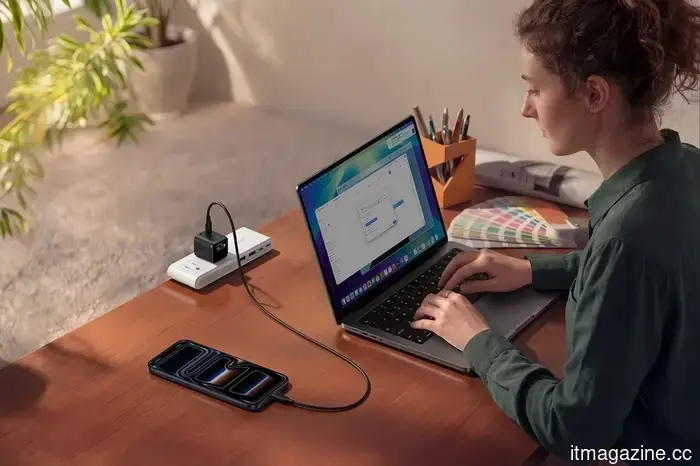 A "smart" charger with a screen has appeared in Russia.
The company Anker has announced the launch of sales in Russia of its new 45W Anker Nano Charger. This is not just another "brick" for the socket, but a real small computer with a color display.
A "smart" charger with a screen has appeared in Russia.
The company Anker has announced the launch of sales in Russia of its new 45W Anker Nano Charger. This is not just another "brick" for the socket, but a real small computer with a color display.
 Mick Jagger claims that AI is acceptable for musicians, as long as it doesn't mimic his voice.
Mick Jagger supports AI as a creative resource but firmly opposes software that replicates the Rolling Stones, coinciding with the band's release of Foreign Tongues.
Mick Jagger claims that AI is acceptable for musicians, as long as it doesn't mimic his voice.
Mick Jagger supports AI as a creative resource but firmly opposes software that replicates the Rolling Stones, coinciding with the band's release of Foreign Tongues.
This rotating drone conceals itself in plain view by employing a visual illusion.
Engineers at Northwestern have developed a spinning drone that takes advantage of motion blur, rendering it approximately ten times less detectable than traditional drones.