
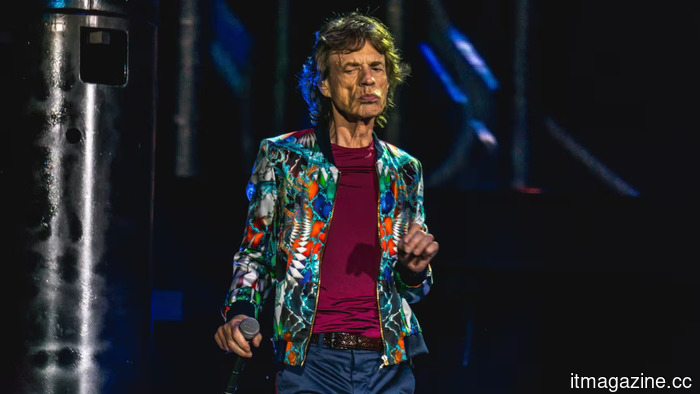
Mick Jagger claims that AI is acceptable for musicians, as long as it doesn't mimic his voice.
Mick Jagger has expressed a cautious support for musicians experimenting with artificial intelligence, provided that the outcomes are truly their own work. “If someone wants to create music with AI, go for it,” he told Billboard in a cover feature released this week. “But it has to be original.”
He quickly clarifies, however, that if the software generates a complete song mimicking someone else's catalog—often created using tracks taken without the artist’s consent—this crosses the line from creativity into theft. The 82-year-old stated, “There are people who use AI to create a song from scratch, in the style of the Rolling Stones. If you were a creative person, you wouldn’t do that.”
His objections are rooted in both principle and self-preservation. “Obviously, I don’t want to be imitated by AI, both vocally and instrumentally, and neither does the band,” he remarked, noting that anything designed to “sound exactly like the Rolling Stones” is “clearly wrong.”
This concern is not imaginary. For the past few years, convincing voice clones of both living and deceased singers have been circulating online, and the issue of ownership over machine-generated replicas of an artist’s sound remains slowly winding through legal systems.
The interview coincided with the release of Foreign Tongues, the group’s 25th studio album, which was launched on July 10. Two years after the Grammy-winning Hackney Diamonds, the band continues to thrive commercially rather than merely existing as a relic.
Keith Richards was even more direct. “I’d rather hear something original,” he told the magazine. “Music could certainly improve by not just attempting to replicate itself.” He expressed a desire for “new input” rather than “more and more copying and synthesizing.” Coming from a band that built its success on American blues, this call for originality has a complex history.
With a twist, the band released a video for the single “In the Stars” in May, which utilized deepfake technology to superimpose their younger faces from around 1968 onto performing actors. The band views this as a deliberate choice they made, underscoring the distinction Jagger repeatedly emphasizes: the difference between a tool the artist controls and one that silently replaces the artist entirely.
In promoting the album, he described AI as a potential means to “unstick” a writer facing creative blocks, serving as both a confidence booster and collaborator. Seeing a machine produce something inferior to one’s instincts, he suggested, can provide its own form of reassurance.
His personal experiments with AI have not been particularly fruitful. He recounted to The Times of London that when he attempted to utilize AI to suggest a name for an earlier record, “it returned such nonsense, it didn’t assist me at all.”
The surrounding industry, however, has been less hesitant. Sony’s AI drummer can function like a session musician, Spotify has a conversational AI curating listener experiences, and entirely synthetic acts are already making their way up the charts.
Yet, this does not overly concern a man who has defied predictions of his decline for six decades. Foreign Tongues received warm reviews, with one cheekily labeling it as a record for the youth, and it is performing well without any digital enhancements.
The irony Jagger faces is that pop music has always relied on imitation, with one generation borrowing from the previous, the Stones included. What he appears to be advocating is not the concept of originality itself, but rather the human choice about what to borrow and the reasoning behind it.
Ultimately, Jagger’s position is less about prohibition and more of a plea. He suggests that while machines are welcome to be used, they should not be deployed to imitate him.
Other articles
 SoftBank is preparing a new $60 billion bond to continue financing its investment in OpenAI.
SoftBank is said to be preparing a new bond of as much as $60 billion to support its OpenAI initiative, a goal that would surpass its previous record retail deal and challenge its borrowing capacity.
SoftBank is preparing a new $60 billion bond to continue financing its investment in OpenAI.
SoftBank is said to be preparing a new bond of as much as $60 billion to support its OpenAI initiative, a goal that would surpass its previous record retail deal and challenge its borrowing capacity.
 Coca-Cola suspends Fairlife production in the US following a ransomware attack.
Coca-Cola has reported that its fairlife dairy division experienced a ransomware attack, leading to a halt in all US production as the company looks into the incident.
Coca-Cola suspends Fairlife production in the US following a ransomware attack.
Coca-Cola has reported that its fairlife dairy division experienced a ransomware attack, leading to a halt in all US production as the company looks into the incident.
 XPeng unveils the MONA L03 in Munich, targeting the electric SUV market in Europe.
On Thursday, XPeng introduced the MONA L03 smart SUV during its global launch event in Munich, Germany. This model is set to be released in 65 countries and regions.
XPeng unveils the MONA L03 in Munich, targeting the electric SUV market in Europe.
On Thursday, XPeng introduced the MONA L03 smart SUV during its global launch event in Munich, Germany. This model is set to be released in 65 countries and regions.
 You can now modify videos in Google Vids just by stating the changes you want.
Google has introduced Gemini Omni and personal avatars to Vids, providing paid users with innovative methods for creating, editing, and presenting videos without the use of conventional editing software.
You can now modify videos in Google Vids just by stating the changes you want.
Google has introduced Gemini Omni and personal avatars to Vids, providing paid users with innovative methods for creating, editing, and presenting videos without the use of conventional editing software.
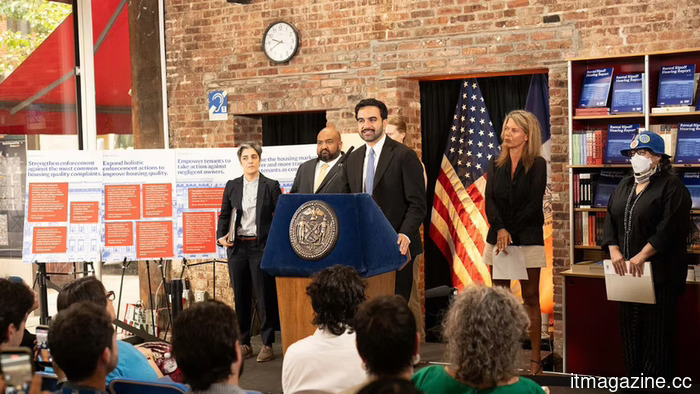 Mamdani is urging landlords in NYC to indicate the use of AI in their apartment images.
New York's Rental Ripoff Report would require landlords to reveal any AI-modified listing images, as outlined in Mayor Mamdani’s 23-point plan for tenants.
Mamdani is urging landlords in NYC to indicate the use of AI in their apartment images.
New York's Rental Ripoff Report would require landlords to reveal any AI-modified listing images, as outlined in Mayor Mamdani’s 23-point plan for tenants.
 SoftBank is preparing a new $60 billion bond to support its investment in OpenAI.
SoftBank is said to be preparing a new bond issue of up to $60 billion to support its initiative with OpenAI, a goal that would exceed its previous record retail transaction and challenge its leverage.
SoftBank is preparing a new $60 billion bond to support its investment in OpenAI.
SoftBank is said to be preparing a new bond issue of up to $60 billion to support its initiative with OpenAI, a goal that would exceed its previous record retail transaction and challenge its leverage.
Mick Jagger claims that AI is acceptable for musicians, as long as it doesn't mimic his voice.
Mick Jagger supports AI as a creative resource but firmly opposes software that replicates the Rolling Stones, coinciding with the band's release of Foreign Tongues.