
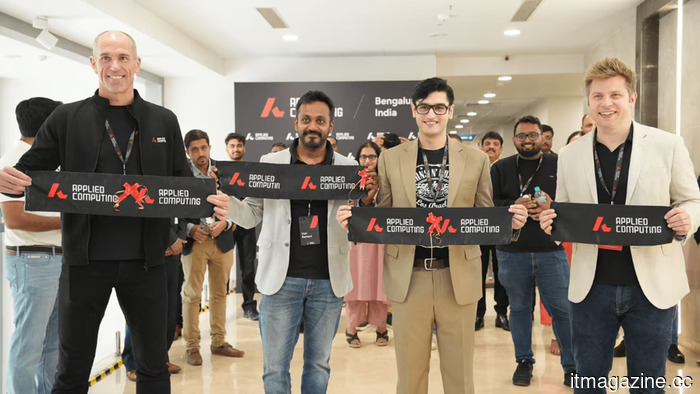
Applied Computing secures $20 million to develop a foundational model for the refinery.
A single refinery can accommodate thousands of sensors that monitor temperature, pressure, velocity, and viscosity. As noted by Applied Computing, operators utilize less than 8% of the information these sensors provide.
The London-based startup has secured a $20 million Series A round, led by engineering powerhouse KBR, with involvement from Databricks Ventures. Established in 2023, it aims to develop a foundation model tailored for oil, gas, refining, and petrochemicals.
According to co-founder and CEO Callum Adamson, the issue is not with data collection, as operators already gather this information. The challenge lies in their inability to rapidly integrate sensor data, engineering documentation, and relevant physics and chemistry to make useful predictions.
The model's structure is familiar: a foundation model informed by proprietary industrial data, with a major player as both an investor and a pathway to market. Mistral launched its industrial engineering layer with well-known clients such as Airbus, BMW, and EDF, following a similar approach.
“It's about getting those three data sources to communicate in real time,” Adamson explained to TechCrunch. “That’s the core challenge.”
Orbital, its model, is not merely a language model with an industrial application. The company asserts it combines a time series model, a physics-based model, and a language model to predict a facility’s state by analyzing sensor data while considering chemistry, equipment limits, and operator actions.
Additionally, it allows technicians to simulate how a change in one area of a plant would affect the others. This functionality has historically incurred consultancy fees and extended downtimes.
This is a critical aspect, as a refinery operates quite differently from a customer service queue; furthermore, Amazon has warned that human oversight of AI tends to decline as people typically cease to scrutinize a system that is usually accurate.
Ultimately, the selling point is speed. Applied Computing claims that Orbital can detect an anomaly, identify its cause, and assess if a suggested solution causes issues elsewhere, all within minutes. Adamson notes that investigations which once took days or weeks can now be completed in seconds.
Some success has already been achieved. The company reports it transitioned from stealth mode to earning double-digit millions in annual recurring revenue in under 18 months, with Orbital implemented at unnamed “large, publicly listed” firms in upstream, refining, and petrochemicals.
Adamson did not disclose the number of customers, which is a notable omission given the revenue claims. KBR has incorporated Orbital into its INSITE 3.0 platform for ammonia production. Adamson mentioned that the company is collaborating with a significant US upstream operator and anticipates revealing a European oil major soon.
The competitive landscape is crowded and established. AspenTech offers simulation and AI-driven modeling for upstream, refining, and chemicals, while AVEVA provides physics-based process simulation and what-if analyses. Cognite and Seeq operate at the data layer. None of these established companies can easily be outpaced.
Adamson contends that these competitors are not attracting the right talent. “This is an AI problem, not a data issue or an energy challenge,” he stated. “If you’re a top-tier AI researcher, which company would you prefer to work for? I doubt Shell ranks highly on that list.”
This statement captures the essence of the venture. The premise is that the barrier to entry is neither industrial data nor process knowledge—which incumbents possess extensively—but rather the capability to attract researchers who can create better models than Orbital.
Whether a $20 million Series A investment is sufficient to compete against AspenTech’s existing customer base remains uncertain.
There’s also a secondary point to consider. Adamson highlights that operational data from active refineries is not publicly available, and simulated data cannot accurately replicate conditions within a functioning plant, which makes the deployments themselves a valuable asset.
The partnership with KBR is significant for this reason: it provides operational data, industry knowledge, and valuable connections.
This rationale explains why heavy industry frequently lands in this situation. For example, UPS is using a real-time digital twin of its entire logistics network based on a similar premise.
Funds will be allocated towards international growth and hiring in research and engineering. The company recently opened a Houston office, adding to its headquarters in London and its operational hub in Bengaluru. The Middle East is the next target market.
Other articles
 Google has just hinted at a Pixel 11 feature that we've been anticipating for several months.
A multicolored light featured in the teaser for Google’s new Pixel 11 series could indicate the functionality of Pixel Glow on the soon-to-be-released Pixel 11 Pro.
Google has just hinted at a Pixel 11 feature that we've been anticipating for several months.
A multicolored light featured in the teaser for Google’s new Pixel 11 series could indicate the functionality of Pixel Glow on the soon-to-be-released Pixel 11 Pro.
 An F1 aerodynamicist has secured $55 million in funding to train factory robots by utilizing videos of individuals performing household tasks.
Microagi secured $55 million in funding, with Hummingbird at the forefront. Its data division compensates 20,000 individuals across 15 nations to record themselves while working. Robots lack internet access for learning.
An F1 aerodynamicist has secured $55 million in funding to train factory robots by utilizing videos of individuals performing household tasks.
Microagi secured $55 million in funding, with Hummingbird at the forefront. Its data division compensates 20,000 individuals across 15 nations to record themselves while working. Robots lack internet access for learning.
 5 Questions Every CIO Must Consider Before Introducing Another Software Tool
In 2023, the typical tech stack comprised 291 applications, resulting in significant software expenditures. By 2026, numerous enterprise tech stacks have evolved to be even more intricate as companies keep integrating AI features into their processes. As vibe coding becomes more widespread and the number of SaaS platforms increases, how can a leader determine which [...]
5 Questions Every CIO Must Consider Before Introducing Another Software Tool
In 2023, the typical tech stack comprised 291 applications, resulting in significant software expenditures. By 2026, numerous enterprise tech stacks have evolved to be even more intricate as companies keep integrating AI features into their processes. As vibe coding becomes more widespread and the number of SaaS platforms increases, how can a leader determine which [...]
 WHO cautions that the gap in health governance for AI in Europe is increasingly becoming irreversible.
Almost two-thirds of nations in the WHO European Region utilize AI diagnostics, but only one out of twelve has a strategy for its governance. Kluge describes this disparity as the key challenge.
WHO cautions that the gap in health governance for AI in Europe is increasingly becoming irreversible.
Almost two-thirds of nations in the WHO European Region utilize AI diagnostics, but only one out of twelve has a strategy for its governance. Kluge describes this disparity as the key challenge.
 Wall Street recently experienced its strongest quarter for investment banking in years, and it is referring to AI as a supercycle.
Goldman recorded a historic $3.4 billion in investment banking fees, an increase of 55%. The CEO describes it as an AI capital expenditure super cycle. Meanwhile, JPMorgan's CFO is opting out of data center agreements.
Uber consents to a $14.8 billion acquisition of Delivery Hero, which is 26% higher than its May offer.
Uber has reached an agreement for a takeover of Delivery Hero at €41.50 per share, which places its valuation at $14.8 billion. In May, Uber had proposed €33 per share. Additionally, fourteen markets will be transferred to SSW Partners for $1.6 billion.
Wall Street recently experienced its strongest quarter for investment banking in years, and it is referring to AI as a supercycle.
Goldman recorded a historic $3.4 billion in investment banking fees, an increase of 55%. The CEO describes it as an AI capital expenditure super cycle. Meanwhile, JPMorgan's CFO is opting out of data center agreements.
Uber consents to a $14.8 billion acquisition of Delivery Hero, which is 26% higher than its May offer.
Uber has reached an agreement for a takeover of Delivery Hero at €41.50 per share, which places its valuation at $14.8 billion. In May, Uber had proposed €33 per share. Additionally, fourteen markets will be transferred to SSW Partners for $1.6 billion.
Applied Computing secures $20 million to develop a foundational model for the refinery.
The London-based startup reports that its plants utilize less than 8% of the data they gather. Its Orbital model integrates time series, physics, and language. KBR spearheaded the $20 million funding round.