
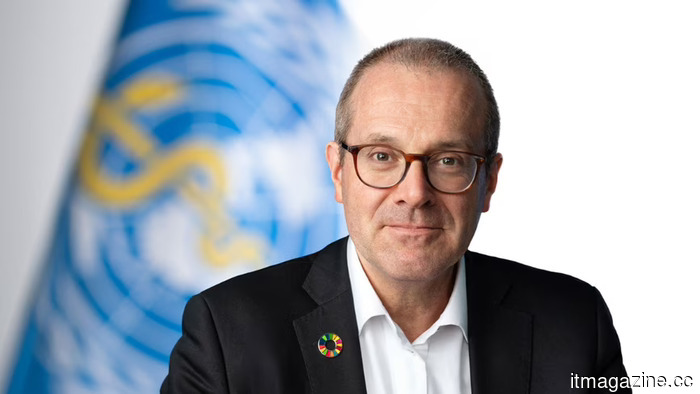
WHO cautions that the gap in health governance for AI in Europe is increasingly becoming irreversible.
Hans Kluge began his address in Lisbon with a statistic, which is not the typical approach for the World Health Organization. “Let me start with a number: 8%,” the WHO Regional Director for Europe informed delegates on July 15. “That’s the percentage of countries in the WHO European Region that possess a health-specific AI strategy. Just 8%.”
In contrast, almost two-thirds of the countries in the region are already utilizing AI in diagnostics, and half have implemented AI-driven patient chatbots. However, only one in twelve has a strategy for governing these technologies.
“That gap between deployment and governance is currently the main challenge of AI in health,” Kluge stated. This perspective will resonate with those who follow the broader issue of AI adoption in Europe, although here the focus is not on productivity.
The figures originate from what WHO/Europe characterizes as the most thorough evaluation of AI readiness ever performed across its 53 member states, following an initial overview of AI in EU healthcare in April. The details behind the main statistic reveal a more troubling scenario.
Only one in five countries offers AI education for health professionals before they graduate, while one in four provides training once they are already in practice. Less than half have evaluated whether their legal frameworks are adequate, and nearly 40% lack any ethical guidelines regarding AI in healthcare.
Kluge was clear about the implications of this lack of governance. “A biased algorithm can lead to an incorrect diagnosis for a real patient, with real consequences,” he noted. “A health worker trained to rely on an AI system they cannot question lacks empowerment, which can result in mistakes beyond their control.”
The latter part of that statement deserves careful consideration. This is not simply a criticism of flawed algorithms. It highlights the issue of clinicians being given a tool they are unable to question, reflecting a governance failure rather than a technical one, and resonates with ongoing concerns among healthcare workers.
This is not an argument against the technology, and Kluge did not make one. Approximately 98% of member states see enhancing patient care as the main motivation for adopting AI, and he cited Coimbra, where AI-driven image analysis is assisting clinicians in more swiftly identifying thoracic diseases and bone fractures, reducing waiting times in primary care and emergency scenarios.
“Real patients are receiving improved care today because of AI,” he asserted. The issue is not that it is ineffective; rather, the problem lies in its usage in areas that have not clarified accountability when it fails.
He outlined three requests: governance that keeps pace with deployment, meaning every country using AI in healthcare must have a strategy, liability standards, and workforce training; international collaboration, which is why WHO invited 37 countries from all six regions to Lisbon; and a designated role for the Portuguese-speaking world.
The final point is tangible. Portugal, Angola, Brazil, Mozambique, and their partners will collaborate on a Lusophone Cooperation Roadmap for AI and Health, which WHO aims to introduce at the Regional Health Summit in Brazil in 2028.
This is a Lusophone initiative, not a global one, a distinction that some coverage of the address has overlooked.
The conference, co-hosted with the Portuguese government and inaugurated by health minister Ana Paula Martins, runs until July 16. Its three main pillars are the regulations governing how AI is managed and held accountable, the tools needed for safe deployment, and the individuals expected to utilize it.
Europe possesses the necessary resources for this. The EU has established testing facilities for medical imaging and robotic rehabilitation, among other areas. What Kluge emphasizes is the disconnect between this infrastructure and the 53 health ministries, many of which have yet to formalize any plans.
Kluge concluded with a point often neglected. “The future of AI in health will not be determined by algorithms,” he said. “It will be shaped by the frameworks we establish now, the partnerships we create, and the political will we muster to ensure this technology benefits everyone, not just those countries and communities wealthy enough to influence it on their own terms.”
Other articles
 An F1 aerodynamicist has secured $55 million in funding to train factory robots by utilizing videos of individuals performing household tasks.
Microagi secured $55 million in funding, with Hummingbird at the forefront. Its data division compensates 20,000 individuals across 15 nations to record themselves while working. Robots lack internet access for learning.
An F1 aerodynamicist has secured $55 million in funding to train factory robots by utilizing videos of individuals performing household tasks.
Microagi secured $55 million in funding, with Hummingbird at the forefront. Its data division compensates 20,000 individuals across 15 nations to record themselves while working. Robots lack internet access for learning.
 xAI's initial lawsuit against a user examines accountability for the content generated by Grok.
xAI has filed a lawsuit against a man from South Carolina for reportedly using Grok to create child sexual abuse material, marking the first case of its kind, while also contending with lawsuits that claim the opposite.
xAI's initial lawsuit against a user examines accountability for the content generated by Grok.
xAI has filed a lawsuit against a man from South Carolina for reportedly using Grok to create child sexual abuse material, marking the first case of its kind, while also contending with lawsuits that claim the opposite.
 Ofcom launches an investigation into child safety regarding TikTok.
Ofcom is looking into TikTok's ability to identify child users and assess if it effectively shields them from harmful content. Penalties may amount to 10% of the company's worldwide revenue.
Ofcom launches an investigation into child safety regarding TikTok.
Ofcom is looking into TikTok's ability to identify child users and assess if it effectively shields them from harmful content. Penalties may amount to 10% of the company's worldwide revenue.
 Ofcom launches an investigation into TikTok regarding child safety.
Ofcom is looking into whether TikTok is capable of identifying child users and if it effectively prevents harmful content from reaching them. Penalties could amount to 10% of the company's global revenue.
Ofcom launches an investigation into TikTok regarding child safety.
Ofcom is looking into whether TikTok is capable of identifying child users and if it effectively prevents harmful content from reaching them. Penalties could amount to 10% of the company's global revenue.
 AGCOM imposed a fine of €750,000 on Google due to gambling videos on YouTube.
AGCOM imposed a €750,000 fine on Google for gambling videos on YouTube. Google referenced the hosting protection. The creator was part of a verified revenue-sharing agreement.
Uber consents to a $14.8 billion acquisition of Delivery Hero, which is 26% higher than its offer made in May.
Uber has reached an agreement for a takeover of Delivery Hero at €41.50 per share, which values the company at $14.8 billion. In May, it had proposed €33 per share. Additionally, fourteen markets will be sold to SSW Partners for $1.6 billion.
AGCOM imposed a fine of €750,000 on Google due to gambling videos on YouTube.
AGCOM imposed a €750,000 fine on Google for gambling videos on YouTube. Google referenced the hosting protection. The creator was part of a verified revenue-sharing agreement.
Uber consents to a $14.8 billion acquisition of Delivery Hero, which is 26% higher than its offer made in May.
Uber has reached an agreement for a takeover of Delivery Hero at €41.50 per share, which values the company at $14.8 billion. In May, it had proposed €33 per share. Additionally, fourteen markets will be sold to SSW Partners for $1.6 billion.
WHO cautions that the gap in health governance for AI in Europe is increasingly becoming irreversible.
Almost two-thirds of nations in the WHO European Region utilize AI diagnostics, but only one out of twelve has a strategy for its governance. Kluge describes this disparity as the key challenge.