
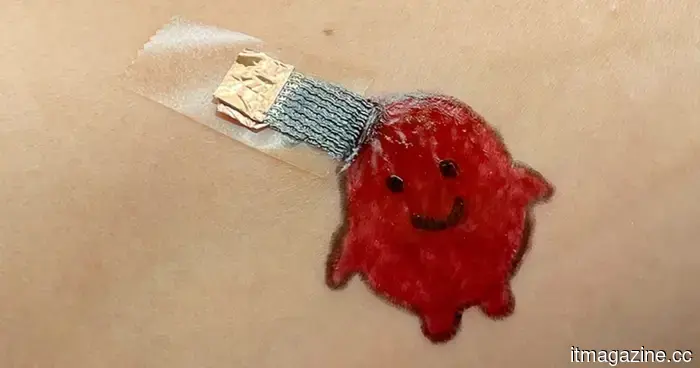
You can apply this wearable on your skin similar to a tattoo to track your heart and brain functions.
Wearable health trackers have evolved to become smaller, smarter, and more functional over time, yet they still remain surprisingly dull. Whether in the form of a smartwatch, a chest strap, or an adhesive ECG patch, most health sensors continue to depend on cumbersome hardware that can peel off, irritate the skin, or become less reliable when you start to sweat. Moreover, technology is shifting from plastic wearables and trackers to textiles that appear to serve a similar purpose. However, that's not the focus of today's discussion.
Researchers at Penn State believe they have discovered a far more sophisticated solution. Instead of attaching another sensor to your skin, why not simply paint one on?
The team has created a conductive ink that can be applied directly onto the skin like temporary body art, turning nearly any design into a functioning health monitor. These colorful tattoos not only have a more engaging appearance but are also capable of tracking electrical activity from the heart, muscles, and brain with remarkable accuracy. This research has been published in the Proceedings of the National Academy of Sciences (PNAS).
A tattoo that functions as a medical sensor
The technology is based around a specially formulated water-based conductive ink that resembles face paint. When wet, it has a glue-like consistency. After application to the skin, it dries in less than ten minutes—or even quicker with a hair dryer—and becomes a usable electrode capable of interpreting the body's electrical signals.
In contrast to traditional wearable sensors, these electrodes are not manufactured in a factory and then attached to the body; they are created directly on the skin.
The painted electrodes on the skin eliminate one of the major challenges faced by contemporary wearable medical sensors. Conventional electrodes often leave tiny air gaps between the skin and the sensor, especially on hairy or sweaty skin. These gaps diminish signal quality and may lead to unreliable readings during movement. By painting the electrode directly onto the skin, the conductive ink conforms to each contour, greatly enhancing contact and signal accuracy.
The researchers demonstrated that the tattoos could continuously record ECG signals to monitor heart activity, EEG signals for brain activity, and EMG signals that track muscle contractions. In one test, the team even utilized muscle signals from a participant’s forearm to wirelessly control a robotic prosthetic hand. The tattoos remained secured during physical activity and continued to accurately record heart activity across a 12-hour test that involved daily activities.
Medical-grade wearables can look less clinical
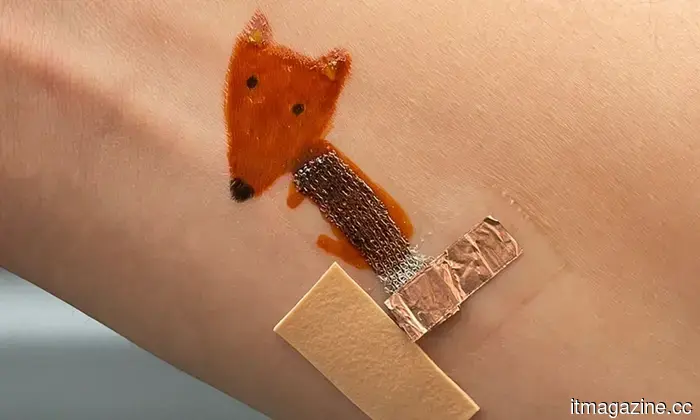
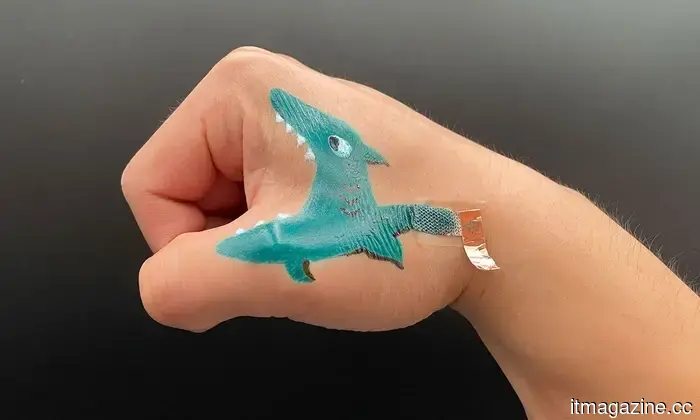
Perhaps the most surprising aspect of the project is that the sensors are not meant to have a clinical appearance. The ink starts out nearly clear but can be blended with regular food coloring, giving users the freedom to design nearly any pattern they wish. Researchers even propose painting cartoon characters or superhero emblems onto the skin instead of using traditional medical patches.
This approach cleverly makes healthcare technology less intimidating—particularly for children who often dislike the adhesive electrodes used during hospital visits. The tattoo itself forms just one part of the system. A small portion of the painted electrode connects to a stretchable silver fabric that functions as conductive material before wirelessly linking to a reusable electronics module worn under clothing. This module transmits data to a computer via Bluetooth.
The electrode material is surprisingly durable. Due to its porous structure, it can stretch over 150 percent of its initial size while allowing sweat and moisture to escape rather than getting trapped on the skin. This enhances comfort and helps prevent irritation during prolonged use.
When it is no longer required, the tattoo can be easily washed off with water. Another one can be painted on within minutes, while the more expensive electronic component can continue to be reused. The researchers have filed a provisional patent for the technology and believe its potential goes far beyond wearable health monitoring. Future iterations could track biomarkers like glucose or cortisol, paving the way for more advanced continuous health assessments. The team is also investigating applications in agriculture, where similar paint-on sensors could turn ordinary plants into “smart plants” that can detect environmental chemicals and report on their health.
It may sound almost futuristic—a tattoo that monitors your body, controls a robotic hand, and disappears when you no longer need it. Yet that is precisely the future that Penn State’s engineers are striving to create, one brushstroke at a time.
Other articles
 India commits $20 billion to encourage chip and smartphone production as Modi advocates for the creation of an Indian mobile brand.
Modi's cabinet has authorized $13.3 billion for semiconductors and $6.5 billion for smartphones. The minister stated that Modi aims for India to "establish an Indian mobile brand."
India commits $20 billion to encourage chip and smartphone production as Modi advocates for the creation of an Indian mobile brand.
Modi's cabinet has authorized $13.3 billion for semiconductors and $6.5 billion for smartphones. The minister stated that Modi aims for India to "establish an Indian mobile brand."
 India commits $20 billion to enhance chip and smartphone production as Modi advocates for a domestic mobile brand.
Modi's cabinet has authorized $13.3 billion for semiconductors and $6.5 billion for smartphones. The minister noted that Modi aims to "establish an Indian mobile brand."
India commits $20 billion to enhance chip and smartphone production as Modi advocates for a domestic mobile brand.
Modi's cabinet has authorized $13.3 billion for semiconductors and $6.5 billion for smartphones. The minister noted that Modi aims to "establish an Indian mobile brand."
 Australia instructs AI data centres to return more power than they consume.
Albanese revealed plans for an Office of AI, new regulations for data centres regarding net generation, and stringent copyright provisions. However, none of these measures have become law at this time.
Australia instructs AI data centres to return more power than they consume.
Albanese revealed plans for an Office of AI, new regulations for data centres regarding net generation, and stringent copyright provisions. However, none of these measures have become law at this time.
 Gold Eagle: the AI cybersecurity hub of the White House
Gold Eagle is the White House's new AI-powered clearinghouse designed to consolidate, prioritize, and manage solutions for cybersecurity vulnerabilities within US critical infrastructure.
Gold Eagle: the AI cybersecurity hub of the White House
Gold Eagle is the White House's new AI-powered clearinghouse designed to consolidate, prioritize, and manage solutions for cybersecurity vulnerabilities within US critical infrastructure.
 The AI-driven government of Abu Dhabi manages everyday life.
Abu Dhabi’s AI-driven government operates through a single app, TAMM, which handles ID renewals and fine payments. The drawback is a system that cannot be replicated by any democracy.
The AI-driven government of Abu Dhabi manages everyday life.
Abu Dhabi’s AI-driven government operates through a single app, TAMM, which handles ID renewals and fine payments. The drawback is a system that cannot be replicated by any democracy.
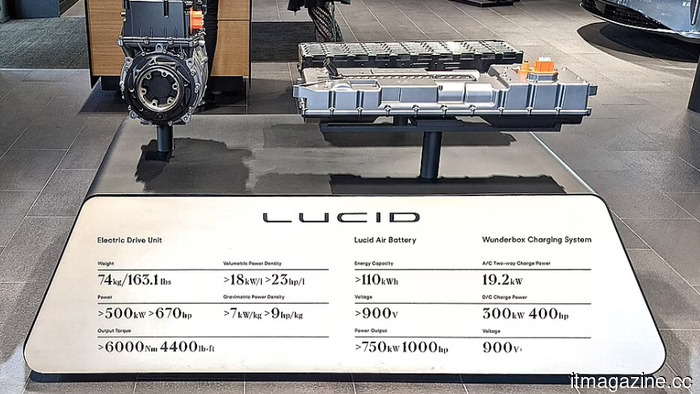 Lucid's stock dropped 40% due to a bankruptcy rumor originating from an EV blog, but a denial was issued just a few hours later.
Lucid's stock fell sharply following a report indicating that AlixPartners was exploring Chapter 11 and privatization alternatives. Lucid refuted the allegations. The shares finished down 16% at $4.62.
Lucid's stock dropped 40% due to a bankruptcy rumor originating from an EV blog, but a denial was issued just a few hours later.
Lucid's stock fell sharply following a report indicating that AlixPartners was exploring Chapter 11 and privatization alternatives. Lucid refuted the allegations. The shares finished down 16% at $4.62.
You can apply this wearable on your skin similar to a tattoo to track your heart and brain functions.
Researchers at Penn State have developed a washable tattoo that can be painted on the skin, capable of monitoring heart, brain, and muscle activity, providing a vibrant alternative to cumbersome wearable health sensors.