
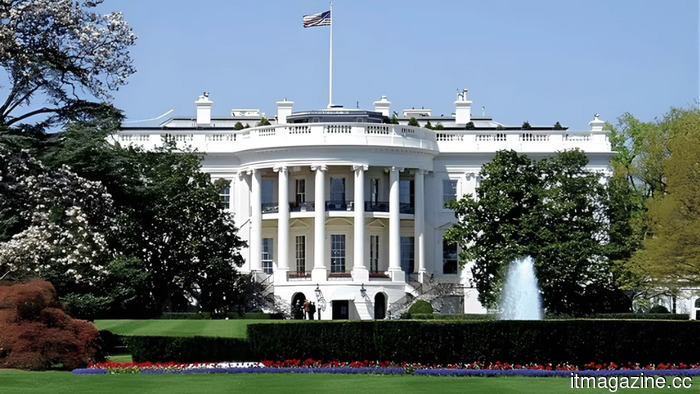
Gold Eagle: the AI cybersecurity hub of the White House
The White House is pushing for rapid advancements in frontier AI for cyber defense. Gold Eagle, a newly established AI-driven clearinghouse, will aggregate software vulnerability data from both government and industry sources. It prioritizes the most critical issues and coordinates fixes for the US's essential infrastructure.
The rationale for using AI to develop malware lies in its ability to operate at machine speed. In response, Washington has created a similar mechanism to keep pace.
On Tuesday, the White House unveiled Gold Eagle, describing it as a clearinghouse for cyber vulnerabilities. In a press release, the administration stated that the system would “receive and patch” security flaws “at a speed and scale never seen before.”
The initiative brings together the White House, the Treasury, and Homeland Security via CISA, with the newly renamed Department of War also engaged. They are collaborating with unnamed open-source software groups and critical infrastructure companies.
The language surrounding the initiative is notably militaristic. Secretary of War Pete Hegseth remarked that Gold Eagle establishes “a wartime footing to the cyber domain,” dubbing it “the vanguard of America’s cyber defense.” Treasury Secretary Scott Bessent highlighted its implications for the financial system, vowing to “harness frontier AI capabilities to stay ahead of our adversaries” with the intent of utilizing models that identify flaws on a large scale to effectively close them.
Gold Eagle is rooted in an executive order signed by Trump on June 2, which encouraged advanced AI developers to provide the government with early access to their technologies. The administration reported that the clearinghouse has already begun receiving and ranking vulnerability reports.
However, the announcement lacks specific details. According to Nextgov/FCW, the release primarily outlines a coordination framework without indicating that it can compel any company to address a flaw.
Furthermore, the White House did not specify which agency would oversee Gold Eagle on a daily basis and how it would safeguard sensitive vulnerability data. CISA already manages a disclosure program in addition to the CVE system and NIST’s National Vulnerability Database, making Gold Eagle one of several existing initiatives.
No companies were named as participants, though Anthropic is a likely candidate. The AI firm indicated last month that it would provide federal officials with advance access to its threat-intelligence reports and agreed to participate in the clearinghouse established by the June executive order. This commitment came shortly after its export-control discussions with the same administration, for which it did not offer a comment.
The timing of this initiative is not accidental. Security researchers have noted that AI is now involved in every phase of an attack, transforming a new vulnerability discovery into a working exploit in mere hours. Last week, OpenAI announced that GPT-5.6 is its most powerful cyber model to date.
Human defenders are struggling to keep pace, prompting the administration to set a 1 August deadline for the NSA and CISA to develop a classified system for evaluating the cyber capabilities of frontier models. This system would help identify the technologies that require monitoring.
Gold Eagle effectively applies the argument for offensive tools internally, directing the same AI that accelerates attackers towards defending systems. However, the launch does not resolve a crucial question: Can a clearinghouse that lacks the authority to enforce patches truly succeed in this race?
Other articles
 You can apply this wearable on your skin similar to a tattoo to track your heart and brain functions.
Researchers at Penn State have developed a washable tattoo that can be painted on the skin, capable of monitoring heart, brain, and muscle activity, providing a vibrant alternative to cumbersome wearable health sensors.
You can apply this wearable on your skin similar to a tattoo to track your heart and brain functions.
Researchers at Penn State have developed a washable tattoo that can be painted on the skin, capable of monitoring heart, brain, and muscle activity, providing a vibrant alternative to cumbersome wearable health sensors.
 India commits $20 billion to enhance chip production and smartphones as Modi advocates for a domestic mobile brand.
Modi's cabinet has authorized $13.3 billion for semiconductors and $6.5 billion for smartphones. The minister indicated that Modi aims for India to "develop an Indian mobile brand."
India commits $20 billion to enhance chip production and smartphones as Modi advocates for a domestic mobile brand.
Modi's cabinet has authorized $13.3 billion for semiconductors and $6.5 billion for smartphones. The minister indicated that Modi aims for India to "develop an Indian mobile brand."
 India commits $20 billion to encourage chip and smartphone production as Modi advocates for the creation of an Indian mobile brand.
Modi's cabinet has authorized $13.3 billion for semiconductors and $6.5 billion for smartphones. The minister stated that Modi aims for India to "establish an Indian mobile brand."
India commits $20 billion to encourage chip and smartphone production as Modi advocates for the creation of an Indian mobile brand.
Modi's cabinet has authorized $13.3 billion for semiconductors and $6.5 billion for smartphones. The minister stated that Modi aims for India to "establish an Indian mobile brand."
 Starlink V5 has arrived, boasting a lighter design, enhanced intelligence, and significantly improved efficiency.
SpaceX has launched the new Starlink V5 kit, featuring a more compact and lightweight design, reduced power usage, and download speeds reaching up to 375 Mbps, emphasizing efficiency over sheer speed.
Starlink V5 has arrived, boasting a lighter design, enhanced intelligence, and significantly improved efficiency.
SpaceX has launched the new Starlink V5 kit, featuring a more compact and lightweight design, reduced power usage, and download speeds reaching up to 375 Mbps, emphasizing efficiency over sheer speed.
 India commits $20 billion to enhance chip and smartphone production as Modi advocates for a domestic mobile brand.
Modi's cabinet has authorized $13.3 billion for semiconductors and $6.5 billion for smartphones. The minister noted that Modi aims to "establish an Indian mobile brand."
India commits $20 billion to enhance chip and smartphone production as Modi advocates for a domestic mobile brand.
Modi's cabinet has authorized $13.3 billion for semiconductors and $6.5 billion for smartphones. The minister noted that Modi aims to "establish an Indian mobile brand."
Gold Eagle: the AI cybersecurity hub of the White House
Gold Eagle is the White House's new AI-powered clearinghouse designed to consolidate, prioritize, and manage solutions for cybersecurity vulnerabilities within US critical infrastructure.