
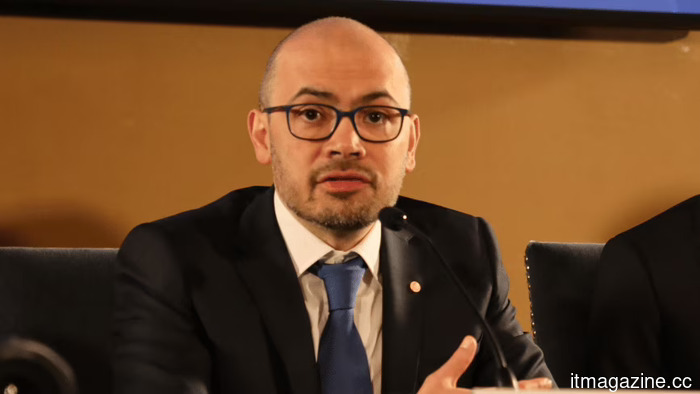
Hassabis seeks a regulatory body similar to FINRA for advanced AI.
The individual behind Google's AI believes there is a need for a referee in the industry, and he has outlined a set of proposed rules. Demis Hassabis is advocating for a US-led regulatory body that would evaluate advanced AI models prior to their public release, drawing inspiration from the regulatory body that oversees Wall Street. This initiative could potentially hinder the pace of progress across the sector.
Typically not one to sound alarms, Hassabis did so on Tuesday when he published a manifesto on platform X, asserting that artificial general intelligence (AGI) could be "just a few short years away." According to him, the world is unprepared for this development. He refers to the current period as a "precious window" that is swiftly closing before AGI makes its debut.
His proposal is notably specific. Hassabis envisions the establishment of a new AI Standards Body in the US, based on the model of FINRA, the organization that supervises Wall Street through industry funding and governmental oversight. This body would operate as a public-private partnership, primarily financed by the labs involved in AI development. Its leadership would include independent experts, including recipients of the Turing Award, as well as representatives from the open-source community and government.
The primary responsibility of this body would be to evaluate the most powerful AI models prior to their deployment. Initially, labs would voluntarily submit their systems for testing up to 30 days before release. These evaluations would assess risks related to cybersecurity, biological and nuclear threats, and signs of potential deception.
Once the system is established, it would become more stringent. A "Frontier-class" model would need to pass this review before being introduced to the US market. The body would establish performance benchmarks and update them quarterly. These standards would apply to any similar models, whether open or proprietary, regardless of their origin, although startups and academic institutions would be exempt.
One of the most notable aspects of Hassabis's proposal is the ability to implement a slowdown in development. He suggests that the body could increase its oversight as risks escalate. This could involve "coordinating a slowdown in development among the Frontier Labs if deemed necessary."
This is a remarkable proposition for a leading figure in the industry, as he is essentially advocating for a mechanism that could halt progress in his own field. In an interview with Axios, which first reported on the plan, Hassabis expressed concerns that current cyber threats are merely "warning shots," and he believes that significantly more dangerous biological and nuclear capabilities could emerge within 18 months. He cautioned that such tools could become available in open-source models that governments would be unable to control. His timeline is ambitious, aiming to have the regulatory body operational before the end of the year, and he mentioned that he has kept the Trump administration, competing labs, and European officials informed about his plans, receiving "very positive" reactions.
The timing of this initiative is deliberate. Last month, the Trump administration abruptly halted the most powerful models from Anthropic through an export order, leading to weeks of tense negotiations without a clear regulatory framework. Hassabis described this event as "a bit of a wake-up call." OpenAI, fearing a similar outcome, delayed the release of GPT-5.6 until receiving governmental approval.
Hassabis is not alone in seeking regulations. He and Dario Amodei from Anthropic advocated for a US-led coalition during the G7 summit, with Amodei suggesting an FAA-like agency that could prohibit unsafe models. The leaders of these labs agree that Washington should take on regulatory responsibilities, differing mainly in who should lead the charge.
Hassabis presents his concerns in almost grandiose terms, likening AGI to transformative forces such as fire or electricity rather than simply the internet. He remarked, "We’ve essentially found a way to make sand think. It’s miraculous." However, the central question that his proposal does not address is whether a body funded by the labs and tasked with monitoring their own deceptions can genuinely be trusted to enforce a halt to development when necessary.
Other articles
 Hassabis seeks a referee similar to FINRA for advanced AI developments.
Demis Hassabis advocates for a U.S.-led AI Standards Body, inspired by Wall Street’s FINRA, to evaluate frontier models prior to their release and to potentially slow industry progress if necessary.
Hassabis seeks a referee similar to FINRA for advanced AI developments.
Demis Hassabis advocates for a U.S.-led AI Standards Body, inspired by Wall Street’s FINRA, to evaluate frontier models prior to their release and to potentially slow industry progress if necessary.
 Hassabis seeks a referee comparable to FINRA for advanced AI.
Demis Hassabis advocates for a US-led AI Standards Body, inspired by Wall Street’s FINRA, to evaluate frontier models prior to their launch and to potentially decelerate the industry if necessary.
Hassabis seeks a referee comparable to FINRA for advanced AI.
Demis Hassabis advocates for a US-led AI Standards Body, inspired by Wall Street’s FINRA, to evaluate frontier models prior to their launch and to potentially decelerate the industry if necessary.
 The vision of Concorde is attainable. NASA's X-59 simply needs to eliminate the sonic boom from supersonic flight.
NASA's X-59 has achieved speeds of 924 mph at an altitude of 55,000 feet, moving the agency closer to demonstrating that future supersonic passenger flights can circumvent loud sonic booms.
The vision of Concorde is attainable. NASA's X-59 simply needs to eliminate the sonic boom from supersonic flight.
NASA's X-59 has achieved speeds of 924 mph at an altitude of 55,000 feet, moving the agency closer to demonstrating that future supersonic passenger flights can circumvent loud sonic booms.
 I didn't fully appreciate this NotebookLM feature until it transformed my studying approach completely.
An upcoming exam finally motivated me to give NotebookLM's Mind Maps a try. Now, it's the initial feature I utilize whenever I create a new notebook.
I didn't fully appreciate this NotebookLM feature until it transformed my studying approach completely.
An upcoming exam finally motivated me to give NotebookLM's Mind Maps a try. Now, it's the initial feature I utilize whenever I create a new notebook.
 Microsoft's emissions increased by 25% due to the expansion of AI data centers.
Microsoft's emissions increased by approximately 25% in 2025, reaching 20.3 million tonnes, largely due to AI data centres, making its goal of being carbon-negative by 2030 more challenging.
Microsoft's emissions increased by 25% due to the expansion of AI data centers.
Microsoft's emissions increased by approximately 25% in 2025, reaching 20.3 million tonnes, largely due to AI data centres, making its goal of being carbon-negative by 2030 more challenging.
 Dimon states that AI has already removed 30 to 40 percent of jobs in certain divisions of JPMorgan.
Jamie Dimon informed analysts that AI has already removed 30 to 40 percent of jobs in certain JPMorgan divisions, but competitive pressures will diminish margin improvements.
Dimon states that AI has already removed 30 to 40 percent of jobs in certain divisions of JPMorgan.
Jamie Dimon informed analysts that AI has already removed 30 to 40 percent of jobs in certain JPMorgan divisions, but competitive pressures will diminish margin improvements.
Hassabis seeks a regulatory body similar to FINRA for advanced AI.
Demis Hassabis advocates for the establishment of a US-led AI Standards Body, inspired by Wall Street’s FINRA, to evaluate frontier models prior to their launch and to potentially decelerate the industry when necessary.