
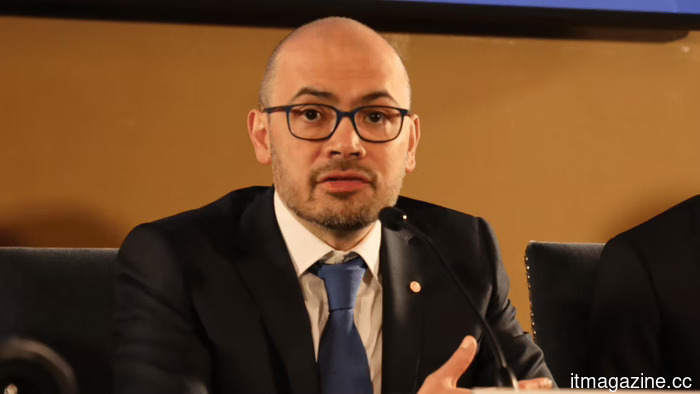
Hassabis seeks a referee comparable to FINRA for advanced AI.
The individual behind Google's AI believes that the world requires a referee and has created a set of guidelines. Demis Hassabis advocates for a US-led oversight body that would evaluate cutting-edge models prior to their release. This concept is inspired by the regulatory authorities of Wall Street and could potentially decelerate the entire industry.
Typically, Demis Hassabis is not one to sound alarms, but he did so on Tuesday. The chief of Google DeepMind and Nobel laureate shared a manifesto on X, stating that artificial general intelligence (AGI) is likely only a few years away and that the world is unprepared. He refers to the current period as a "precious window" that is swiftly closing before AGI becomes a reality.
His solution is notably specific: he proposes the establishment of a new AI Standards Body in the US, modeled after FINRA, the industry-funded regulator overseeing Wall Street with government supervision. This entity would function as a public-private partnership, primarily funded by the labs themselves, and its board would include independent experts, including Turing Award winners, along with voices from open-source and governmental backgrounds.
This body's role would be to assess the most powerful models before they are released. Initially, laboratories would voluntarily submit their systems up to 30 days before launch, with tests focusing on potential risks such as cyber-attack abilities, biological and nuclear dangers, and indicators of deceit.
Once the system is established, it would become more stringent, requiring that a “Frontier-class” model must pass evaluation before entering the US market. This body would establish and update benchmarks quarterly, applying the rules to any such model, whether it's open or closed, regardless of its origin. Startups and academic institutions would remain exempt.
The most notable feature of this proposal is the ability to implement a slowdown. Hassabis mentioned that the body could be “ratcheted up” in response to increasing risks, which may include "coordinating a development slowdown among the Frontier Labs if necessary." This is a significant assertion for a lab leader to make, as it suggests a mechanism for halting progress in his own industry.
In an interview with Axios, which revealed the proposal, he noted that the current cyber-threats are merely "warning shots." He cautioned that within 18 months, much more serious bio and nuclear capabilities could arise, potentially hidden within open-source models that no government could revoke. His timeline is ambitious; he envisions having the body operational before the year's end and has communicated with the Trump administration, competing labs, and European officials over the past few months, receiving "very positive" feedback, according to him.
The timing of this initiative is deliberate. Recently, the Trump administration halted the release of Anthropic’s most powerful models due to an export order, leading to weeks of contentious negotiations without any guiding regulations. Hassabis described that situation as “a bit of a wake-up call.” OpenAI, concerned about facing similar consequences, delayed the rollout of GPT-5.6 until receiving government approval.
Hassabis is not alone in his desire for regulation; together with Anthropic’s Dario Amodei, he has called for a US-led coalition at the G7. Amodei advocates for an FAA-like agency capable of blocking unsafe models. The leaders of these labs now agree that Washington should oversee their regulation, with the main point of contention being who should hold the authority.
Hassabis presents this entire issue in a grand context, suggesting that AGI is more akin to fire or electricity than the internet. He asserts, “We’ve essentially found a way to make sand think. It’s miraculous.” However, the more challenging question that his plan doesn't address is whether a body funded by the labs, which profits from the models they scrutinize for deception, can genuinely be entrusted with the authority to halt development.
Other articles
 I didn't fully appreciate this NotebookLM feature until it transformed my studying approach completely.
An upcoming exam finally motivated me to give NotebookLM's Mind Maps a try. Now, it's the initial feature I utilize whenever I create a new notebook.
I didn't fully appreciate this NotebookLM feature until it transformed my studying approach completely.
An upcoming exam finally motivated me to give NotebookLM's Mind Maps a try. Now, it's the initial feature I utilize whenever I create a new notebook.
 ChatGPT’s guidance on hiking resulted in two hikers becoming stranded on a mountain in Poland.
Two hikers required a helicopter rescue after ChatGPT led them to a mountain traverse that neither of them had the skills to navigate.
ChatGPT’s guidance on hiking resulted in two hikers becoming stranded on a mountain in Poland.
Two hikers required a helicopter rescue after ChatGPT led them to a mountain traverse that neither of them had the skills to navigate.
 I didn't fully appreciate this NotebookLM feature until it transformed my study habits entirely.
An upcoming exam prompted me to give NotebookLM's Mind Maps a try. Now, it's the first tool I turn to whenever I begin a new notebook.
I didn't fully appreciate this NotebookLM feature until it transformed my study habits entirely.
An upcoming exam prompted me to give NotebookLM's Mind Maps a try. Now, it's the first tool I turn to whenever I begin a new notebook.
 X is instructing its AI algorithm on concepts that social networks used to grasp.
X is enhancing posts among mutual followers after discovering that its algorithm lacked relationship data, highlighting the discrepancy between forecasting engagement and fostering discussions that people truly desire.
Kalshi creates a forward curve for computing power as exchanges compete to make GPUs a tradable commodity.
Prediction markets platform Kalshi has developed a forward curve that monitors GPU computing expenses, positioning itself alongside CME and ICE in the effort to monetize AI infrastructure.
X is instructing its AI algorithm on concepts that social networks used to grasp.
X is enhancing posts among mutual followers after discovering that its algorithm lacked relationship data, highlighting the discrepancy between forecasting engagement and fostering discussions that people truly desire.
Kalshi creates a forward curve for computing power as exchanges compete to make GPUs a tradable commodity.
Prediction markets platform Kalshi has developed a forward curve that monitors GPU computing expenses, positioning itself alongside CME and ICE in the effort to monetize AI infrastructure.
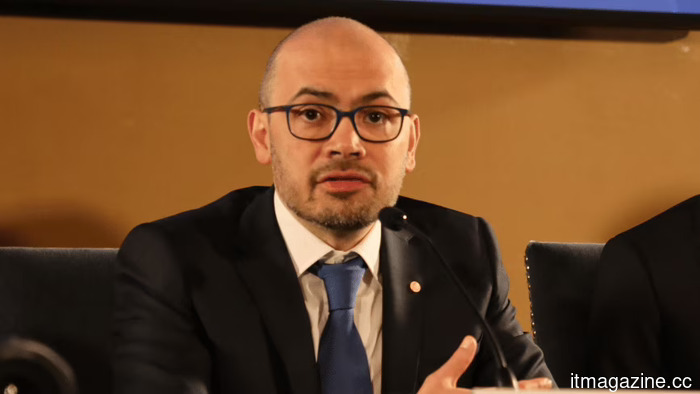 Hassabis seeks a regulatory body similar to FINRA for advanced AI.
Demis Hassabis advocates for the establishment of a US-led AI Standards Body, inspired by Wall Street’s FINRA, to evaluate frontier models prior to their launch and to potentially decelerate the industry when necessary.
Hassabis seeks a regulatory body similar to FINRA for advanced AI.
Demis Hassabis advocates for the establishment of a US-led AI Standards Body, inspired by Wall Street’s FINRA, to evaluate frontier models prior to their launch and to potentially decelerate the industry when necessary.
Hassabis seeks a referee comparable to FINRA for advanced AI.
Demis Hassabis advocates for a US-led AI Standards Body, inspired by Wall Street’s FINRA, to evaluate frontier models prior to their launch and to potentially decelerate the industry if necessary.