
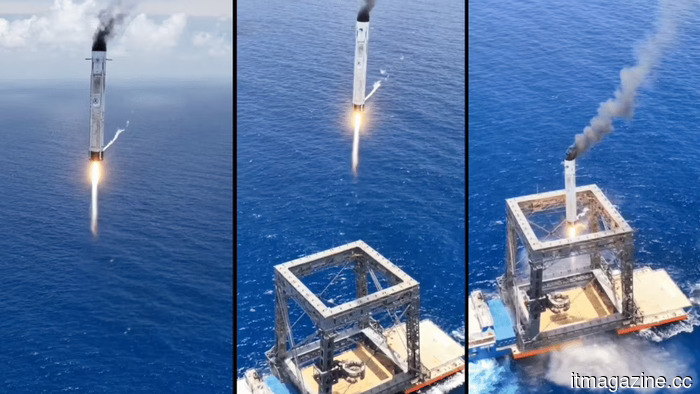
China successfully lands a reusable rocket booster for the first time.
SpaceX lands its rockets using legs, while Blue Origin employs a platform, and China has now captured one with a massive net. For the first time, China has successfully recovered the first stage of an orbital rocket, joining an exclusive group consisting of just two other entities. On Friday, a Long March-10B booster lifted off from Hainan Island, detached, and returned to a barge at sea, as reported by the Associated Press citing state media.
The landing was unique; approximately six minutes after takeoff, the first stage landed on the platform and was caught by a large net. Local media referred to this as the world’s first “net-based recovery” of a rocket, according to Business Insider. With this achievement, China’s state-owned Aerospace Science and Technology Corporation joins an elite group, previously only occupied by SpaceX and Jeff Bezos’ Blue Origin, which had both landed rocket boosters before. Mao Ning, a spokesperson for the foreign ministry, described it as a “major leap toward reusable launch capabilities.”
Why catching a booster is significant
The key advantage here is cost. The first stage of a rocket is its most expensive component, and allowing it to disintegrate during re-entry means needing to build a new one for each flight. If it can be landed, refurbished, and reused, the expenses of reaching orbit can decrease significantly. This fundamental principle is what has propelled SpaceX to become the leading launch company globally.
SpaceX achieved its first booster landing in 2015 and has since completed this feat hundreds of times. In 2024, it took things a step further by capturing a 120-meter Starship booster using the chopstick-like arms of its launch tower. Blue Origin recorded its first landing only last November, but its New Glenn rocket subsequently exploded on the launch pad in May.
Still trailing behind
Although China’s success is notable, there is still a significant gap. The reusable Long March-10B can transport around 16 tons to low Earth orbit, while a Falcon 9 can handle approximately 25 tons, and SpaceX's Starship is designed for over 100 tons. Furthermore, SpaceX launches more payload into orbit than all other countries and companies combined.
The competition in the satellite sector reflects a similar trend. China is developing its own version of Starlink through a state-supported initiative, SpaceSail, which has launched around 200 satellites since 2024. In contrast, Starlink already boasts over 10,000 satellites. It is among several potential Starlink competitors, including Russia’s delayed satellite constellation and Amazon's efforts, all vying for a share of a lucrative market that continues to generate revenue for SpaceX.
Why this matters
Even Elon Musk has taken note. In an October social media post, he remarked that Chinese engineers have incorporated “aspects of Starship, such as the use of stainless steel and methalox, into a Falcon 9 design,” giving them the potential to “outdo Falcon 9.” However, he added his usual caveat: “Starship is in another league.” The recent capture does not close that gap.
Nevertheless, it demonstrates that China is now capable of executing the most challenging aspect of affordable spaceflight. A nation that can reuse its rockets is one that can conduct launches more frequently and in greater numbers. This new net approach alters the equation significantly.
Other articles
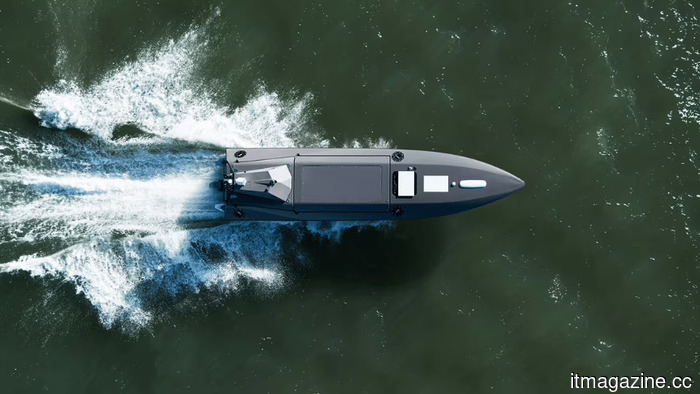 Kraken secures $175 million to achieve unicorn status in maritime defense.
The British company Kraken secured $175 million (€152.9 million), with DTCP at the helm, achieving a valuation of $1 billion to develop unmanned warboats for NATO, the United States, and the United Kingdom.
Kraken secures $175 million to achieve unicorn status in maritime defense.
The British company Kraken secured $175 million (€152.9 million), with DTCP at the helm, achieving a valuation of $1 billion to develop unmanned warboats for NATO, the United States, and the United Kingdom.
 Anthropic reaches a valuation of $1.2 trillion, surpassing OpenAI.
Shares of Anthropic suggest a valuation of $1.2 trillion in secondary markets, surpassing OpenAI's $908 billion. The drawback is that very few are willing to sell.
Anthropic reaches a valuation of $1.2 trillion, surpassing OpenAI.
Shares of Anthropic suggest a valuation of $1.2 trillion in secondary markets, surpassing OpenAI's $908 billion. The drawback is that very few are willing to sell.
 Facewatch will notify UK police within seconds if you are flagged.
Facewatch will soon notify the police within approximately four seconds when a flagged customer enters a store in the UK. Civil liberties organizations describe this as a "dangerous escalation."
Facewatch will notify UK police within seconds if you are flagged.
Facewatch will soon notify the police within approximately four seconds when a flagged customer enters a store in the UK. Civil liberties organizations describe this as a "dangerous escalation."
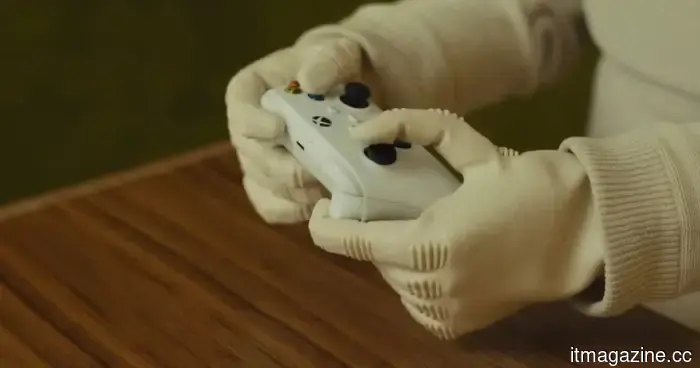 Home robots are capable of walking. The challenging aspect is preventing them from damaging your glassware.
1X's NEO home robot features tendon-driven hands equipped with tactile sensing, force control, and water resistance. However, despite its impressive hardware, it still requires dependable autonomy to manage everyday tasks.
Home robots are capable of walking. The challenging aspect is preventing them from damaging your glassware.
1X's NEO home robot features tendon-driven hands equipped with tactile sensing, force control, and water resistance. However, despite its impressive hardware, it still requires dependable autonomy to manage everyday tasks.
 Google has recently updated the way it evaluates the AI models employed in Android development.
Google has updated its Android Bench leaderboard by introducing a new testing framework and adding eight new models.
Google has recently updated the way it evaluates the AI models employed in Android development.
Google has updated its Android Bench leaderboard by introducing a new testing framework and adding eight new models.
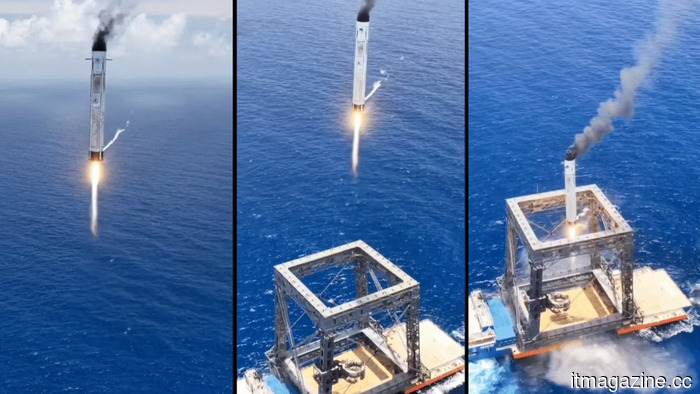 China successfully lands a reusable rocket booster for the first time.
China successfully captured a Long March-10B booster in a net at sea, marking its initial recovery of a reusable rocket. This places it alongside SpaceX and Blue Origin, though it significantly lags behind them.
China successfully lands a reusable rocket booster for the first time.
China successfully captured a Long March-10B booster in a net at sea, marking its initial recovery of a reusable rocket. This places it alongside SpaceX and Blue Origin, though it significantly lags behind them.
China successfully lands a reusable rocket booster for the first time.
China successfully captured a Long March-10B booster in a net at sea, marking its initial recovery of a reusable rocket. This move puts it in the same league as SpaceX and Blue Origin, although it lags significantly behind them.