
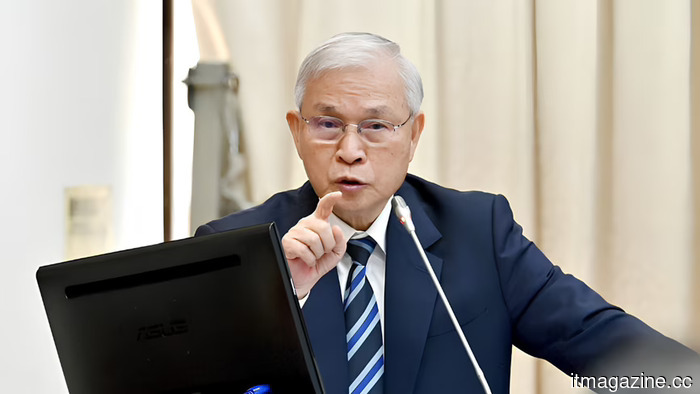
The head of Taiwan's central bank is advising caution regarding leverage as the stock surge driven by AI continues to gain momentum.
Taiwan's leading central banker has advised investors against engaging in heavy borrowing to capitalize on the island's booming stock market, a surge driven by the global demand for AI hardware supplied by Taiwanese companies. Yang Chin-long, the governor of the Central Bank of the Republic of China (Taiwan), issued this warning on Thursday during a presentation to lawmakers, as discussions regarding an overheating AI sector intensify in Taipei.
"I can only say that we hope investors do not use excessive leverage in their investments," Yang remarked to the Finance Committee of the legislature, noting that the overall market is underpinned by robust fundamentals. His remarks were more tempered compared to the bubble talk circulating in worldwide markets. Instead of asserting that an AI bubble exists, Yang minimized the notion that increasing retail borrowing posed any immediate danger, stating that the situation was far from indicating systemic risk.
The backdrop is a remarkable performance in Taipei, where the benchmark Taiex has surged about 60% since the year's beginning, reaching a peak of 46,459 points on June 3, before entering a correction phase. This increase corresponds with the fortunes of companies central to the AI supply chain, particularly chipmaker TSMC, which holds significant weight in the index. As demand for AI accelerators has surged, so has the inclination for retail investors to leverage home equity and other assets to invest.
Lawmakers have raised concerns about what they term the "four loans" issue, referring to mortgages, margin financing, personal loans, and car loans being diverted into stock investments. Yang acknowledged the rapid inflow of funds but stated that regulators were closely monitoring the situation and had not observed any signs of a widespread threat to financial stability.
He also carefully differentiated the central bank's own financial stability report, which highlighted rapid growth in financing associated with AI-related sectors. Yang noted that those observations were based on analyses by the International Monetary Fund, rather than the bank's own independent evaluations.
This distinction is important. The primary risk that markets are wary of—a sudden revaluation of AI stocks—was not the main concern Yang was highlighting. His worry was more specific: that excessive leverage could transform a standard correction into forced selling, resulting in losses that households may struggle to bear.
Taiwan finds itself in a unique position in the AI discourse, as its economy has reaped significant benefits from the boom, with exports and growth boosted by relentless demand for chips; however, this same concentration puts it at risk if sentiment shifts.
The implications are national, rather than merely individual. Taiwan's export-driven economy has been performing unusually well, with projections indicating some of its most rapid growth in years, primarily due to chip exports from a small number of firms.
This nuance is something others in the industry have been grappling with, from those asserting it is not a bubble to skeptics who perceive inflated valuations. For a central bank whose currency supports one of the world’s most AI-sensitive economies, the calculations are more complex than a straightforward judgment on the technology itself.
Central bankers in other regions have expressed more stern warnings, with some cautioning that inflated AI valuations could trigger a broader financial crisis. Yang's tone was more composed, focusing on investor behavior rather than the technology itself.
Regulators possess tools to address market exuberance, such as raising margin requirements and tightening credit; however, Yang indicated that no such measures were on the horizon. His approach, consistent with the bank’s cautious philosophy, was to advise investors to be prudent rather than impose restrictive measures.
At present, the governor's guidance is one of moderation rather than alarm. He refrained from suggesting new limits on margin lending, conveying a straightforward message to investors: enjoy the rally if you choose, but avoid overextending yourself.
Other articles
 Apple supplier Luxshare sees a decline in its record debut on the Hong Kong stock exchange.
Luxshare dropped by as much as 9.6% on its debut after securing $3.1 billion in Hong Kong's largest listing of 2026, marking a lackluster start for the Apple supplier.
Apple supplier Luxshare sees a decline in its record debut on the Hong Kong stock exchange.
Luxshare dropped by as much as 9.6% on its debut after securing $3.1 billion in Hong Kong's largest listing of 2026, marking a lackluster start for the Apple supplier.
 Thick phone or exhausted nervous system?
Imagine you are in an unfamiliar city, a bill rustling in your pocket, but the smartphone screen is dead, like a mammoth. A power outlet is a myth, and the power bank was left at home. For 48.7% of Russians, this nightmare is comparable in stress level to having no money at all.
Thick phone or exhausted nervous system?
Imagine you are in an unfamiliar city, a bill rustling in your pocket, but the smartphone screen is dead, like a mammoth. A power outlet is a myth, and the power bank was left at home. For 48.7% of Russians, this nightmare is comparable in stress level to having no money at all.
 Quant fund Qube is recruiting human stock pickers to work alongside its algorithms.
Qube Research & Technologies, one of the largest quantitative funds in London, is assembling an internal team of human stock pickers headed by Stephen Irvine.
Quant fund Qube is recruiting human stock pickers to work alongside its algorithms.
Qube Research & Technologies, one of the largest quantitative funds in London, is assembling an internal team of human stock pickers headed by Stephen Irvine.
 New research warns that Europe's aspirations for sovereign AI may be hindered by restrictions on data centers.
The Onnec survey reveals that 74% of operators view sovereign cloud as a significant opportunity; however, constraints related to power, planning, and retrofitting may hinder its implementation.
New research warns that Europe's aspirations for sovereign AI may be hindered by restrictions on data centers.
The Onnec survey reveals that 74% of operators view sovereign cloud as a significant opportunity; however, constraints related to power, planning, and retrofitting may hinder its implementation.
 New research warns that Europe’s aspirations for sovereign AI may be impeded by limitations on data centres.
An Onnec survey reveals that 74% of operators view sovereign cloud as a significant opportunity, although challenges related to power, planning, and retrofitting may hinder progress.
New research warns that Europe’s aspirations for sovereign AI may be impeded by limitations on data centres.
An Onnec survey reveals that 74% of operators view sovereign cloud as a significant opportunity, although challenges related to power, planning, and retrofitting may hinder progress.
 Quant fund Qube is bringing on human stock pickers to work alongside its algorithms.
Qube Research & Technologies, one of the largest quantitative investment funds in London, is assembling an internal team of human stock pickers under the leadership of Stephen Irvine.
Quant fund Qube is bringing on human stock pickers to work alongside its algorithms.
Qube Research & Technologies, one of the largest quantitative investment funds in London, is assembling an internal team of human stock pickers under the leadership of Stephen Irvine.
The head of Taiwan's central bank is advising caution regarding leverage as the stock surge driven by AI continues to gain momentum.
Governor Yang Chin-long cautioned Taiwanese investors about over-leveraging to pursue AI-driven stocks, while downplaying concerns regarding systemic risk.