
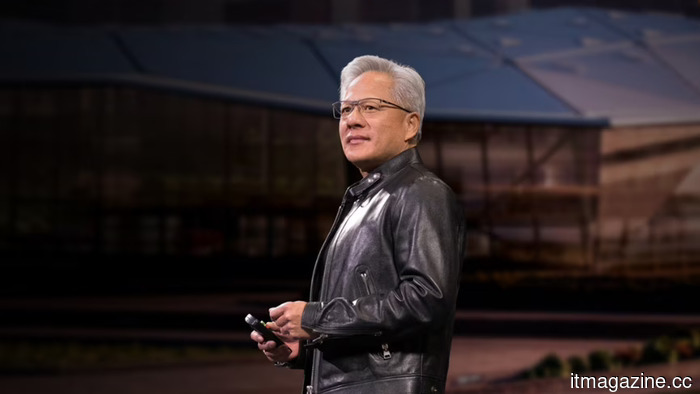
Jensen Huang mentioned that his engineers prefer creating agents to writing code.
Nvidia’s software engineers are now writing less code than ever, and according to their CEO, that’s exactly what they prefer. Jensen Huang stated this week that his engineers have come to favor the creation of AI agents over writing Python code, viewing this shift as an advancement rather than a setback.
“These agentic systems require new skills, and many software engineers are currently focused on building these agents,” Huang mentioned in an interview published by the company on Wednesday. “If you ask me, every one of my software engineers would rather be developing agents than writing Python code.” This is a message he has been refining over the past few months, from his speech at a Carnegie Mellon commencement to the Computex stage.
He differentiates between coding as a task and engineering as a craft. According to him, the repetitive part of the job—transforming an idea into syntax—is something that can now be handled by an agent. “You’re taking all the mundane tasks and assigning them to this agent,” he explained. “This requires imagination, creativity, and a lot of technology.” Instead of merely producing lines of Python code, his engineers now dedicate their time to building agents, creating benchmarks, and designing safety measures for those systems.
An AI agent decomposes a large objective into a sequence of smaller tasks, which are addressed one by one, allowing the software to plan and execute rather than just respond to a single query. Huang, who co-founded Nvidia in 1993, has become a prominent proponent of utilizing AI assistants within companies. He has frequently proposed a future where Nvidia implements agents across all divisions to boost productivity, a vision that aligns seamlessly with the sale of the chips and platforms that support them.
This commercial rationale is always evident. Over the past year, Nvidia has positioned itself as the backbone of the agent economy, with a workforce dedicated to building agents also leading to greater demand for computation resources.
Where Huang diverges from some of his counterparts is in terms of employment implications. He dismissed the increasingly prevalent concern that AI will eliminate white-collar jobs, asserting that the technology is creating new roles instead of eliminating existing ones. “The amount of work required to integrate AI into the world is significant,” he stated. “So it’s generating a multitude of jobs. And my software engineers enjoy this.”
His optimistic outlook distinguishes him from Anthropic CEO Dario Amodei and Amazon’s Andy Jassy, both of whom have warned about potential job losses in entry-level and administrative sectors due to AI. Huang has consistently rejected that perspective, even as other companies report that progress with agents is slower than anticipated. “This is what people don’t understand about AI. The primary impact of AI right now is the creation of a substantial number of jobs,” he expressed in a television interview in May. “AI generates jobs. AI is the best opportunity for the United States to re-industrialize.”
Whether this holds true across the broader economy is a different discussion than what is occurring at Nvidia, where the engineers Huang refers to remain gainfully employed. His assertion is narrower and more defensible, suggesting that providing skilled individuals with improved tools alleviates much of the monotony.
Currently, this message resonates not only with investors but also with employees. A company where its engineers naturally choose to work with agents serves as a compelling endorsement for the hardware Nvidia offers, and Huang is aware of this. The true challenge will be whether his enthusiasm endures when faced with the more complex aspects of software work, where judgment, bug fixes, and accountability still lie with humans. After all, creating an agent constitutes a form of coding in itself.
Other articles
 My top choice for a multiplayer survival sandbox is finally receiving the mobile version it truly deserves.
Don’t Starve Together will be available on mobile starting July 21, offering players a mobile option to survive The Constant alongside friends.
My top choice for a multiplayer survival sandbox is finally receiving the mobile version it truly deserves.
Don’t Starve Together will be available on mobile starting July 21, offering players a mobile option to survive The Constant alongside friends.
 Spotify has finally allowed users to pin more than four items in their library, a change that has been a long time coming.
Spotify's library pin limit had been fixed at four for many years. It has now been increased to 20, making it the most generous pin limit among the leading music streaming services.
Spotify has finally allowed users to pin more than four items in their library, a change that has been a long time coming.
Spotify's library pin limit had been fixed at four for many years. It has now been increased to 20, making it the most generous pin limit among the leading music streaming services.
 A survey reveals that fifty percent of parents are concerned that their children depend excessively on AI.
A Deloitte survey conducted with 1,150 parents regarding back-to-school concerns reveals that half of them are worried their child depends too heavily on AI, while many also believe schools do not teach enough AI skills.
A survey reveals that fifty percent of parents are concerned that their children depend excessively on AI.
A Deloitte survey conducted with 1,150 parents regarding back-to-school concerns reveals that half of them are worried their child depends too heavily on AI, while many also believe schools do not teach enough AI skills.
 Xiaomi introduces Sky Nomad, a square-shaped SUV lineup targeting the family vehicle market in China.
Xiaomi has announced the Sky Nomad, a new SUV series that features an extended-range N90 equipped with a rooftop tent, aiming to compete with Li Auto and Aito in the Chinese market.
Xiaomi introduces Sky Nomad, a square-shaped SUV lineup targeting the family vehicle market in China.
Xiaomi has announced the Sky Nomad, a new SUV series that features an extended-range N90 equipped with a rooftop tent, aiming to compete with Li Auto and Aito in the Chinese market.
 Criterion states that Burnout is not overlooked, yet that is precisely what concerns me.
Criterion indicates that Burnout is still a significant aspect of the studio's identity, but Battlefield is now its focus moving forward. Although this decision is sound from a business perspective following the success of Battlefield 6, it also underscores the scarcity of genuine arcade racing games in the current market.
Criterion states that Burnout is not overlooked, yet that is precisely what concerns me.
Criterion indicates that Burnout is still a significant aspect of the studio's identity, but Battlefield is now its focus moving forward. Although this decision is sound from a business perspective following the success of Battlefield 6, it also underscores the scarcity of genuine arcade racing games in the current market.
 Recruiters pursue specialized AI positions as their own roles face challenges.
Confronted with tools that can evaluate and select candidates in just seconds, staffing agencies are shifting their focus to the limited, difficult-to-fill positions in the AI sector to maintain their relevance.
Recruiters pursue specialized AI positions as their own roles face challenges.
Confronted with tools that can evaluate and select candidates in just seconds, staffing agencies are shifting their focus to the limited, difficult-to-fill positions in the AI sector to maintain their relevance.
Jensen Huang mentioned that his engineers prefer creating agents to writing code.
Nvidia's CEO Jensen Huang stated that all of his engineers favor developing AI agents over coding in Python, asserting that AI is generating jobs rather than eliminating them.